
Pre-Authentication Vulnerabilities: 6 Misreadings That Expose Systems
Pre-authentication flaws bypass access controls entirely, allowing attackers to execute code or extract data without any valid credentials or session tokens.
Pre-authentication vulnerabilities exist in endpoints that process requests before verifying user identity. These flaws allow unauthenticated actors to trigger logic errors, access sensitive data, or execute code. Misunderstanding their scope leads to incomplete patching and false security assumptions.
Misreading: It Is Just a Weak Password Issue
Correct reading: Pre-authentication vulnerabilities have nothing to do with password strength. They exist in endpoints that accept and process requests before the system checks whether the user is logged in. Imagine a file upload endpoint that parses image metadata to determine file type. If the parser crashes when it encounters a malformed header, an attacker can trigger this crash without logging in.
This is a pre-auth denial of service. Password policies protect accounts after identity is established. They offer zero protection against flaws in the initial request handling layer. Security teams often waste time auditing password complexity while leaving unauthenticated endpoints exposed to logic bombs.
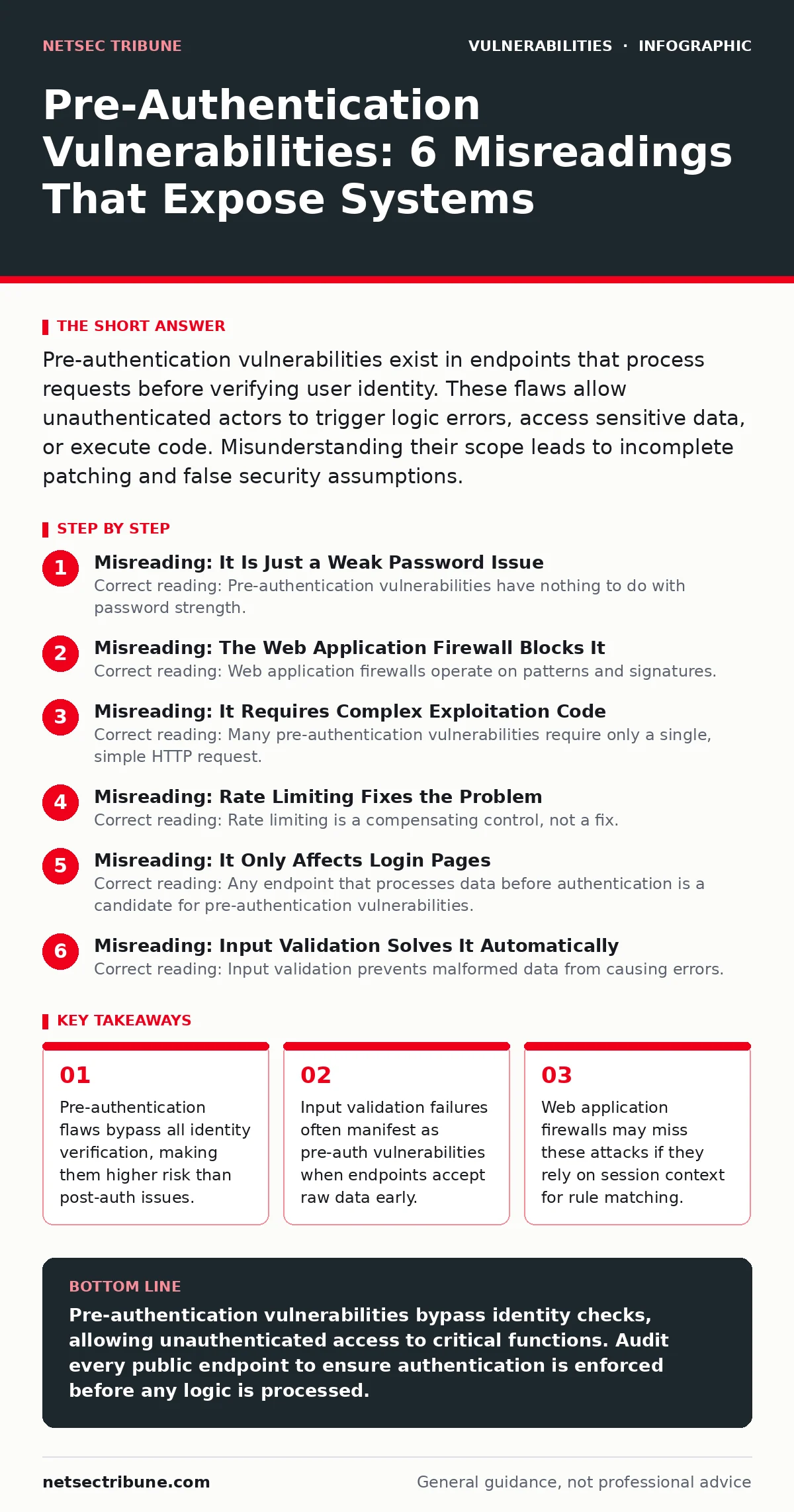
Misreading: The Web Application Firewall Blocks It
Correct reading: Web application firewalls operate on patterns and signatures. They struggle to identify pre-authentication attacks because these attacks often use valid HTTP methods with unusual payloads. A WAF might allow a GET request to a debug endpoint because the URL looks benign. The vulnerability lies in the application logic, not the transport layer.
Suppose an API endpoint returns verbose error messages when given a missing parameter. An attacker can map the application structure by sending thousands of variations. The WAF sees standard traffic. The application reveals its internal state. Relying on perimeter tools to catch logic errors creates a false sense of security. You must validate behavior at the application level.
Misreading: It Requires Complex Exploitation Code
Correct reading: Many pre-authentication vulnerabilities require only a single, simple HTTP request. The complexity lies in finding the endpoint, not in crafting the payload. Consider a health check endpoint that was accidentally left accessible to the public internet. It might return system status including version numbers and memory usage.
An attacker needs only a browser to view this data. No injection strings, no buffer overflows, no complex scripts. The danger is the exposure of information that aids further attacks. Simplicity makes these flaws persistent. Developers often assume that if an endpoint does not return user data, it is safe. It is not safe if it reveals application architecture.
Misreading: Rate Limiting Fixes the Problem
Correct reading: Rate limiting is a compensating control, not a fix. It slows down an attacker but does not remove the vulnerability. If a pre-authentication endpoint allows an unauthenticated user to read database records, rate limiting only restricts how many records they can read per minute. The data is still exposed.
Imagine a login form that allows enumeration of valid usernames by timing responses. Rate limiting prevents rapid enumeration. It does not stop a slow, distributed attack from multiple sources. The correct fix is to ensure the endpoint does not leak information about username validity. You must address the root cause in the code, not just throttle the network traffic.
Misreading: It Only Affects Login Pages
Correct reading: Any endpoint that processes data before authentication is a candidate for pre-authentication vulnerabilities. This includes API endpoints, file upload handlers, and even favicon requests. Developers often focus security efforts on the login page. They forget that other parts of the application may accept input without checking session tokens.
Suppose a search API allows full-text queries without authentication. An attacker can use this to extract sensitive data from the index. The vulnerability is not in the login mechanism. It is in the search logic failing to enforce access controls. You must audit every public-facing endpoint, not just the authentication forms.
See also: Broken Access Control OWASP: How to Fix IDOR and Privilege Escalation · Insider Threats Types: How Internal Access Creates External Risk
Misreading: Input Validation Solves It Automatically
Correct reading: Input validation prevents malformed data from causing errors. It does not solve pre-authentication logic flaws. If an endpoint accepts a valid command parameter without authentication, input validation ensures the command is syntactically correct. It does not stop the command from executing.
Imagine a configuration endpoint that allows changing system settings. Input validation ensures the setting value is within expected ranges. It does not check if the caller has permission to change settings. The flaw is the missing access control check. You need both input validation and strict authentication enforcement. Relying on one without the other leaves critical gaps.
Misreading: It Is a Low Severity Finding
Correct reading: Pre-authentication vulnerabilities are often higher severity than post-authentication ones. They allow attackers to operate without credentials. This means they can target the system before defenders notice unauthorized access. Imagine a flaw that allows an unauthenticated user to execute system commands. This is a critical finding. It bypasses all identity management controls. Security teams sometimes downgrade these findings if no sensitive data is immediately exposed. This is a dangerous mistake. The potential for escalation is high. Attackers can use pre-auth flaws to pivot into deeper system access. Treat these findings with maximum priority.
Misreading: Cross-Site Request Forgery Is Related
Correct reading: Cross-site request forgery (CSRF) relies on an authenticated user performing an unintended action. Pre-authentication vulnerabilities do not require an authenticated user. CSRF is an attack against the user. Pre-auth flaws are attacks against the system. Imagine a CSRF attack that forces a logged-in user to change their email. The attacker needs the user to be logged in. A pre-auth flaw allows the attacker to change the email directly by exploiting a backend API. The mechanisms are distinct. Confusing them leads to incorrect mitigation strategies. CSRF tokens do not protect against pre-authentication logic errors.
Misreading: It Is Rare in Modern Frameworks
Correct reading: Modern frameworks automate much of the authentication process. They do not automate access control for every endpoint. Developers often assume that if they use a standard authentication library, all endpoints are protected. This is false. A developer might add authentication to the login route but forget to protect a new API endpoint.
The framework does not flag this omission. The endpoint remains open to pre-authentication attacks. Suppose a developer adds a new endpoint for exporting data. They copy code from an authenticated section but forget to add the authentication middleware. The endpoint works but is open to the world. Frameworks help, but they do not replace careful code review.
Misreading: It Cannot Be Exploited Remotely
Correct reading: Most pre-authentication vulnerabilities are exploitable remotely. They exist in network-facing services. An attacker does not need physical access or local network presence. Imagine a server listening on a public IP address. If a pre-auth flaw exists in a web service, an attacker can exploit it from anywhere. This makes these vulnerabilities particularly dangerous. They allow wide-scale scanning and exploitation. Security teams sometimes prioritize local vulnerabilities over remote ones. This is a strategic error. Remote pre-auth flaws allow attackers to breach the perimeter entirely. You must assume these flaws are accessible from the open internet.
Misreading: Patching Is Just a Code Change
Correct reading: Patching pre-authentication vulnerabilities often requires architectural changes. Simply adding an authentication check might not be enough. You may need to restructure how requests are routed. Imagine a microservices architecture where one service handles authentication and another handles data. A pre-auth flaw might exist because the data service trusts requests from the authentication service without verifying them. Patching requires implementing mutual TLS or service mesh policies. It is not just a line of code. It is a change in trust boundaries. You must understand the system architecture to patch these flaws effectively.
Misreading: It Is Only a Web Application Issue
Correct reading: Pre-authentication vulnerabilities exist in any network service. This includes DNS servers, mail servers, and IoT devices. Imagine a smart camera that allows configuration changes via a local API. If this API is exposed to the network without authentication, it is a pre-auth vulnerability. It is not a web application in the traditional sense. It is a network service. Security teams often focus on web apps and ignore other services. This leaves critical infrastructure exposed. You must apply the same scrutiny to all network-facing services. Authentication must be enforced before any logic is processed.
Misreading: It Is Easy to Test for
Correct reading: Testing for pre-authentication vulnerabilities requires a deep understanding of the application flow. Automated scanners often miss these flaws. They look for known patterns. Pre-auth flaws are unique to the application logic. Imagine a custom API that uses a non-standard header for authentication. A scanner might not recognize this header. It might assume the endpoint is unauthenticated. A manual tester must understand the custom protocol. They must verify that every endpoint enforces authentication. This requires time and expertise. You cannot rely solely on automated tools. Manual review is necessary to catch logic errors.
Misreading: It Is a Legacy Problem
Correct reading: Pre-authentication vulnerabilities are common in modern applications. Rapid development cycles often lead to overlooked access controls. Developers prioritize features over security. They add new endpoints without reviewing authentication requirements. Imagine a startup launching a new API. They focus on functionality. They forget to secure the endpoints. The result is a pre-auth vulnerability. This is not a legacy issue. It is a current risk. You must integrate security into the development process. Use CI/CD pipeline vulnerabilities checks to catch these issues early. Security is not an afterthought. It is a continuous process.
Key takeaways
- Pre-authentication flaws bypass all identity verification, making them higher risk than post-auth issues.
- Input validation failures often manifest as pre-auth vulnerabilities when endpoints accept raw data early.
- Web application firewalls may miss these attacks if they rely on session context for rule matching.
- Compensating controls like rate limiting do not fix the underlying logic error in the authentication flow.
Pre-authentication vulnerabilities bypass identity checks, allowing unauthenticated access to critical functions. Audit every public endpoint to ensure authentication is enforced before any logic is processed.
Frequently asked questions
How do I find pre-authentication vulnerabilities in my application?
Map all public endpoints and verify that each one requires valid authentication before processing requests. Use manual testing to trace request paths.
Can a WAF prevent pre-authentication attacks?
A WAF can block some known attack patterns, but it cannot fix logic errors. You must enforce authentication at the application level.
Is rate limiting a sufficient fix for pre-auth flaws?
No, rate limiting only slows down attacks. It does not remove the vulnerability. You must fix the underlying access control issue.
Do modern frameworks prevent pre-authentication vulnerabilities?
Modern frameworks provide tools for authentication, but they do not automatically secure every endpoint. Developers must explicitly enforce access controls.
How this guide was produced: written by the NetSec Tribune editorial team with AI assistance, checked against the public references listed below, and reviewed when the facts change. See our editorial policy or report an error.