What Is Input Validation: How to Stop Bad Data From Breaking Systems
Input validation fails when teams treat it as a front-end feature rather than a backend constraint, leaving the core logic exposed to malformed data.
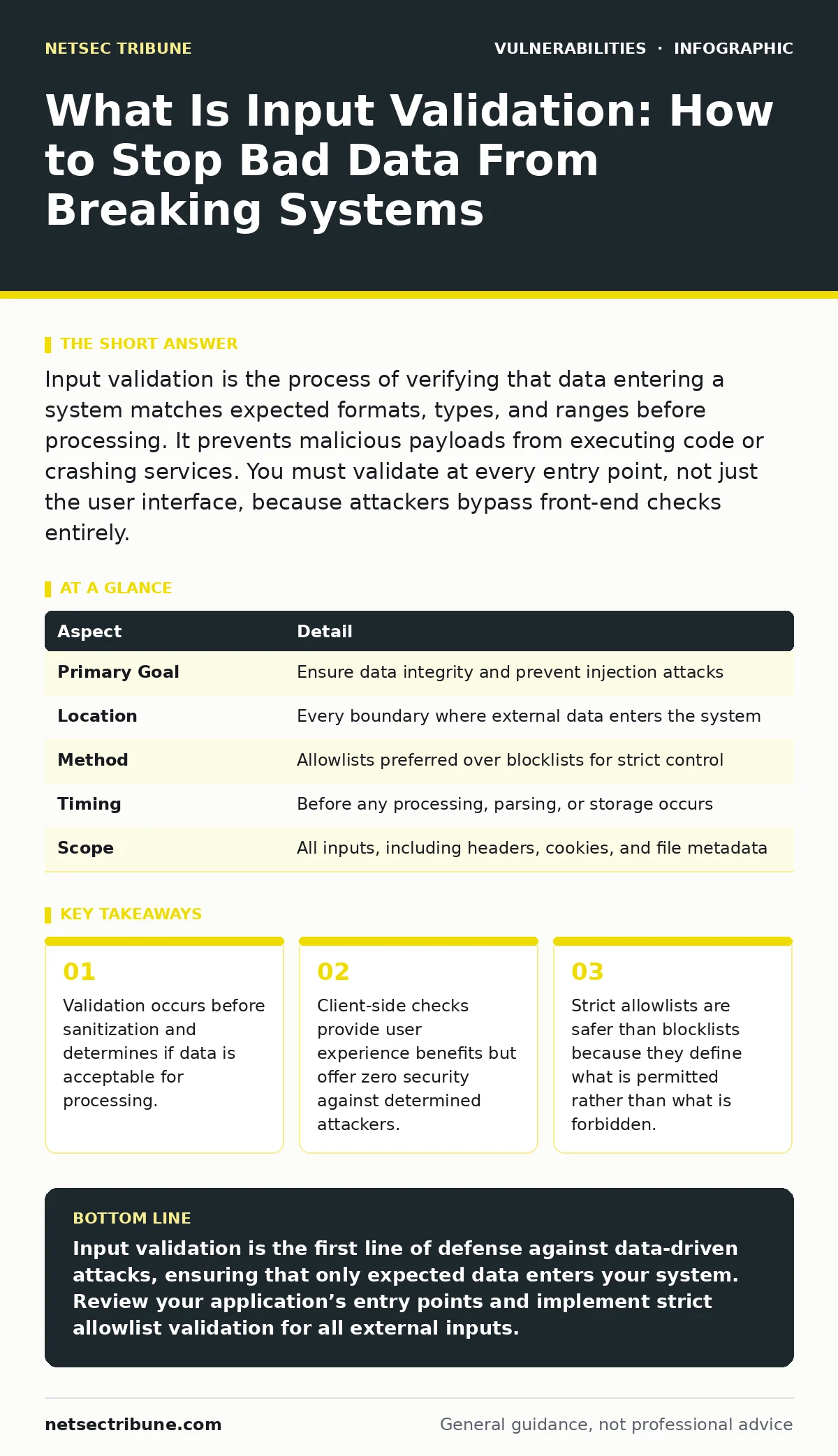
Input validation is the process of verifying that data entering a system matches expected formats, types, and ranges before processing. It prevents malicious payloads from executing code or crashing services. You must validate at every entry point, not just the user interface, because attackers bypass front-end checks entirely.
What Is Input Validation and Why It Matters
Input validation is the mechanism that checks whether incoming data conforms to specific rules before the application processes it. These rules define acceptable data types, length limits, character sets, and structural formats. Without this step, an application treats every byte as trustworthy, which allows attackers to inject commands, overflow buffers, or manipulate logic.
Imagine a form field that accepts a user’s age. A proper validator checks that the input is a number between 0 and 120. If the system accepts the string DELETE FROM users, the database might execute that command instead of storing an age. This distinction between expected data and arbitrary input is the foundation of secure software design.
| Aspect | Detail |
|---|---|
| Primary Goal | Ensure data integrity and prevent injection attacks |
| Location | Every boundary where external data enters the system |
| Method | Allowlists preferred over blocklists for strict control |
| Timing | Before any processing, parsing, or storage occurs |
| Scope | All inputs, including headers, cookies, and file metadata |
How Input Validation Works in Practice
The process begins by defining the contract for each piece of data. You specify that a username must contain only alphanumeric characters and be between 8 and 20 characters long. The system then receives the raw input and compares it against this contract. If the data matches, it proceeds to the next stage. If it fails, the system rejects it immediately and logs the event.
This mechanism relies on strict parsing. Many frameworks attempt to guess the intent of malformed data, which creates ambiguity. Ambiguity is dangerous because attackers exploit inconsistent interpretations. For example, a parser that accepts both 123 and 0x7B for the number 123 creates two valid paths for the same value. An attacker might use the hex representation to bypass a filter that only checks decimal digits.
You must validate at the deepest possible layer. Relying on a web application firewall to filter bad requests is insufficient because these devices can be misconfigured or bypassed. The application code itself must enforce the rules. This ensures that even if the firewall fails, the core logic remains protected against malformed inputs.
Common Mistakes in Implementation
Teams often confuse validation with sanitization. Validation decides whether to accept the data. Sanitization cleans the data after acceptance. If you sanitize first, you might accept dangerous data that becomes harmless, but you also lose the ability to reject clearly malicious attempts early. Early rejection reduces the attack surface and simplifies logging.
Another frequent error is using blocklists. A blocklist attempts to filter out known bad characters, such as <, >, or '. Attackers can often encode these characters in ways that the blocklist does not recognize. For instance, URL encoding or Unicode normalization might hide a forbidden character. An allowlist is superior because it only permits known good characters. If a character is not on the list, it is rejected by default.
Developers also neglect hidden inputs. They validate the text box on the screen but forget to check the hidden fields, cookies, or HTTP headers that accompany the request. These fields are often trusted implicitly because they are not visible to the user. An attacker can modify these values using browser developer tools or proxy software. Every piece of external data must be validated, regardless of how it arrives.
The Hidden Cost of Poor Validation
Poor input validation leads to more than just injection vulnerabilities. It causes stability issues when unexpected data formats crash parsers or exhaust memory. A system that does not validate length constraints can be forced into denial of service conditions by sending excessively large payloads. The application tries to process the data, consumes resources, and becomes unresponsive to legitimate users.
This instability complicates vulnerability management programs because the root cause is often obscure. Developers spend time debugging crashes instead of fixing security flaws. The noise from malformed inputs also drowns out real attack signals in logs. When every invalid request is logged, it becomes difficult to identify the specific patterns of a coordinated attack.
Furthermore, inconsistent validation across different entry points creates race condition vulnerabilities. If one API endpoint validates data strictly and another is lenient, an attacker might use the lenient endpoint to insert data that the strict endpoint later tries to process. This mismatch can lead to logic errors or data corruption that is difficult to trace back to the original input.
What People Usually Get Wrong About Input Validation
Many believe that client-side validation is sufficient for security. They add JavaScript checks to forms to ensure users enter valid data. This improves the user experience by providing immediate feedback. However, it provides no security benefit. An attacker can disable JavaScript, use a different client like a command-line tool, or simply send raw HTTP requests to the server. The server must validate independently.
Another misconception is that only user-facing applications need validation. Internal services, APIs, and microservices also receive external data. If Service A calls Service B, the data from Service A is external to Service B. Service B must validate the input because Service A might be compromised or misconfigured. Trusting internal boundaries without validation assumes that all internal components are secure, which is rarely true in complex environments.
Teams also assume that framework defaults are secure. Many web frameworks provide automatic escaping or validation features. These defaults might be disabled for performance reasons or overridden by custom code. You must verify that the framework is actually enforcing the rules you expect. Do not assume that because a framework exists, the data is safe. Explicit validation logic is always clearer and more reliable.
See also: WebSocket Vulnerabilities: 8 Critical Questions Answered · Pre-Authentication Vulnerabilities: 6 Misreadings That Expose Systems
Integrating Validation with Other Controls
Input validation works best when combined with other security measures. It reduces the load on web application firewalls by catching obvious errors early. It complements cross-site request forgery (CSRF) protections by ensuring that even if a forged request is sent, the data within it is rejected if it does not conform to expectations.
It also supports exposed admin panels by ensuring that administrative interfaces receive only structured, expected data. Admin interfaces are high-value targets because they often have elevated privileges. Strict validation here prevents attackers from manipulating administrative actions through parameter tampering.
When designing security misconfigurations audits, check for disabled validation libraries or overly permissive parsers. These configurations often arise from development environments where strict checks are turned off to speed up testing. If these settings persist in production, the system remains vulnerable. Regular code reviews should focus on input handling logic to ensure consistency.
Building a Resilient Validation Strategy
Start by mapping all entry points in your application. Identify every place where external data enters the system. This includes HTTP requests, file uploads, database connections, and message queues. For each entry point, define the expected data format clearly. Write tests that send malformed data to each point and verify that it is rejected.
Use standard libraries for validation whenever possible. These libraries are often updated to address new encoding tricks or parsing ambiguities. Avoid writing custom parsers for complex formats like JSON or XML unless you have significant expertise. Custom parsers are prone to errors that create hidden vulnerabilities.
Monitor validation failures in production. Track the frequency and type of rejected inputs. A sudden spike in validation errors might indicate an attack or a change in client behavior. Use this data to refine your rules and improve detection. Continuous improvement ensures that your validation logic stays effective against evolving techniques.
Key takeaways
- Validation occurs before sanitization and determines if data is acceptable for processing.
- Client-side checks provide user experience benefits but offer zero security against determined attackers.
- Strict allowlists are safer than blocklists because they define what is permitted rather than what is forbidden.
Input validation is the first line of defense against data-driven attacks, ensuring that only expected data enters your system. Review your application’s entry points and implement strict allowlist validation for all external inputs.
Frequently asked questions
Does input validation replace the need for encryption?
No, validation checks data format and safety, while encryption protects data confidentiality. Both are necessary for a secure system.
How do I handle complex data formats like JSON?
Use a strict parser that rejects unknown fields and enforces type constraints. Do not use generic parsers that allow arbitrary nesting or types.
Is it enough to validate only the most dangerous inputs?
No, attackers often target less obvious inputs to bypass defenses. Validate all external data consistently to avoid weak points.
Can automated tools find all validation errors?
Automated tools can find common issues, but they may miss logic errors or context-specific rules. Manual code review is also necessary.
How this guide was produced: written by the NetSec Tribune editorial team with AI assistance, checked against the public references listed below, and reviewed when the facts change. See our editorial policy or report an error.