
Lateral Movement in Cybersecurity: Definition and Detection
Attackers rarely breach networks directly; they move sideways through trusted connections to reach high-value targets while staying beneath detection thresholds.
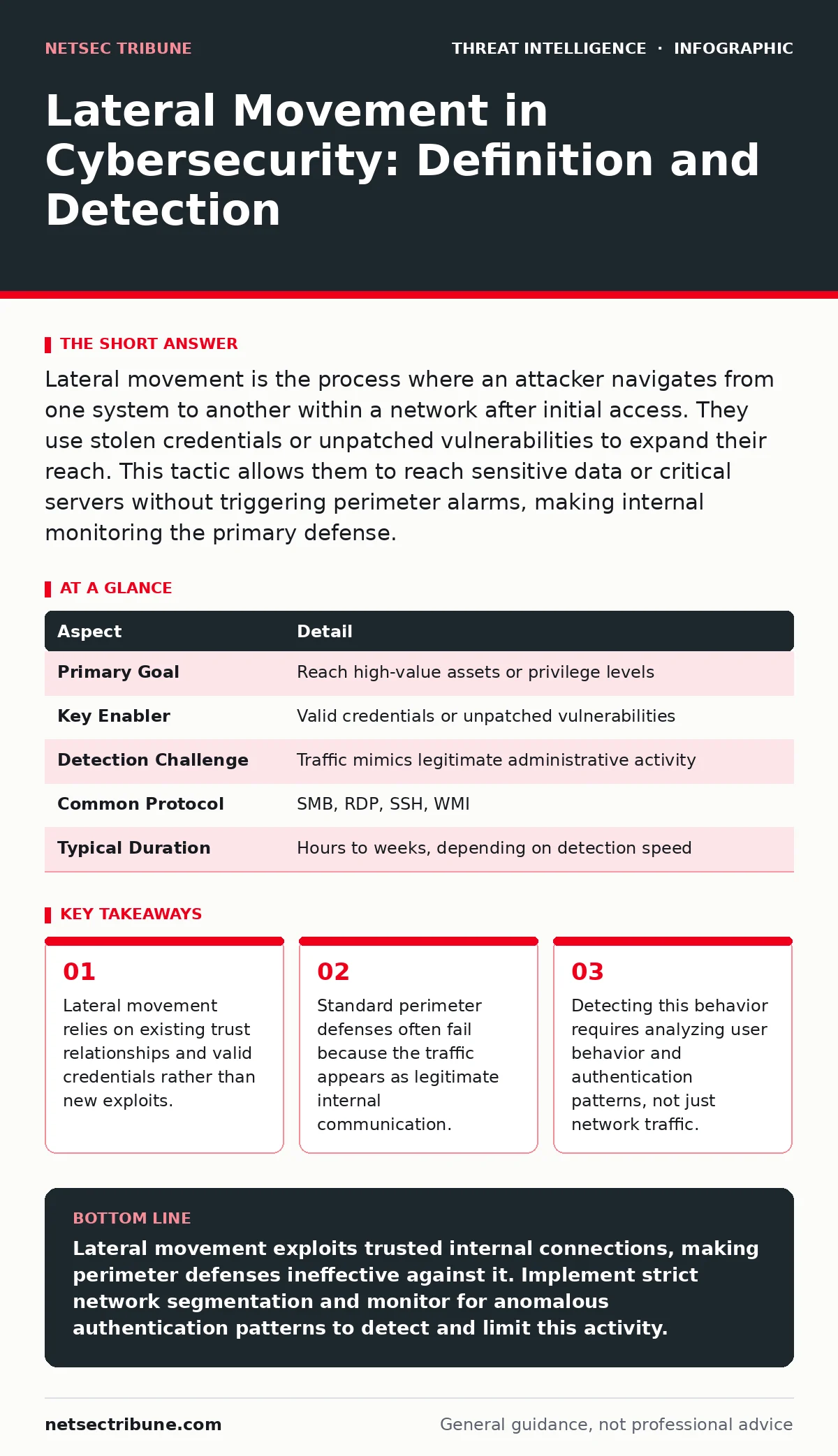
Lateral movement is the process where an attacker navigates from one system to another within a network after initial access. They use stolen credentials or unpatched vulnerabilities to expand their reach. This tactic allows them to reach sensitive data or critical servers without triggering perimeter alarms, making internal monitoring the primary defense.
Understanding the Mechanics of Lateral Movement
Lateral movement describes the horizontal expansion of an attacker’s control within a network. Imagine a burglar who picks a side window to enter a house. Once inside, they do not immediately steal the safe. Instead, they move from room to room, testing doors and copying keys, until they reach the master bedroom. In digital terms, the initial breach is the side window. The movement through the house is lateral movement. The attacker seeks a specific high-value target, such as a domain controller or a database server, by traversing less critical systems along the way.
This phase is distinct from initial access and exfiltration. It is the bridge between gaining a foothold and achieving the final objective. Attackers use this time to avoid detection, escalate privileges, and map the environment. They prefer paths of least resistance, exploiting trust relationships that administrators established for legitimate operational needs.
| Aspect | Detail |
|---|---|
| Primary Goal | Reach high-value assets or privilege levels |
| Key Enabler | Valid credentials or unpatched vulnerabilities |
| Detection Challenge | Traffic mimics legitimate administrative activity |
| Common Protocol | SMB, RDP, SSH, WMI |
| Typical Duration | Hours to weeks, depending on detection speed |
How Attackers Traverse Network Boundaries
Attackers move laterally by leveraging the trust inherent in network design. Most enterprise networks rely on shared credentials or service accounts to allow systems to communicate. An attacker who compromises a single workstation can extract these credentials and use them to access other systems. This is not a hack in the traditional sense. It is the misuse of a valid key.
The most common method involves credential theft. The attacker captures password hashes or memory dumps from an active session. They then use these captured materials to authenticate to other machines. This technique bypasses many security controls because the authentication request contains a valid hash. The system accepting the login sees a legitimate credential and grants access. The attack succeeds because the network trusts the credential, not because the attacker cracked a password.
Another approach exploits unpatched software. If a server runs an outdated version of a remote management tool, an attacker can use a known exploit to gain code execution. This method does not require credentials. It requires only that the vulnerable service is accessible from the compromised host. Attackers often combine these methods, using stolen credentials to reach a vulnerable server and then exploiting that server to reach the core infrastructure.
Common Techniques and Protocols
Attackers prefer protocols that are already present and trusted within the environment. Using standard tools reduces the chance of triggering alerts. The most prevalent techniques include:
- Pass-the-Hash: The attacker uses a stolen password hash to authenticate to a remote system. The system validates the hash without needing the plaintext password. This works because many protocols, such as NTLM, send the hash during authentication.
- Pass-the-Ticket: The attacker steals a Kerberos ticket, which is a digital token that proves identity. This allows access to services that use Kerberos authentication without needing the user’s password or hash.
- Remote Execution: The attacker uses built-in administrative tools to run commands on other machines. Windows Management Instrumentation (WMI) and PowerShell Remoting are common vectors. These tools are designed for IT administration, so their traffic looks normal.
- Shared Folders: Attackers access network shares that are left open or misconfigured. They may drop malicious scripts or exfiltrate data directly from these shares. This method relies on poor access control rather than a technical exploit.
Who Is Affected and Why It Matters
Lateral movement affects any organization that relies on interconnected systems. Small businesses with flat network structures are often the easiest targets. In these environments, a single compromised device can provide access to all other devices. There are few barriers to stop the attacker. Large enterprises are not immune. They face greater complexity, which creates more trust relationships and more potential paths for movement.
The impact depends on the attacker’s goal. If the goal is data theft, lateral movement allows access to sensitive records stored on central servers. If the goal is disruption, it allows the attacker to deploy ransomware across multiple systems. The damage is often delayed. The attacker may move silently for weeks, mapping the network and identifying critical assets. By the time an alert triggers, the attacker has already reached the target.
What People Usually Get Wrong
Security teams often misunderstand the nature of lateral movement. A common error is focusing solely on external threats. Organizations invest heavily in firewalls and intrusion prevention systems. These tools are effective at blocking unauthorized entry. They are useless against an attacker who is already inside. The assumption that the network is safe once the perimeter is secured leads to blind spots in internal monitoring.
Another mistake is relying on static indicators. Teams look for known malicious IP addresses or file hashes. Lateral movement rarely uses these. It uses legitimate tools and protocols. An attacker running a PowerShell command to query a remote server looks identical to an administrator performing the same task. Static signatures fail to catch this behavior. Detection requires context, not just pattern matching.
Teams also often ignore the principle of least privilege. They grant broad administrative rights to service accounts. This makes lateral movement easier because a single compromised account can access many systems. Restricting these rights is difficult but necessary. Without strict access controls, every system is a potential launchpad for the next step in the attack chain.
See also: Computer Worms: How Self-Replicating Code Bypasses Small Business Defenses · Unauthorized Access Myths: What Detection Actually Misses
Reducing the Risk of Internal Spread
Mitigating lateral movement requires a shift in perspective. The goal is not to prevent all internal traffic. It is to make movement difficult and visible. Implementing network segmentation is the first step. Divide the network into zones. Limit communication between zones to only what is necessary. If an attacker compromises a workstation in the guest zone, they should not be able to reach the database zone.
Credential hygiene is equally important. Enforce strict password policies and rotate credentials regularly. Disable legacy authentication protocols like NTLM where possible. Use multi-factor authentication for all administrative access. This adds a layer of security that stolen hashes cannot bypass. If an attacker has a password hash, they still cannot log in without the second factor.
Monitoring must focus on behavior. Look for anomalies in user activity. A user who never accesses the server room suddenly logging into multiple servers at night is suspicious. Implement solutions that track authentication events and process creation. Sysmon can provide detailed logs of system activity. Analyzing these logs helps identify unusual patterns. Regular purple teaming exercises can test these defenses. They reveal gaps in detection that theoretical planning misses.
Connecting to Broader Threat Intelligence
Understanding lateral movement is part of a larger security strategy. It connects to other areas of threat intelligence and defense. For instance, recognizing the signs of LSASS credential theft helps you detect the initial step of many lateral movement attacks. Understanding the MITRE ATT&CK framework provides a structured way to categorize these techniques. It allows you to map your defenses to specific adversary behaviors.
Threat actor profiling can reveal which groups are likely to use specific lateral movement techniques. Some groups prefer living-off-the-land tools, while others use custom malware. Knowing this helps you prioritize your monitoring efforts. Indicators of compromise from threat intelligence feeds can alert you to new tools used for lateral movement. However, these feeds are reactive. Proactive defense requires understanding the underlying mechanics.
Packet capture analysis can provide deep visibility into internal traffic. It helps you identify encrypted channels that may be hiding malicious activity. While resource-intensive, it offers a level of detail that logs alone cannot provide. Combining these approaches creates a layered defense. No single tool stops lateral movement. A combination of segmentation, monitoring, and access control reduces the risk significantly.
Key takeaways
- Lateral movement relies on existing trust relationships and valid credentials rather than new exploits.
- Standard perimeter defenses often fail because the traffic appears as legitimate internal communication.
- Detecting this behavior requires analyzing user behavior and authentication patterns, not just network traffic.
Lateral movement exploits trusted internal connections, making perimeter defenses ineffective against it. Implement strict network segmentation and monitor for anomalous authentication patterns to detect and limit this activity.
Frequently asked questions
How does lateral movement differ from privilege escalation?
Privilege escalation involves gaining higher access rights on a single system, while lateral movement involves moving from one system to another within the network.
Can multi-factor authentication stop lateral movement?
Multi-factor authentication can stop movement that relies on stolen passwords, but it does not stop movement based on stolen Kerberos tickets or unpatched vulnerabilities.
What is the best tool for detecting lateral movement?
No single tool is best. Effective detection requires combining endpoint logs, network traffic analysis, and identity monitoring to spot anomalous behavior patterns.
Does network segmentation prevent lateral movement?
Network segmentation limits the scope of lateral movement by creating barriers between network zones, but it does not prevent it entirely if internal connections are misconfigured.
How this guide was produced: written by the NetSec Tribune editorial team with AI assistance, checked against the public references listed below, and reviewed when the facts change. See our editorial policy or report an error.