
Broken Access Control OWASP: How to Fix IDOR and Privilege Escalation
Broken access control fails when servers trust client-side inputs to determine user permissions, allowing attackers to bypass intended boundaries without exploiting code logic errors.
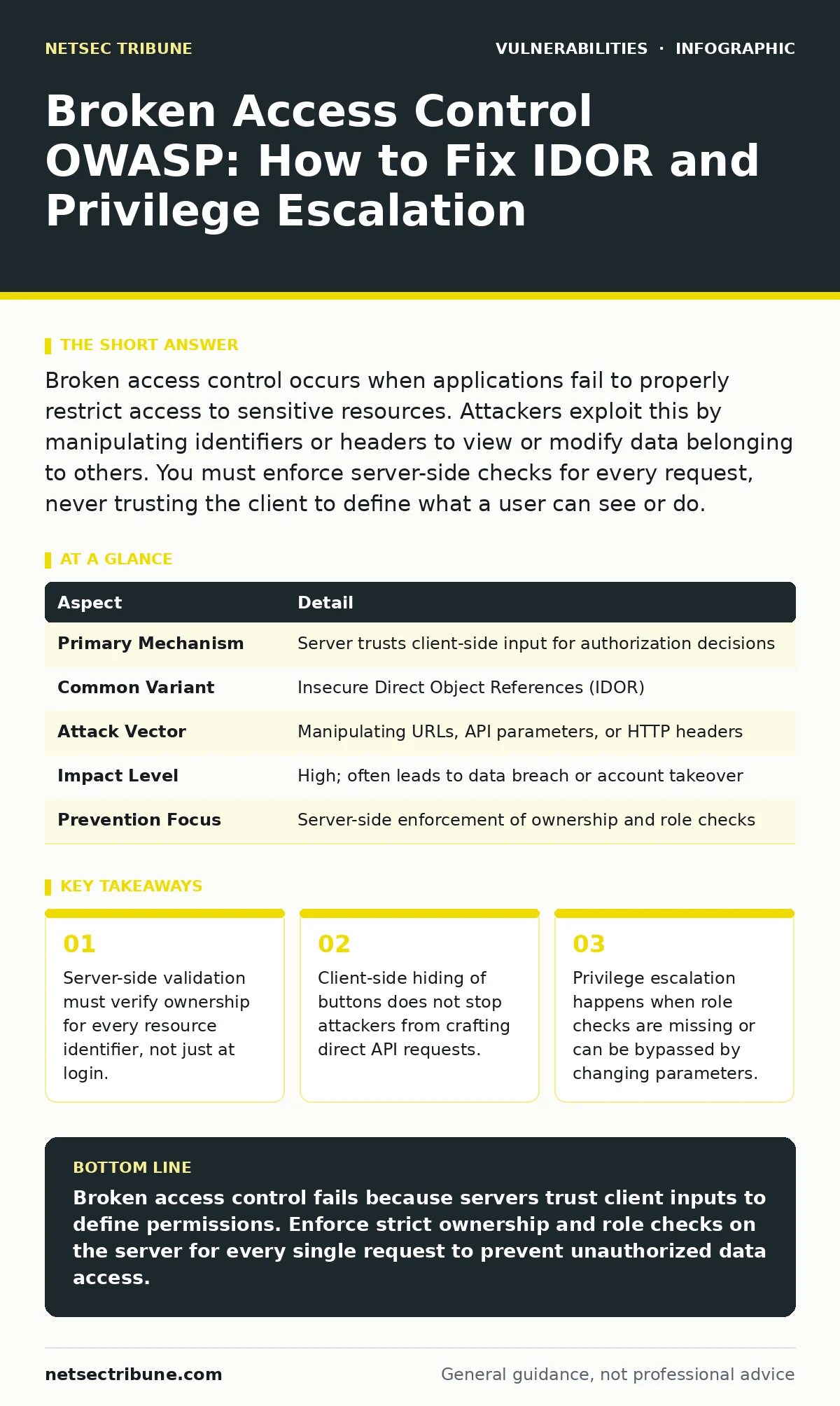
Broken access control occurs when applications fail to properly restrict access to sensitive resources. Attackers exploit this by manipulating identifiers or headers to view or modify data belonging to others. You must enforce server-side checks for every request, never trusting the client to define what a user can see or do.
Why Broken Access Control OWASP Matters
Imagine a library where the librarian asks you for a book number but never checks if you have a library card. You can request any book, even those reserved for staff. Broken access control works the same way in software. It happens when an application fails to properly enforce restrictions on what a user can do or see. The Open Web Application Security Project (OWASP) lists this as a top risk because it allows attackers to bypass security boundaries without needing complex exploits.
This vulnerability affects every web application that manages user data. It impacts small startups with simple admin panels and large enterprises with complex identity systems. The damage ranges from viewing private profiles to taking full control of user accounts.
| Aspect | Detail |
|---|---|
| Primary Mechanism | Server trusts client-side input for authorization decisions |
| Common Variant | Insecure Direct Object References (IDOR) |
| Attack Vector | Manipulating URLs, API parameters, or HTTP headers |
| Impact Level | High; often leads to data breach or account takeover |
| Prevention Focus | Server-side enforcement of ownership and role checks |
How Broken Access Control OWASP Works
The core failure is a mismatch between what the user interface shows and what the backend allows. Developers often hide "Edit" buttons for users who lack permission. This is a cosmetic fix, not a security control. An attacker uses browser developer tools or a proxy to send a request directly to the server. The server receives the request and processes it. If the server does not verify that the requester owns the target resource, it performs the action.
This often manifests as Insecure Direct Object References (IDOR). An application uses a predictable identifier, such as a sequential integer, to reference a database record. A user with ID 100 views their profile. The attacker changes the URL to reference ID 101. The server returns the data for ID 101 because it assumes the request is legitimate. The server fails to check if the authenticated user is the owner of ID 101.
Privilege escalation is another form. A standard user discovers an administrative endpoint. They change a parameter in their request from "role=user" to "role=admin". If the server does not validate this change against the user's actual session data, it grants administrative access. This bypasses the intended separation of duties.
What People Usually Get Wrong
Many teams believe that hiding sensitive links in the user interface provides security. This is false. The browser is controlled by the attacker. Any request sent from the browser can be intercepted and modified. Security controls must exist on the server, where the attacker has no direct control.
Another common error is checking permissions only during the initial page load. Applications often load a dashboard and cache permissions. If a user's role changes, or if they access a resource directly via API, the cached permissions may not apply. Every request that modifies or accesses sensitive data must re-verify the user's right to perform that specific action.
Teams also underestimate the risk of horizontal privilege escalation. This occurs when a user accesses data of another user with the same role. It is often harder to detect than vertical escalation (gaining admin rights) because the data structure looks similar. Without strict ownership checks, any user can access any other user's data.
The Hidden Cost of Client-Side Trust
The most unexpected consequence of broken access control is the erosion of audit integrity. When an attacker accesses data via IDOR, the logs may show the action as coming from the victim's account or a valid session. This makes forensic analysis difficult. You cannot easily distinguish between a user viewing their own data and an attacker viewing stolen data if the server does not log the target resource owner separately.
This trust issue extends to third-party integrations. Applications often use tokens to communicate with external services. If the application does not validate that the token belongs to the requesting user, an attacker can replay tokens to impersonate others. This creates a chain of trust failure that spans multiple systems.
Enforcing Server-Side Authorization
You must implement authorization checks on every endpoint that accesses sensitive data. Do not rely on framework defaults unless you have verified they enforce ownership. Use a consistent pattern for checking permissions. This pattern should verify the authenticated user's identity and then verify that the user has the right to access the specific resource requested.
For databases, use queries that include the user ID as a filter. Instead of fetching a record by ID alone, fetch the record where the ID matches and the owner matches the current user. If the query returns no results, deny access. This prevents IDOR by design.
For role-based access, store roles in the server-side session or token. Do not accept roles from the client. Validate the role against the required permissions for the action. If the action requires "admin" rights, check that the user's session contains "admin". Do not trust a parameter sent in the request body or URL.
See also: Lateral Movement in Cybersecurity: Definition and Detection · Exposed Admin Panels: 7 Configuration Mistakes That Invite Intrusion
Testing for Broken Access Control
Standard functional testing often misses these flaws because it follows the intended user flow. You need adversarial testing. Testers should attempt to access resources they do not own. This involves changing identifiers in URLs and API requests. They should also try to access administrative functions as a standard user.
Automated scanners can help find obvious issues, but they often miss logic flaws. Manual testing is necessary to understand the business logic. Testers should map out all resources and the permissions required to access them. Then they should attempt to bypass those permissions.
Integration with Other Security Measures
Broken access control often coexists with other vulnerabilities. If an application has security misconfigurations, it may expose debug endpoints that bypass access controls. If it lacks proper input validation, an attacker might inject commands that alter how access checks are performed.
Web application firewalls can block common attack patterns, but they cannot understand business logic. They may allow a request that looks normal but violates access rules. You must treat WAFs as a perimeter defense, not a substitute for application-level authorization.
Understanding cross-site request forgery (CSRF) is also relevant. CSRF attacks force a user to perform actions while authenticated. If access controls are weak, a CSRF attack can lead to significant data modification. Strong anti-CSRF tokens help, but they do not fix the underlying access control flaw.
Fixing the Root Cause
The fix is not a patch; it is a structural change. You must adopt a principle of least privilege. Every component should only have the access it needs. Review your architecture to ensure that access checks are centralized and consistent. Use libraries or frameworks that enforce authorization patterns.
Regular code reviews should focus on access control logic. Look for endpoints that accept identifiers without verifying ownership. Look for places where roles are accepted from the client. Address these issues before deployment. Continuous monitoring can detect anomalous access patterns, such as a user accessing many different resources in a short time, which may indicate an IDOR attack.
Key takeaways
- Server-side validation must verify ownership for every resource identifier, not just at login.
- Client-side hiding of buttons does not stop attackers from crafting direct API requests.
- Privilege escalation happens when role checks are missing or can be bypassed by changing parameters.
Broken access control fails because servers trust client inputs to define permissions. Enforce strict ownership and role checks on the server for every single request to prevent unauthorized data access.
Frequently asked questions
Does HTTPS prevent broken access control?
No. HTTPS encrypts data in transit but does not verify if the user is authorized to access the decrypted content.
Can a WAF fix IDOR vulnerabilities?
A WAF can block known malicious patterns but cannot understand business logic. It will not stop an attacker from changing a numeric ID in a URL.
Is checking the user role enough?
No. You must also check if the user owns the specific resource. A user with "editor" rights should not edit another editor's draft.
How do I test for privilege escalation?
Attempt to access administrative endpoints or modify data belonging to other users using your standard user credentials.
How this guide was produced: written by the NetSec Tribune editorial team with AI assistance, checked against the public references listed below, and reviewed when the facts change. See our editorial policy or report an error.