Bug Bounty Triage Explained: How to Filter Noise From Real Threats
Most reported vulnerabilities are false positives or low-impact issues that require minimal effort to dismiss, saving teams from wasting resources on noise.
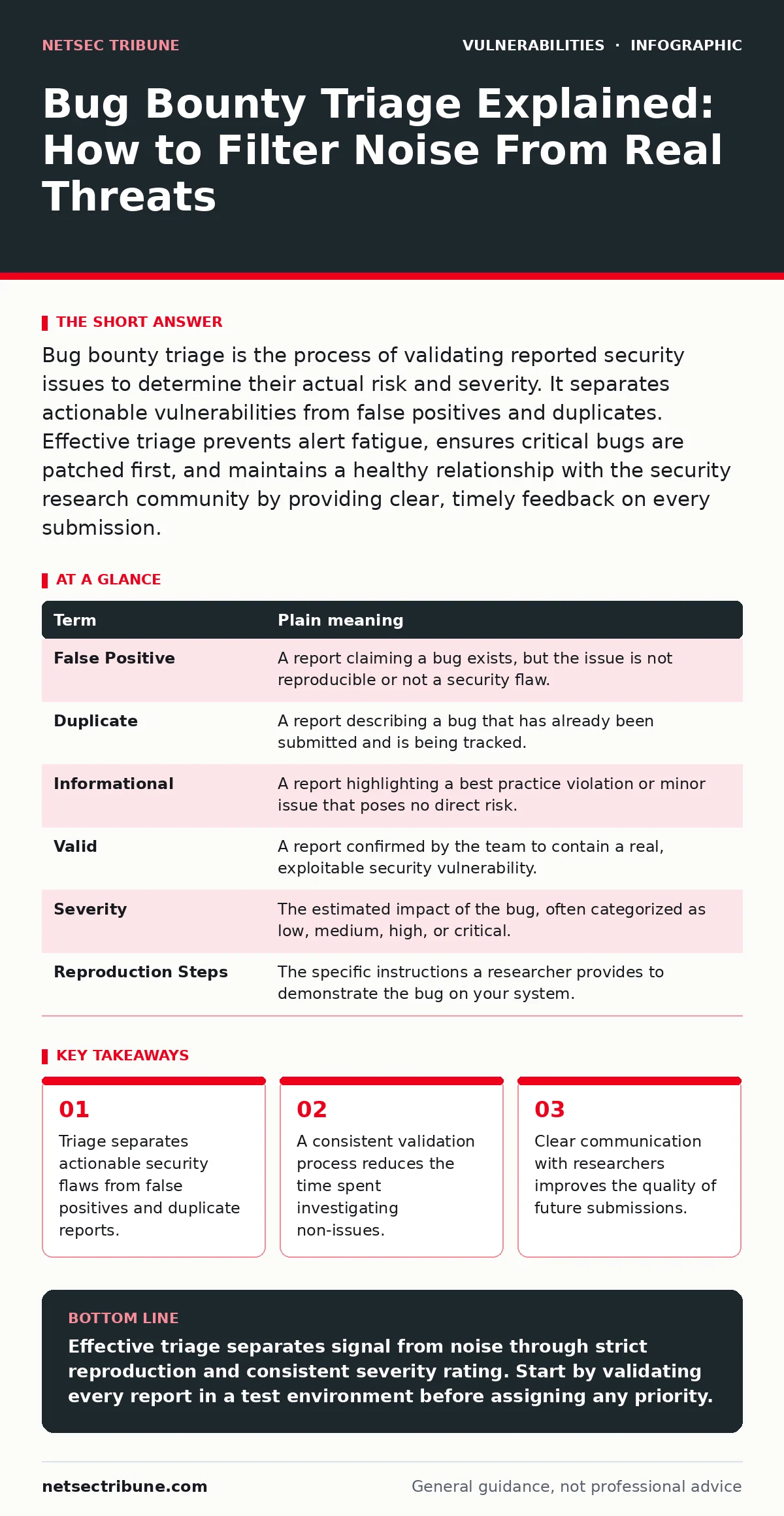
Bug bounty triage is the process of validating reported security issues to determine their actual risk and severity. It separates actionable vulnerabilities from false positives and duplicates. Effective triage prevents alert fatigue, ensures critical bugs are patched first, and maintains a healthy relationship with the security research community by providing clear, timely feedback on every submission.
The Sorting Hat Analogy for Security Reports
Imagine you run a busy post office. Every day, hundreds of letters arrive. Most are standard mail that needs immediate delivery. Some are undeliverable due to bad addresses. Others are duplicates of letters already processed. Your job is not to read every letter. Your job is to sort them into the correct bins quickly. Bug bounty triage works the same way. Researchers send you reports. Most are noise. Your goal is to find the few that actually contain a security threat.
This sorting process determines which issues get developer attention and which get closed. If you read every letter, the post office stops functioning. If you ignore the mail, critical packages get lost. Triage is the mechanism that keeps the flow manageable. It requires a systematic approach to validation rather than a deep dive into every claim.
Key Terms in Vulnerability Triage
Understanding the vocabulary helps you communicate clearly with researchers and internal teams. These terms define the state and severity of each report.
| Term | Plain meaning |
|---|---|
| False Positive | A report claiming a bug exists, but the issue is not reproducible or not a security flaw. |
| Duplicate | A report describing a bug that has already been submitted and is being tracked. |
| Informational | A report highlighting a best practice violation or minor issue that poses no direct risk. |
| Valid | A report confirmed by the team to contain a real, exploitable security vulnerability. |
| Severity | The estimated impact of the bug, often categorized as low, medium, high, or critical. |
| Reproduction Steps | The specific instructions a researcher provides to demonstrate the bug on your system. |
Why Triage Fails Without Structure
Without a defined process, triage becomes chaotic. One person might mark a report as critical while another marks it as low priority. This inconsistency leads to missed deadlines and frustrated researchers. Imagine if the post office clerk decided which letters were important based on their mood. Critical bills would pile up while junk mail gets delivered. Structure ensures that every report receives the same level of scrutiny.
A lack of structure also hides the true volume of work. If you do not log how much time you spend on false positives, you cannot justify hiring more staff or improving your testing tools. The hidden cost of bad triage is not just wasted time. It is the loss of visibility into your actual security posture. You cannot fix what you do not measure.
The First Practical Step: Reproduce the Claim
The single most important action in triage is reproduction. You must follow the researcher’s steps exactly. Do not assume the bug exists because the report looks convincing. Do not assume it does not exist because it seems unlikely. Set up a test environment that mirrors your production system. Execute the steps. Observe the result. If you cannot reproduce the issue, mark it as a false positive.
Reproduction validates the existence of the flaw. It also helps you understand the scope. Sometimes a bug is real but only affects a deprecated feature. Sometimes it requires specific user permissions that most attackers will not have. These details change the severity rating. Without reproduction, you are guessing. Guessing leads to incorrect prioritization and wasted developer hours.
Handling False Positives and Duplicates
False positives are reports where the researcher misunderstood the application logic. Perhaps they found an error message that looks sensitive but contains no data. Perhaps they reported a missing header that is intentionally omitted for performance reasons. Duplicates happen when multiple researchers find the same bug. You must check your existing ticket system before investigating.
Closing these reports quickly is vital. It frees up your time for real threats. It also tells researchers that you are paying attention. If you leave false positives open for weeks, researchers assume you are disorganized. They may stop submitting high-quality reports. Provide a brief explanation when closing these tickets. Explain why the issue is not a vulnerability. This feedback loop improves the quality of future submissions.
See also: CWE Weakness Categories: Practical Defense for Small Teams · Self-Hosted GitLab Vulnerabilities: Definition, Risks, and Fixes
Prioritizing Valid Vulnerabilities
Once you confirm a bug is valid, you must assign a severity. This rating determines how fast your team must fix it. Critical bugs require immediate attention. Low-severity bugs can wait for the next release cycle. Use a standardized framework to assign these ratings. Consistency is key. If you rate similar bugs differently, developers will not trust your triage process.
Consider the context of the vulnerability. A bug in a public-facing login page is more severe than a bug in an internal admin tool. A bug that exposes user data is more severe than one that exposes server headers. Look at the potential impact, not just the technical complexity. A simple bug that steals passwords is worse than a complex bug that crashes a non-essential service.
Improving Your Triage Workflow Over Time
Triage is not a one-time task. It is a continuous process. Review your closed tickets regularly. Look for patterns. Are many researchers reporting the same type of false positive? This indicates a need for better documentation or clearer security headers. Are you missing certain types of bugs? This suggests a gap in your testing coverage.
Use these insights to improve your defenses. If you see many race condition vulnerabilities, add more concurrency testing to your CI pipeline. If you see many injection flaws, improve your input validation libraries. The goal is to reduce the number of valid bugs over time. As your application becomes more secure, the ratio of false positives to valid bugs will increase. Your triage process must adapt to this change.
Integrating Triage with Broader Security Efforts
Bug bounty triage does not exist in isolation. It connects to other parts of your security program. When you find a valid bug, you must patch it. This leads to patch prioritization decisions. You must weigh the cost of fixing the bug against the risk of leaving it open. Sometimes, a compensating control can mitigate the risk while you work on a permanent fix.
For specific technical issues, you may need deeper knowledge. Understanding WebSocket vulnerabilities helps you triage reports related to real-time data streams. Familiarity with GitHub Actions workflow injection helps you evaluate reports about your CI/CD pipeline. These technical depths ensure you do not underestimate complex issues.
Key takeaways
- Triage separates actionable security flaws from false positives and duplicate reports.
- A consistent validation process reduces the time spent investigating non-issues.
- Clear communication with researchers improves the quality of future submissions.
Effective triage separates signal from noise through strict reproduction and consistent severity rating. Start by validating every report in a test environment before assigning any priority.
Frequently asked questions
How long should triage take for a single report?
Simple false positives should be dismissed within hours. Complex valid bugs may take days to fully understand and reproduce. Aim for initial acknowledgment within 24 hours.
What if a researcher disputes my severity rating?
Explain your reasoning clearly. Reference your severity framework. Offer to review the rating again if the researcher provides new evidence of impact. Maintain a respectful tone.
Should I pay for false positives?
No. Bounties are reserved for valid, reproducible security vulnerabilities. Paying for false positives encourages low-quality submissions and wastes budget. Close them with clear feedback.
How do I handle duplicate reports?
Link the duplicate report to the original ticket. Close the duplicate. Credit the first reporter with the bounty. This prevents double payment and keeps your tracking clean.
How this guide was produced: written by the NetSec Tribune editorial team with AI assistance, checked against the public references listed below, and reviewed when the facts change. See our editorial policy or report an error.