
Insider Threats Types: How Internal Access Creates External Risk
Most data loss originates from authorized accounts that bypass perimeter defenses, making internal behavior harder to detect than external attacks.
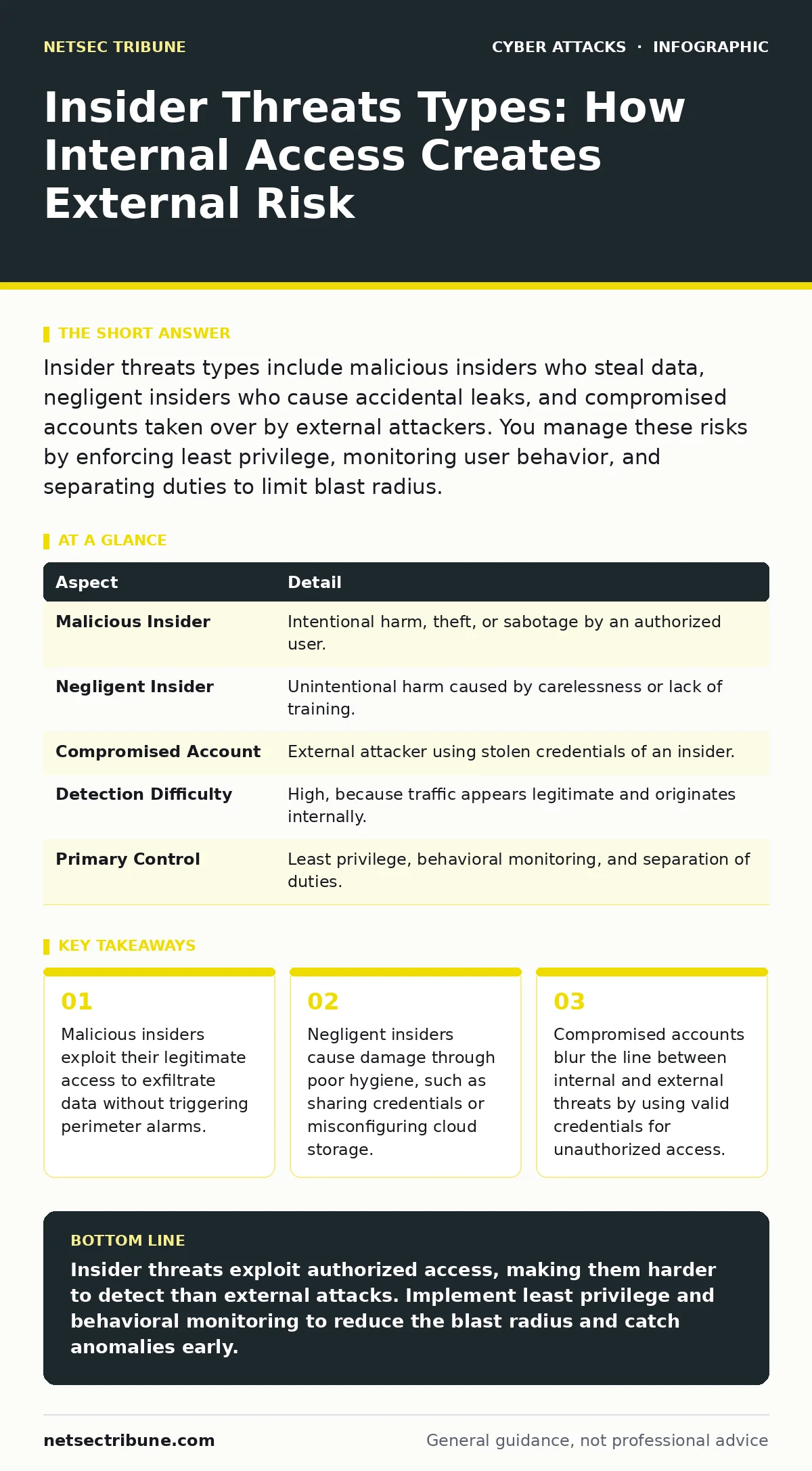
Insider threats types include malicious insiders who steal data, negligent insiders who cause accidental leaks, and compromised accounts taken over by external attackers. You manage these risks by enforcing least privilege, monitoring user behavior, and separating duties to limit blast radius.
Why the Fence Inside Matters
Think of a company as a house with a high fence. Most security measures focus on the fence, keeping strangers out. Insider threats ignore the fence because they already hold the keys. They walk through the front door, past the alarm system, and into the rooms where the valuables are kept. This analogy highlights a fundamental flaw in traditional security models that prioritize perimeter defense over internal control.
Insider threats are risks that originate from within the organization. They involve individuals with authorized access who misuse that access intentionally or accidentally. This definition covers employees, contractors, and partners who have legitimate reasons to be inside the network. The threat is not the person, but the combination of their access rights and their actions.
| Aspect | Detail |
|---|---|
| Malicious Insider | Intentional harm, theft, or sabotage by an authorized user. |
| Negligent Insider | Unintentional harm caused by carelessness or lack of training. |
| Compromised Account | External attacker using stolen credentials of an insider. |
| Detection Difficulty | High, because traffic appears legitimate and originates internally. |
| Primary Control | Least privilege, behavioral monitoring, and separation of duties. |
Insider Threats Types Explained
People searching for insider threats types want to categorize the risk so they can build specific controls. The three main categories are malicious insiders, negligent insiders, and compromised accounts. Each type requires a different detection strategy because the intent and method vary significantly. Understanding these distinctions prevents you from applying a single solution to distinct problems.
Malicious insiders act with intent. They may be disgruntled employees stealing intellectual property, spies planting malware, or individuals seeking financial gain. They understand the security controls and know how to work around them. They use their legitimate credentials to access sensitive files, making their activity look like normal work. This makes them the most dangerous type because they have both motive and means.
Negligent insiders act without intent to harm. They click on phishing links, share passwords on sticky notes, or upload sensitive data to personal cloud drives. They believe they are working efficiently, not realizing they are creating a vulnerability. This type is the most common because human error is inevitable. The damage is often accidental but can be as severe as a deliberate attack.
Compromised accounts sit between the other two types. An external attacker steals the credentials of a legitimate user. The attacker then logs in and acts as that user. To the security system, this looks like a malicious insider. The distinction matters because the response involves resetting credentials and investigating the breach vector, not just disciplining an employee. This blurs the line between internal and external threats, requiring unified monitoring.
How Access Becomes Liability
Access is a liability when it exceeds what a user needs to perform their job. This is the principle of least privilege. Many organizations grant broad access to simplify onboarding or avoid friction. This creates a large blast radius for every user. If one account is compromised or misused, the attacker can move laterally to many systems.
The mechanism of insider threats relies on trust. Security tools often trust traffic that originates from internal IPs. They assume that if a user has logged in successfully, their subsequent actions are valid. This assumption fails when the user is malicious or compromised. The traffic looks normal, so it passes through firewalls and intrusion detection systems without alerting anyone.
You must treat internal traffic with the same suspicion as external traffic. Zero trust architecture addresses this by verifying every request, regardless of origin. It does not assume trust based on network location. This approach increases friction for users but reduces the risk of undetected movement. The trade-off is user convenience for security depth.
What People Usually Get Wrong
A common mistake is equating insider threats only with malicious intent. Security teams often focus on catching bad actors and ignore negligent behavior. This is a critical error because negligent insiders cause more data loss than malicious ones. Negligence is harder to predict because it is random and unintentional. It requires a different set of controls, such as automated backups and strict data loss prevention policies.
Another error is relying solely on technical controls. You can install monitoring software, but it cannot stop a user from writing a password on a whiteboard. Human behavior drives insider risk. Training and culture are as important as software. Users must understand the consequences of their actions. They need to know why certain restrictions exist and how their negligence impacts the organization.
Finally, many teams fail to monitor for compromised accounts. They assume that if a user logs in, it is the user. They do not check for anomalies in login time, location, or behavior. This allows attackers to persist in the network for months. You must monitor for behavioral changes, not just credential validation. This requires a baseline of normal behavior for each user.
Detection and Response Strategies
Detecting insider threats requires a shift from signature-based detection to behavior-based analytics. Signatures look for known bad patterns, such as a specific virus. Behavior analytics look for deviations from the norm, such as a user downloading large amounts of data at 3 AM. This approach catches novel attacks and insider misuse that do not match known signatures.
You must establish a baseline for each user. What files do they normally access? When do they log in? How much data do they transfer? Deviations from this baseline trigger alerts. These alerts are not proof of malicious activity, but they indicate a need for investigation. False positives are common, so you must tune the system carefully.
Response strategies must be swift and discreet. Confronting a malicious insider immediately can lead to data destruction or flight. You must preserve evidence and limit their access quietly. For negligent insiders, the response is remediation and retraining. For compromised accounts, the response is credential reset and forensic analysis. Each type requires a different playbook.
See also: Exposed Admin Panels: 7 Configuration Mistakes That Invite Intrusion · Broken Access Control OWASP: How to Fix IDOR and Privilege Escalation
Limiting the Blast Radius
The most effective control against insider threats is limiting the blast radius. This means ensuring that no single user has access to more than they need. Separation of duties ensures that no single person can complete a critical process alone. This prevents both malicious and negligent actions from causing catastrophic damage.
Regular access reviews are necessary. Users change roles, leave the company, or change responsibilities. Their access rights must change with them. Stale accounts are a major risk. They may be used by former employees or compromised by attackers. You must automate the revocation of access when employment ends. This reduces the window of opportunity for misuse.
Encryption adds another layer of protection. If data is encrypted, even if an insider copies it, they cannot read it without the key. This limits the damage of data theft. You must manage keys carefully, ensuring that insiders cannot access them. This creates a defense in depth, where multiple controls must fail for a breach to occur.
The Role of Process and Culture
Security is not just a technology problem. It is a process and culture problem. Users must feel comfortable reporting suspicious behavior. They must not fear retaliation for reporting a colleague or their own mistake. A culture of fear hides problems. A culture of transparency exposes them early.
Tabletop exercises help teams prepare for insider threats. These simulations test the response plan and identify gaps. They involve IT, legal, HR, and management. This ensures that everyone knows their role in an incident. It also highlights the need for clear policies on data handling and access.
Related guides on passkeys and session hijacking provide additional context on credential security. These technologies reduce the risk of compromised accounts by making credentials harder to steal. They do not stop malicious insiders, but they reduce the overall attack surface. Integrating these controls into your strategy creates a more resilient environment.
Key takeaways
- Malicious insiders exploit their legitimate access to exfiltrate data without triggering perimeter alarms.
- Negligent insiders cause damage through poor hygiene, such as sharing credentials or misconfiguring cloud storage.
- Compromised accounts blur the line between internal and external threats by using valid credentials for unauthorized access.
Insider threats exploit authorized access, making them harder to detect than external attacks. Implement least privilege and behavioral monitoring to reduce the blast radius and catch anomalies early.
Frequently asked questions
How do you distinguish between a malicious and negligent insider?
Malicious insiders show intent to harm or steal, often covering their tracks. Negligent insiders make mistakes without intent, such as misconfiguring settings or sharing passwords.
Can automated tools detect all insider threats?
No. Automated tools detect anomalies based on behavior. They cannot determine intent. Human investigation is required to confirm whether an anomaly is malicious, negligent, or benign.
What is the first step in an insider threat program?
Define what normal behavior looks like for each role. Establish baselines for data access and network activity. This allows you to detect deviations effectively.
How does least privilege reduce insider risk?
Least privilege ensures users only have access to what they need. This limits the amount of data they can steal or damage, reducing the blast radius of any incident.
How this guide was produced: written by the NetSec Tribune editorial team with AI assistance, checked against the public references listed below, and reviewed when the facts change. See our editorial policy or report an error.