
Compensating Controls: When Standard Fixes Fail
Compensating controls shift risk rather than eliminate it, requiring continuous validation to prevent security posture decay over time.
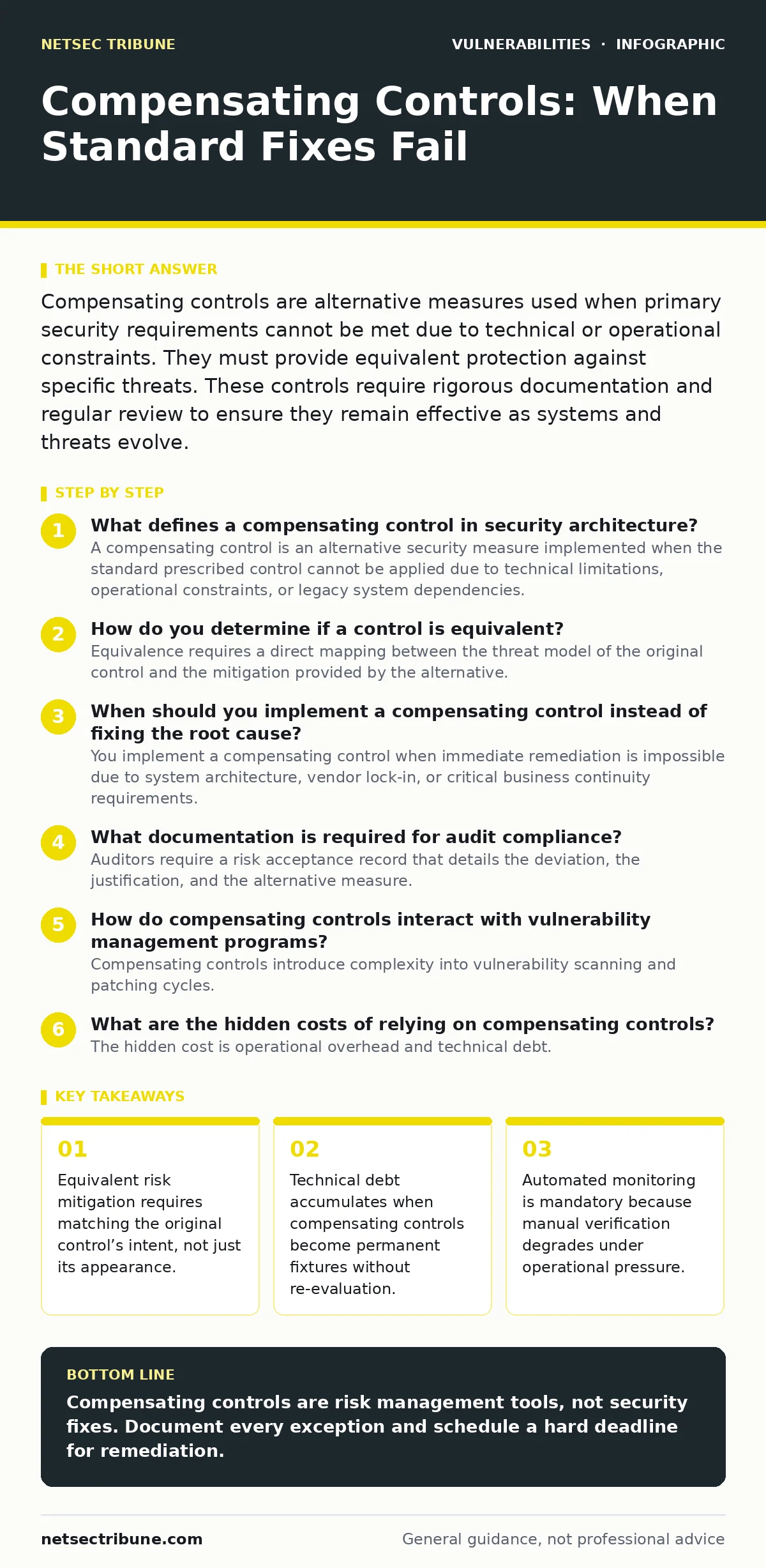
Compensating controls are alternative measures used when primary security requirements cannot be met due to technical or operational constraints. They must provide equivalent protection against specific threats. These controls require rigorous documentation and regular review to ensure they remain effective as systems and threats evolve.
What defines a compensating control in security architecture?
A compensating control is an alternative security measure implemented when the standard prescribed control cannot be applied due to technical limitations, operational constraints, or legacy system dependencies. It must address the same risk as the primary control. The measure does not remove the vulnerability but reduces the likelihood or impact of exploitation to an acceptable level. This distinction matters because compensating controls are exceptions to policy, not replacements for best practices.
How do you determine if a control is equivalent?
Equivalence requires a direct mapping between the threat model of the original control and the mitigation provided by the alternative. You must analyze the specific attack vector the primary control blocked. If the standard control prevents unauthorized data access via role-based access control, the compensating control must achieve the same isolation. Simply adding a firewall rule is not equivalent if the application logic remains flawed. The alternative must close the same logical gap in the security boundary.
When should you implement a compensating control instead of fixing the root cause?
You implement a compensating control when immediate remediation is impossible due to system architecture, vendor lock-in, or critical business continuity requirements. Suppose a legacy mainframe cannot support modern multi-factor authentication protocols. In this case, you might implement network segmentation to restrict access to specific trusted subnets. This buys time for a longer-term migration plan. Compensating controls are temporary bridges, not permanent architectural decisions. They address the symptom while the root cause remains unresolved.
What documentation is required for audit compliance?
Auditors require a risk acceptance record that details the deviation, the justification, and the alternative measure. The documentation must include the specific risk being mitigated, the technical implementation details, and the expected duration of the control. You must also record the residual risk level. This paper trail proves that the decision was informed and deliberate. Without explicit documentation, the control is treated as a security gap. Compliance frameworks demand transparency about why standard controls were bypassed.
| Control Type | Primary Function | Compensating Alternative | Risk Residual |
|---|---|---|---|
| Input Validation | Prevents injection attacks | WAF rule blocking patterns | Moderate |
| Encryption at Rest | Protects stored data | Air-gapped storage | Low |
| MFA | Verifies user identity | IP allowlisting | High |
How do compensating controls interact with vulnerability management programs?
Compensating controls introduce complexity into vulnerability scanning and patching cycles. Scanners may flag the underlying vulnerability as critical, even if the compensating control effectively mitigates the risk. Your vulnerability management programs must allow for risk-based prioritization. You need a mechanism to tag vulnerabilities as "mitigated by compensating control" to avoid false positives in reporting. This requires tight integration between security operations and development teams. Failure to coordinate leads to redundant work and alert fatigue.
See also: Why Is Identity Theft Insurance Important for Your Organization · Tabletop Exercises Checklist for Security Incident Response
What are the hidden costs of relying on compensating controls?
The hidden cost is operational overhead and technical debt. Compensating controls often require manual verification, custom scripting, or specialized monitoring tools. They do not self-heal like standard security configurations. Over time, these ad-hoc measures become fragile. If the underlying system changes, the compensating control may break silently. You must invest in continuous monitoring to ensure the alternative measure remains effective. This ongoing maintenance often exceeds the cost of implementing the primary control initially.
How do you monitor the effectiveness of a compensating control?
Monitoring requires defining specific success criteria that prove the control is functioning as intended. If the control is network segmentation, you must verify that traffic cannot traverse the boundary. You need automated alerts for policy violations. Manual checks are insufficient for dynamic environments. You should integrate these checks into your security orchestration tools. Regular penetration testing or red team exercises can validate that the compensating control holds against realistic attacks. Without active verification, the control is assumed to work, which is a dangerous assumption.
Can compensating controls address logic flaws like broken access control?
Logic flaws are difficult to mitigate with compensating controls because they reside in the application code. Broken access control occurs when the application fails to enforce proper permissions on sensitive actions. A firewall cannot fix this. You might use a web application firewall to block suspicious request patterns, but this is a partial measure. The most effective compensating control for logic flaws is often strict input validation and output encoding, which reduces the attack surface. However, this does not fix the underlying authorization logic.
How do compensating controls relate to cross-site request forgery (CSRF) protection?
Standard CSRF protection relies on anti-CSRF tokens embedded in forms. If the application architecture cannot support these tokens, you might implement strict referer header checking. This is a compensating control. It works only if the browser sends the referer header and if the server validates it strictly. This method fails if the referer header is stripped by intermediate proxies. You must test this control against various proxy configurations. Another option is same-site cookie attributes, which is a more robust compensating measure that shifts the burden to the browser.
What is the lifecycle of a compensating control?
A compensating control has a defined start and end date. The start date is when the primary control becomes unavailable. The end date is when the primary control is implemented or the system is decommissioned. You must review the control periodically to ensure it is still necessary. If the technical constraint is resolved, you must remove the compensating control and implement the standard measure. Leaving compensating controls in place indefinitely creates security drift. Regular audits should flag any compensating control that has existed longer than its planned duration.
Key takeaways
- Equivalent risk mitigation requires matching the original control’s intent, not just its appearance.
- Technical debt accumulates when compensating controls become permanent fixtures without re-evaluation.
- Automated monitoring is mandatory because manual verification degrades under operational pressure.
Compensating controls are risk management tools, not security fixes. Document every exception and schedule a hard deadline for remediation.
Frequently asked questions
Can a compensating control replace encryption for data at rest?
Yes, if the data is stored in a physically secure, air-gapped environment with strict access controls. The physical security must be as rigorous as the cryptographic protection would have been.
Do compensating controls satisfy GDPR requirements?
GDPR requires appropriate technical and organizational measures. Compensating controls can satisfy this if they provide equivalent protection and are properly documented as risk mitigation strategies.
How do you handle mass assignment vulnerabilities with compensating controls?
You can use an allowlist of permitted fields in the API controller. This prevents users from injecting unexpected parameters, effectively mitigating the mass assignment risk without changing the underlying ORM.
Are compensating controls acceptable for pre-authentication vulnerabilities?
Pre-auth vulnerabilities are high-risk. Compensating controls like rate limiting and IP reputation scoring can reduce the impact, but they do not fix the underlying authentication flaw. Immediate patching is preferred.
How this guide was produced: written by the NetSec Tribune editorial team with AI assistance, checked against the public references listed below, and reviewed when the facts change. See our editorial policy or report an error.