
Cross-Site Request Forgery: How Browsers Force Actions Without Consent
CSRF exploits the browser’s automatic inclusion of credentials, turning trusted sessions into attack vectors that standard access controls often miss.
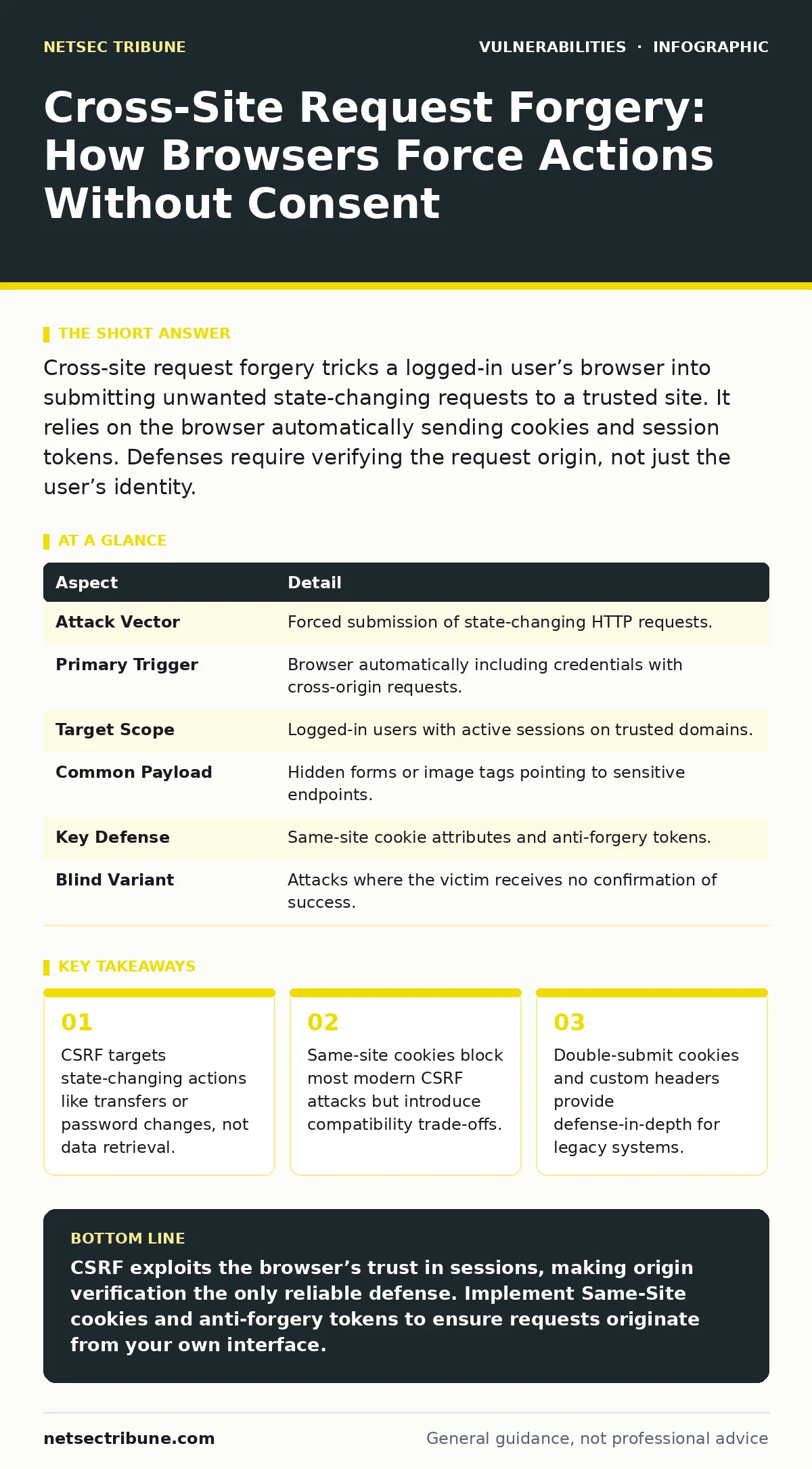
Cross-site request forgery tricks a logged-in user’s browser into submitting unwanted state-changing requests to a trusted site. It relies on the browser automatically sending cookies and session tokens. Defenses require verifying the request origin, not just the user’s identity.
The Silent Accomplice
Imagine you are at a bank. You hand the teller a deposit slip. The teller trusts you because you are wearing your employee badge. Now imagine a stranger hands the teller a different slip, but the teller still sees your badge and processes it. The teller assumes the action came from you because the badge is present.
In web security, the browser is the teller. The website is the bank. Your session cookie is the badge. When you log into a service, the server issues a session identifier. The browser stores this identifier and automatically attaches it to every subsequent request to that domain. This automation is convenient for you, but it creates a blind spot for the server. The server cannot distinguish between a request you intentionally made and one that a malicious site forced your browser to make.
This is the core of cross-site request forgery. It is not about stealing data. It is about forcing actions. The attacker does not need to read the response. They only need the server to process the request as if you authorized it.
At a Glance
| Aspect | Detail |
|---|---|
| Attack Vector | Forced submission of state-changing HTTP requests. |
| Primary Trigger | Browser automatically including credentials with cross-origin requests. |
| Target Scope | Logged-in users with active sessions on trusted domains. |
| Common Payload | Hidden forms or image tags pointing to sensitive endpoints. |
| Key Defense | Same-site cookie attributes and anti-forgery tokens. |
| Blind Variant | Attacks where the victim receives no confirmation of success. |
How the Mechanism Works
For a CSRF attack to succeed, three conditions must align. First, the target action must be state-changing. Changing a password, transferring funds, or deleting an account are valid targets. Reading a profile page is not, because the attacker cannot see the response. Second, the action must rely on implicit session management. If the server only checks for a valid session cookie, it assumes the request is legitimate. Third, the attacker must be able to induce the victim’s browser to send a request to the target.
The attacker creates a malicious webpage. This page contains a form that submits to the victim’s bank, email provider, or any other service where the victim is logged in. The form fields are pre-filled with the attacker’s desired values. When the victim visits the malicious page, the attacker’s script automatically submits the form. The browser includes the victim’s session cookie with the request. The target server receives a valid session and a valid request structure. It processes the action.
The server logs show a successful operation from the victim’s IP address. The session ID matches the victim’s active session. There is no technical evidence in the request itself that it was forged. The failure lies in the lack of proof that the request originated from the trusted site’s own interface.
Common Forms and Variations
The simplest form uses an image tag. An image tag forces the browser to make a GET request to fetch the image source. If the target site processes GET requests for state-changing actions, the attack succeeds. The victim loads the malicious page, and the browser sends the GET request with their credentials. This method is unreliable because many modern frameworks ignore GET requests for mutations, but it remains a theoretical risk for poorly designed APIs.
A more reliable method uses a hidden HTML form. The attacker uses JavaScript to auto-submit the form. This allows the use of POST, PUT, or DELETE methods. It also allows the attacker to set custom headers, though standard browser security restricts some headers. This form mimics a legitimate user action closely. The server sees a POST request with the correct parameters and a valid session.
Blind CSRF is a variant where the attacker cannot confirm success. The attacker posts a link to the malicious page on a forum or sends it in an email. They wait for the victim to click it. There is no feedback loop. The attacker hopes the victim is logged in and that the action is critical enough to warrant the attempt. This form is harder to exploit but can be highly effective if the target action is irreversible.
What People Usually Get Wrong
Many developers believe that checking the HTTP Referer header is sufficient. The Referer header tells the server which page linked to the current request. If the request comes from a different domain, the server can reject it. However, the Referer header can be stripped by privacy extensions, corporate proxies, or the browser itself when moving from HTTPS to HTTP. Relying on it alone creates a false sense of security. It is a heuristic, not a guarantee.
Another common mistake is assuming that CSRF only affects web browsers. Any client that automatically attaches credentials is vulnerable. Mobile apps that use shared credential stores or single sign-on tokens can be tricked into making requests if the app does not validate the context of the request. The vulnerability exists wherever authentication is implicit and context is ignored.
See also: Website Defacement Attack: How It Works and How to Stop It · What Is Input Validation: How to Stop Bad Data From Breaking Systems
Reducing the Risk
The most effective modern defense is the Same-Site cookie attribute. This attribute instructs the browser to only send the cookie if the request originates from the same site. If a malicious site tries to trigger a request, the browser withholds the session cookie. The server receives an unauthenticated request and rejects it. This stops the vast majority of CSRF attacks at the protocol level. However, it can break functionality if you rely on cross-site embedding of your own resources, such as iframes for analytics or payment widgets. You must test thoroughly after enabling it.
For systems that cannot use Same-Site cookies, anti-forgery tokens are the standard approach. The server generates a unique, unpredictable token for each session or form. This token is included in the form as a hidden field. The server also requires the token to be sent in a custom header or as a parameter. The attacker cannot guess this token because it is tied to the user’s session and not publicly accessible. The server validates that the token in the header matches the token in the body. This proves the request was generated by the server’s own page.
Custom headers provide another layer of defense. Standard HTML forms cannot set custom headers like X-Requested-With. JavaScript can, but the Same-Origin Policy prevents a malicious site from reading the response of a cross-origin request that uses custom headers. If your API requires a custom header for state-changing actions, a simple form submission will fail. This technique is often used in conjunction with Content Security Policy to restrict script sources and reduce the attack surface.
Edge Cases and Legacy Systems
Legacy systems often rely on POST-only methods to prevent CSRF. The assumption is that browsers will not auto-submit POST requests. This is incorrect. JavaScript can easily auto-submit POST forms. Furthermore, some older browsers or specific configurations may allow POST requests via image tags or other mechanisms. Relying on method restriction alone is insufficient.
Race condition vulnerabilities can complicate CSRF defenses. If an application processes requests asynchronously without proper locking, an attacker might exploit a timing window. For example, an attacker might trigger multiple CSRF requests to exhaust a resource or bypass a one-time token check. Ensuring that state changes are atomic and idempotent helps mitigate this risk.
When dealing with third-party integrations, web application firewalls may offer some protection, but they are not a substitute for application-level controls. WAFs can filter known attack patterns, but they cannot validate the business logic of a request. A forged request that looks legitimate to a WAF will still be processed by the application. You must validate the origin and intent of every state-changing request at the application layer.
Implementation Checklist
- Set the Same-Site attribute to Strict or Lax on all session cookies.
- Generate unique anti-forgery tokens for all state-changing forms.
- Validate tokens on the server side before processing requests.
- Use custom headers for API endpoints that accept JSON or non-form data.
- Ensure that GET requests never trigger state changes.
- Test applications with privacy extensions and strict browser settings.
- Review third-party libraries for default CSRF protection settings.
Key takeaways
- CSRF targets state-changing actions like transfers or password changes, not data retrieval.
- Same-site cookies block most modern CSRF attacks but introduce compatibility trade-offs.
- Double-submit cookies and custom headers provide defense-in-depth for legacy systems.
- Blind CSRF remains a risk when applications lack proper request validation mechanisms.
CSRF exploits the browser’s trust in sessions, making origin verification the only reliable defense. Implement Same-Site cookies and anti-forgery tokens to ensure requests originate from your own interface.
Frequently asked questions
Does HTTPS prevent CSRF?
No. HTTPS encrypts the data in transit but does not change how the browser handles session cookies. The browser still sends credentials automatically with cross-origin requests.
Can CSRF steal data?
Typically no. CSRF forces actions but does not allow the attacker to read the response. To steal data, an attacker would need to combine CSRF with another vulnerability like broken access control.
Is Same-Site cookie support universal?
Most modern browsers support it, but older browsers may ignore the attribute. Use anti-forgery tokens as a fallback for broader compatibility.
How do I test for CSRF?
Attempt to submit a form from a different domain without the required anti-forgery token or custom headers. If the server processes the request, it is vulnerable.
How this guide was produced: written by the NetSec Tribune editorial team with AI assistance, checked against the public references listed below, and reviewed when the facts change. See our editorial policy or report an error.