
Vulnerability Management Myths That Waste Your Time and Budget
Treating vulnerability management as a simple scanning task ignores the complex operational reality of asset discovery and risk context.
Vulnerability management fails when teams treat it as a checklist rather than a continuous risk reduction process. Misunderstandings about scope, severity, and remediation speed create false security postures. Correct views focus on asset visibility, contextual risk, and measurable exposure reduction over time.
Misreading: Scanning Frequency Equals Security
Correct reading: Running scans more often does not fix the underlying lack of visibility into your environment. A daily scan of an incomplete asset list provides a false sense of security. The primary failure in vulnerability management is not the scanner’s accuracy, but the inventory’s completeness. If you do not know an asset exists, you cannot scan it. You cannot patch what you cannot see.
Imagine a server that was decommissioned three years ago but still holds a valid IP address in your DNS records. It no longer receives patches. It has no owners. A scanner might report it as clean if it is offline, or as vulnerable if it is online. Either way, the data is useless because the asset management process failed. You must treat asset discovery as the first step of vulnerability management, not a separate administrative task. Without a single source of truth for every device, user, and service, your scanning efforts are merely generating noise.
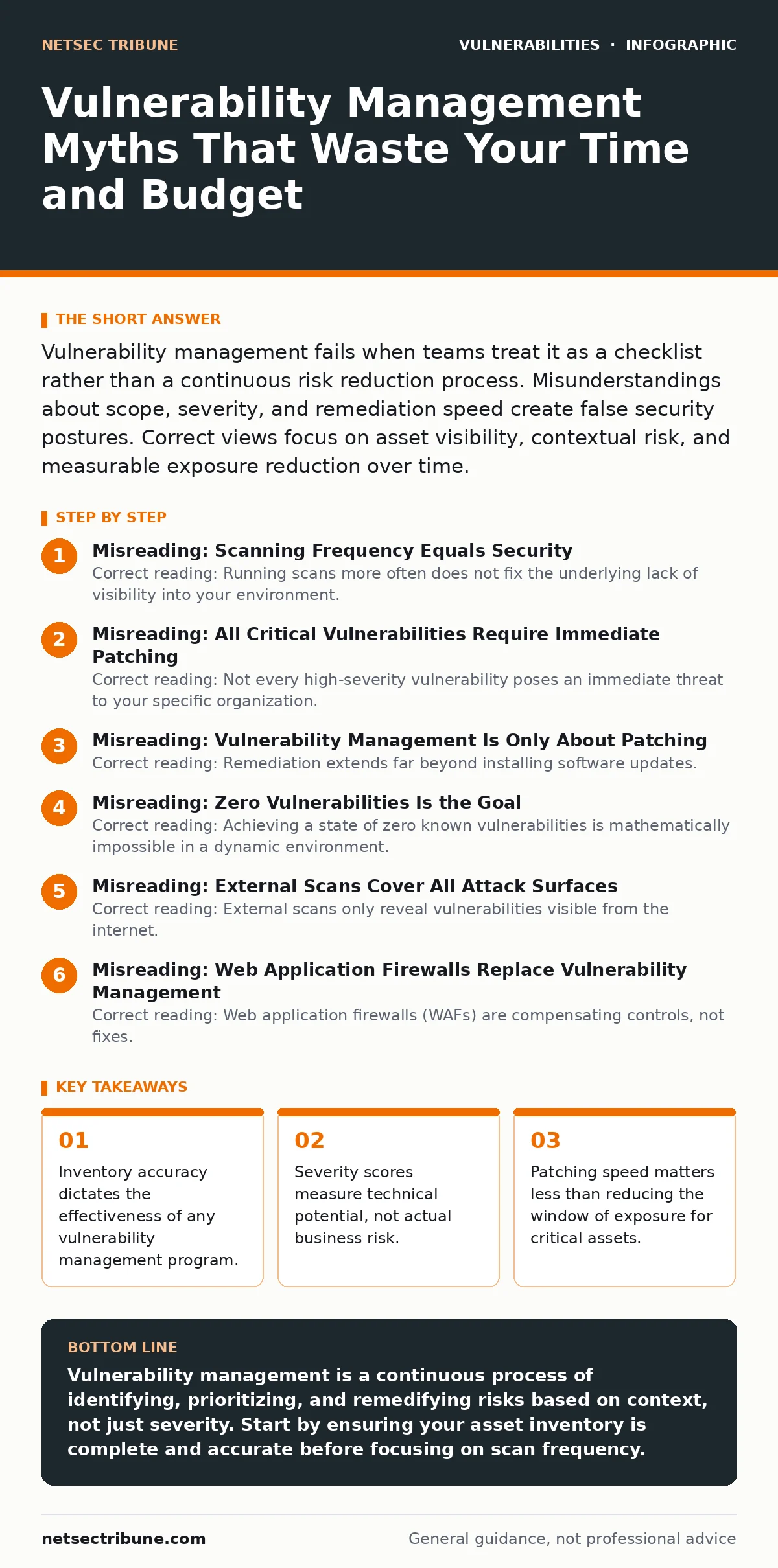
Misreading: All Critical Vulnerabilities Require Immediate Patching
Correct reading: Not every high-severity vulnerability poses an immediate threat to your specific organization. Severity scores like CVSS provide a standardized way to compare technical flaws, but they do not account for your network architecture or exposure. A critical vulnerability in a service that is air-gapped from the internet presents a different risk profile than one in a public-facing web server.
Patching everything immediately is operationally impossible and often counterproductive. Emergency patches can introduce new bugs or break existing functionality. You must triage vulnerabilities based on exploitability and asset value. If a vulnerability requires user interaction to exploit, and your application does not accept user uploads, the risk is negligible. Prioritize remediation based on the likelihood of exploitation and the impact on your business operations. This approach reduces alert fatigue and focuses resources on threats that actually matter.
Misreading: Vulnerability Management Is Only About Patching
Correct reading: Remediation extends far beyond installing software updates. Many vulnerabilities stem from security misconfigurations rather than code flaws. A correctly patched server can still be compromised if it runs with default credentials or exposes unnecessary ports. Patching addresses the software defect; configuration management addresses the deployment error.
Consider a web application that is fully patched but still allows mass assignment vulnerabilities because the developer did not properly validate input parameters. No patch will fix this logic error. You must also address broken access control issues, where users can access data they should not see. These are often configuration or code logic problems. Your management program must include configuration audits, code reviews, and runtime application self-protection, not just patch deployment.
Misreading: Zero Vulnerabilities Is the Goal
Correct reading: Achieving a state of zero known vulnerabilities is mathematically impossible in a dynamic environment. New vulnerabilities are discovered daily. Software dependencies change constantly. The goal is not perfection; it is risk reduction within an acceptable timeframe. Chasing zero creates a race you cannot win.
Instead of aiming for zero, aim for zero unmanaged risk. This means every known vulnerability is either patched, mitigated, or accepted with documented business justification. Acceptance is not negligence; it is a conscious decision. For example, you might accept a low-risk vulnerability in a legacy system that is being decommissioned next quarter. Documenting this decision allows you to prove due diligence. It also frees up resources to address higher-risk issues.
Misreading: External Scans Cover All Attack Surfaces
Correct reading: External scans only reveal vulnerabilities visible from the internet. They miss internal threats, lateral movement paths, and segmentation failures. An attacker who compromises a single external-facing server can often move laterally to internal systems that are never scanned from the outside.
Internal networks often have weaker segmentation than external perimeters. An insider threat or a compromised endpoint can access sensitive databases without ever touching the internet. You must run internal scans regularly to identify vulnerabilities that are only explovable from within the network. This includes checking for exposed admin panels that are hidden behind firewalls but accessible to internal users. It also involves testing for cross-site request forgery (CSRF) flaws that rely on authenticated sessions.
See also: Asset Inventory for Patching: Definition, Purpose, and Execution
Misreading: Web Application Firewalls Replace Vulnerability Management
Correct reading: Web application firewalls (WAFs) are compensating controls, not fixes. They block known attack patterns, but they do not remove the underlying vulnerability. Attackers can often bypass WAF rules using obfuscation or novel techniques. Relying on a WAF to protect a vulnerable application is like locking the door while leaving the window open.
A WAF can provide temporary protection while you develop and test a patch. It can block specific exploit signatures. It cannot fix HTTP request smuggling issues that occur at the protocol level. It cannot fix logic flaws in your application code. Using a WAF as a permanent substitute for vulnerability management creates a fragile security posture. When the WAF rule expires or is bypassed, your application is left exposed.
Misreading: Third-Party Risk Is Someone Else’s Problem
Correct reading: Your supply chain is part of your attack surface. Vulnerabilities in third-party libraries, plugins, and services can compromise your systems just as easily as flaws in your own code. Many breaches occur through vulnerabilities in self-hosted GitLab instances or other widely used third-party tools.
You must monitor and manage the security posture of all third-party components. This includes checking for known vulnerabilities in open-source libraries you use. It also involves reviewing the security practices of your vendors. If a vendor’s API is compromised, your application may be exposed. Treat third-party dependencies with the same rigor as your own code. Regularly update libraries and monitor for new vulnerabilities in your supply chain.
Key takeaways
- Inventory accuracy dictates the effectiveness of any vulnerability management program.
- Severity scores measure technical potential, not actual business risk.
- Patching speed matters less than reducing the window of exposure for critical assets.
Vulnerability management is a continuous process of identifying, prioritizing, and remedifying risks based on context, not just severity. Start by ensuring your asset inventory is complete and accurate before focusing on scan frequency.
Frequently asked questions
How do I prioritize vulnerabilities when resources are limited?
Focus on vulnerabilities that are actively exploited in the wild, affect internet-facing assets, or impact critical business functions.
What is the difference between vulnerability management and patch management?
Patch management is the process of applying updates. Vulnerability management includes discovery, assessment, prioritization, and remediation, which may include configuration changes or compensating controls.
How often should I scan for vulnerabilities?
Scan frequency depends on your environment’s change
How this guide was produced: written by the NetSec Tribune editorial team with AI assistance, checked against the public references listed below, and reviewed when the facts change. See our editorial policy or report an error.



