Web Application Firewall Checklist: Configuration, Logic, and Bypass Prevention
A web application firewall often fails because it blocks only what it already knows, leaving novel logic flaws and encoded attacks to pass through to your backend systems.
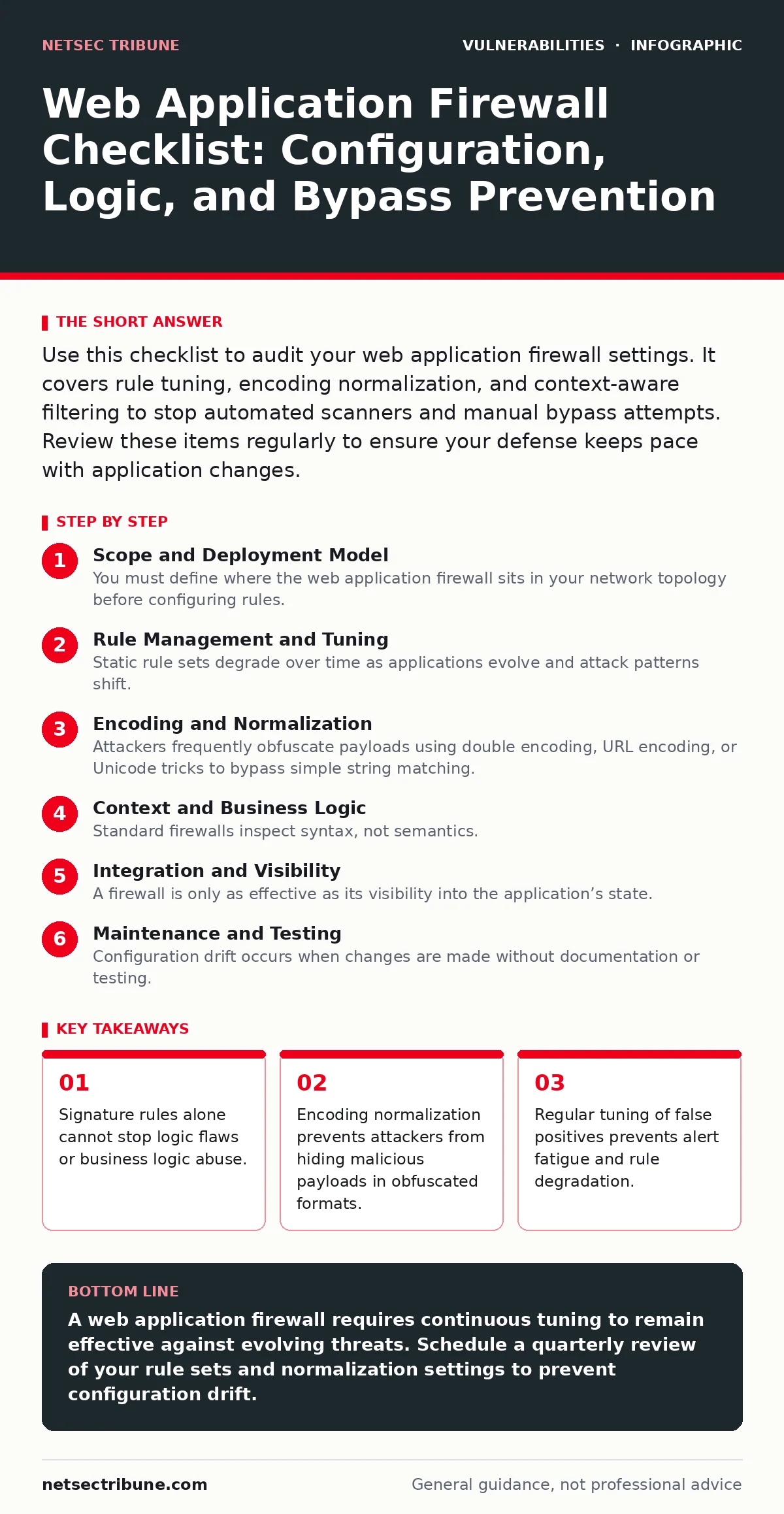
Use this checklist to audit your web application firewall settings. It covers rule tuning, encoding normalization, and context-aware filtering to stop automated scanners and manual bypass attempts. Review these items regularly to ensure your defense keeps pace with application changes.
Scope and Deployment Model
You must define where the web application firewall sits in your network topology before configuring rules. A reverse proxy model intercepts traffic before it reaches the application server, allowing the firewall to drop requests early. This reduces load on your backend but requires careful handling of SSL termination. If you deploy the firewall inline, ensure it does not become a single point of failure.
The checklist below applies to both cloud-managed and on-premise devices. It focuses on configuration hygiene rather than initial setup. You should use this list during quarterly reviews or after significant application updates.
Rule Management and Tuning
Static rule sets degrade over time as applications evolve and attack patterns shift. You must actively manage the ruleset to balance security with availability.
- Audit custom rules for redundancy: Duplicate rules increase processing latency and complicate troubleshooting during incidents.
- Review false positive logs weekly: High false positive rates indicate overly broad rules that may be bypassed by slight payload variations.
- Disable unused OWASP CRS rules: Unused rules consume resources and may trigger on legitimate API endpoints that use non-standard parameters.
- Verify rule version integrity: Ensure your rule set matches the published baseline to detect accidental deletions or malicious modifications.
- Separate rules for APIs and web pages: APIs often use JSON and different HTTP methods, requiring distinct parsing logic than HTML-based forms.
Encoding and Normalization
Attackers frequently obfuscate payloads using double encoding, URL encoding, or Unicode tricks to bypass simple string matching. Your firewall must normalize these inputs before inspection.
- Enable deep decoding for all layers: Ensure the firewall decodes parameters at every stage of parsing, not just the initial request line.
- Validate UTF-8 normalization: Improper handling of Unicode characters can lead to path traversal vulnerabilities if the backend interprets them differently than the firewall.
- Test with encoded payloads: Regularly send obfuscated test requests to verify that the firewall strips encoding before applying security rules.
Refer to our guide on path traversal vulnerabilities to understand how improper normalization can allow directory escape sequences to reach the file system.
Context and Business Logic
Standard firewalls inspect syntax, not semantics. They cannot easily determine if a valid SQL query is malicious or if a file upload is a weaponized document. You must add context-aware checks.
- Implement rate limiting per user session: This mitigates brute-force attacks and automated scraping without blocking all traffic from a single IP address.
- Restrict HTTP methods to allowed actions: Disable TRACE, DELETE, and other methods unless explicitly required by your application logic.
- Validate Content-Type headers strictly: Mismatched headers and body content often indicate multipart boundary attacks or request smuggling attempts.
- Monitor for mass assignment vulnerabilities: Ensure the firewall blocks unexpected parameters in JSON or XML payloads that could modify user roles or settings.
See our analysis of HTTP request smuggling for details on how header manipulation can bypass caching layers and confuse application servers.
Integration and Visibility
A firewall is only as effective as its visibility into the application’s state. Isolated devices miss context about user authentication and session validity.
- Integrate with SIEM for log correlation: Firewall logs alone lack context; combining them with application logs reveals attack chains.
- Enable virtual patching for known CVEs: Deploy temporary rules to block exploits for zero-day vulnerabilities while waiting for application patches.
- Verify WAF bypass detection: Regularly test for common bypass techniques like header injection or unusual content lengths.
- Monitor for broken access control patterns: While the firewall cannot enforce logic, it can block requests that deviate from normal access patterns.
Consult our guide on broken access control to understand why perimeter defenses cannot replace application-level authorization checks.
See also: Asset Inventory for Patching: Definition, Purpose, and Execution
Maintenance and Testing
Configuration drift occurs when changes are made without documentation or testing. You must treat your firewall configuration as code that requires review.
- Document every rule change: Record the reason, author, and expected impact of each modification to facilitate rollback.
- Perform regular penetration testing: External testers will attempt to bypass your firewall, revealing gaps in your normalization and rule logic.
- Review whitelist exceptions: Temporary whitelists often become permanent, creating blind spots in your security posture.
- Update threat intelligence feeds: Ensure your firewall receives updates for newly discovered attack patterns and malware signatures.
Review our article on security misconfigurations to identify common setup errors that render firewall rules ineffective.
Key takeaways
- Signature rules alone cannot stop logic flaws or business logic abuse.
- Encoding normalization prevents attackers from hiding malicious payloads in obfuscated formats.
- Regular tuning of false positives prevents alert fatigue and rule degradation.
A web application firewall requires continuous tuning to remain effective against evolving threats. Schedule a quarterly review of your rule sets and normalization settings to prevent configuration drift.
Frequently asked questions
Does a web application firewall stop all attacks?
No, it primarily blocks known attack patterns and syntax errors. It cannot fully protect against logic flaws, zero-day vulnerabilities, or authenticated business logic abuse.
How often should I update my WAF rules?
You should review and update rules after every major application release and at least quarterly to address new threat patterns and reduce false positives.
Can a WAF replace input validation?
No, input validation must occur at the application level. The firewall acts as a perimeter defense, but developers must validate data to prevent injection and logic errors.
What is the biggest risk with WAFs?
The biggest risk is alert fatigue and false negatives caused by poor tuning. Overly broad rules may block legitimate traffic, while overly narrow rules may miss subtle attacks.
How this guide was produced: written by the NetSec Tribune editorial team with AI assistance, checked against the public references listed below, and reviewed when the facts change. See our editorial policy or report an error.



