
Fix IOC Enrichment Errors: 6 Common Misunderstandings
Enriched indicators of compromise often carry false context that degrades detection quality rather than improving operational accuracy.
IOC enrichment adds context to raw data points, but it frequently introduces noise, stale data, or incorrect attribution. Treat enriched fields as hypotheses, not facts. Validate every indicator against local telemetry before building rules. This prevents alert fatigue and ensures your security operations focus on genuine threats rather than data artifacts.
Misreading: Enrichment Equals Truth
Correct reading: Enrichment adds context, not certainty. When you query a database for an indicator of compromise, the returned metadata represents the collective knowledge of that source, not an absolute fact. External databases often aggregate data from multiple contributors with varying verification standards. An IP address labeled as "malicious" might simply be a compromised server that has since been cleaned. Trusting the label without checking the timestamp or the source methodology leads to false positives. You must treat every enriched field as a hypothesis that requires local testing.
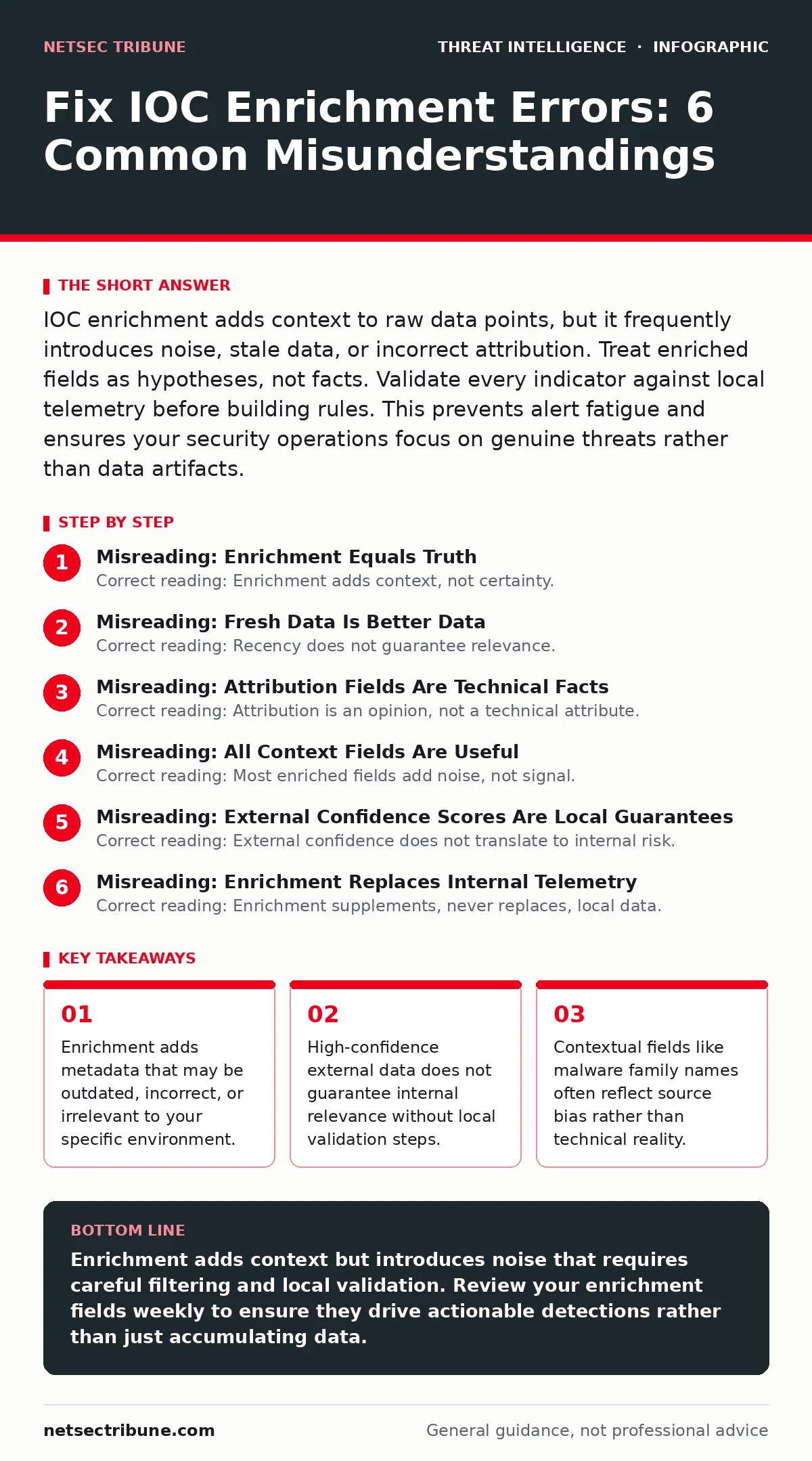
Misreading: Fresh Data Is Better Data
Correct reading: Recency does not guarantee relevance. Many teams assume that newer indicators are more valuable because they reflect current campaigns. This ignores the lifecycle of threat infrastructure. Attackers reuse infrastructure to maintain persistence and avoid detection costs. An older indicator might be tied to a long-running access point that remains active. Conversely, a brand-new indicator might be a one-time use tool that is already discarded. Evaluate the indicator based on its persistence potential and the threat actor’s typical operational rhythm, not just its creation date.
Misreading: Attribution Fields Are Technical Facts
Correct reading: Attribution is an opinion, not a technical attribute. Enrichment services often attach names like "APT-29" or "Lazarus" to indicators. These labels represent the intelligence community’s best guess, which changes as new evidence emerges. Technical analysis should focus on behavior, not identity.
If you build detection rules based on a specific group name, you miss attacks from other groups using the same toolkit. Focus on the binary hash, the network signature, or the file structure. These technical traits remain constant even if the attribution label changes. See our guide on threat actor profiling for methods that separate behavior from identity.
Misreading: All Context Fields Are Useful
Correct reading: Most enriched fields add noise, not signal. Databases return dozens of fields for a single indicator, including geolocation, reverse DNS, and historical tags. Many of these are irrelevant to local detection. Geolocation is frequently spoofed or routed through cloud providers, making it useless for determining origin. Reverse DNS can be modified by attackers to look legitimate. You need to filter enrichment results aggressively. Keep only the fields that directly inform your detection logic, such as first seen date, last seen date, and specific threat tags. Discard the rest to reduce cognitive load on analysts.
Misreading: External Confidence Scores Are Local Guarantees
Correct reading: External confidence does not translate to internal risk. A high confidence score from a threat intelligence feed indicates that many sources agree on the indicator’s malicious nature. It does not indicate that the indicator is present in your environment or that it poses a risk to your specific architecture. A high-confidence indicator for a web server attack is useless if you have no internet-facing web servers. You must map external confidence to internal exposure. Check if the asset type exists in your network before elevating the indicator’s priority. This prevents wasting resources on threats that cannot reach you.
See also: Indicators of Compromise: 6 Common Misreadings That Fail in Detection · How the MITRE ATT&CK Framework Works for Detection
Misreading: Enrichment Replaces Internal Telemetry
Correct reading: Enrichment supplements, never replaces, local data. Relying solely on external enrichment creates a blind spot for novel attacks that are not yet in public databases. Internal telemetry, such as Sysmon logs or packet capture analysis, provides ground truth about what is actually happening on your network. Enrichment helps you understand the broader context of an alert, but it cannot confirm the alert’s validity. Always cross-reference enriched indicators with your own logs. If an external source flags a hash, but your internal logs show no execution, the threat may not be present. This verification step is the core of effective detection engineering.
Misreading: Static Indicators Are Sufficient
Correct reading: Behavioral context beats static identifiers. Static indicators like file hashes or IP addresses are easy to change. Attackers modify their code slightly to generate new hashes, or they rotate their IP addresses. Enrichment that focuses only on static traits becomes obsolete quickly. You need enrichment that provides behavioral context, such as the typical lateral movement techniques associated with a tool or the usual LSASS credential theft methods used by a specific malware family. This behavioral data helps you detect variations of the attack even when the static indicators change. It shifts your defense from signature-based to behavior-based.
Misreading: One Source Is Enough
Correct reading: Diversity reduces bias. Relying on a single threat intelligence feed introduces that source’s blind spots and biases into your security posture. Different feeds specialize in different areas, such as ransomware, state-sponsored attacks, or cybercrime syndicates. Using multiple sources with different methodologies provides a more balanced view. However, more sources do not automatically mean better data. You need a process to reconcile conflicting information. If one source labels an IP as malicious and another labels it as benign, you must investigate the discrepancy. This reconciliation process is where real intelligence is generated.
Misreading: Enrichment Is a One-Time Process
Correct reading: Context changes over time. The meaning of an indicator evolves as the threat environment shifts. An IP address used for command and control today might be reclaimed by a legitimate organization tomorrow. Enrichment data decays. You need a process to refresh and re-evaluate your stored indicators periodically. Stale indicators clutter your databases and slow down lookups. Implement a retention policy that removes or archives indicators that have not been seen or validated in a defined period. This keeps your enrichment pipeline efficient and relevant.
Misreading: Enrichment Solves Attribution
Correct reading: Attribution requires deep analysis. Enrichment provides clues, not conclusions. Determining the true actor behind an attack requires correlating multiple indicators, analyzing code similarities, and understanding operational patterns. This is beyond the scope of simple enrichment. Enrichment can tell you what tool was used, but not who used it. Avoid building your security strategy around attribution. Focus on mitigating the impact of the attack, regardless of the actor’s identity. This approach is more resilient and less prone to error.
Key takeaways
- Enrichment adds metadata that may be outdated, incorrect, or irrelevant to your specific environment.
- High-confidence external data does not guarantee internal relevance without local validation steps.
- Contextual fields like malware family names often reflect source bias rather than technical reality.
Enrichment adds context but introduces noise that requires careful filtering and local validation. Review your enrichment fields weekly to ensure they drive actionable detections rather than just accumulating data.
Frequently asked questions
How do I verify if an enriched indicator is relevant to my network?
Cross-reference the indicator with your internal asset inventory and telemetry. If the asset type does not exist in your environment or if local logs show no interaction, the indicator is likely irrelevant.
Can I automate the blocking of high-confidence enriched indicators?
Automation is risky for blocking actions. Use enrichment for alerting and investigation. Manual verification or secondary automated checks should precede any blocking action to prevent business disruption.
What is the difference between an indicator and intelligence?
An indicator is a raw data point like a hash or IP. Intelligence is the contextualized understanding of that point, including its purpose, origin, and potential impact. Enrichment turns indicators into preliminary intelligence.
How often should I refresh my enrichment data?
Refresh data in real-time for critical alerts and batch-process less critical data daily. Regularly review your stored indicators to remove stale entries and ensure your context remains current.
How this guide was produced: written by the NetSec Tribune editorial team with AI assistance, checked against the public references listed below, and reviewed when the facts change. See our editorial policy or report an error.