
Indicators of Compromise: 6 Common Misreadings That Fail in Detection
Treating indicators as absolute proof of compromise ignores the high false-positive rate inherent in static data without behavioral context.
Indicators of compromise are static data points that suggest malicious activity but lack context. Misreading them as definitive proof leads to alert fatigue and missed threats. You must combine them with behavioral analysis and contextual data to distinguish between benign anomalies and actual intrusions.
Misreading: An indicator is proof of a breach
When you see a known malicious hash in your logs, the instinct is to declare a breach. This is a logical error. An indicator of compromise is merely a clue, not a verdict. A file hash might match a known malware variant, but that file could be a benign copy used for research, a false positive from a misconfigured scanner, or an old artifact that was already cleaned.
Correct reading: Treat an indicator as a hypothesis. It suggests that something suspicious exists on your system. You must investigate the context. Did the file execute? Did it communicate with external servers? Was it created by a user or a service account? Without behavioral evidence, the indicator is just a data point. Relying on it alone leads to wasted time on false alarms.
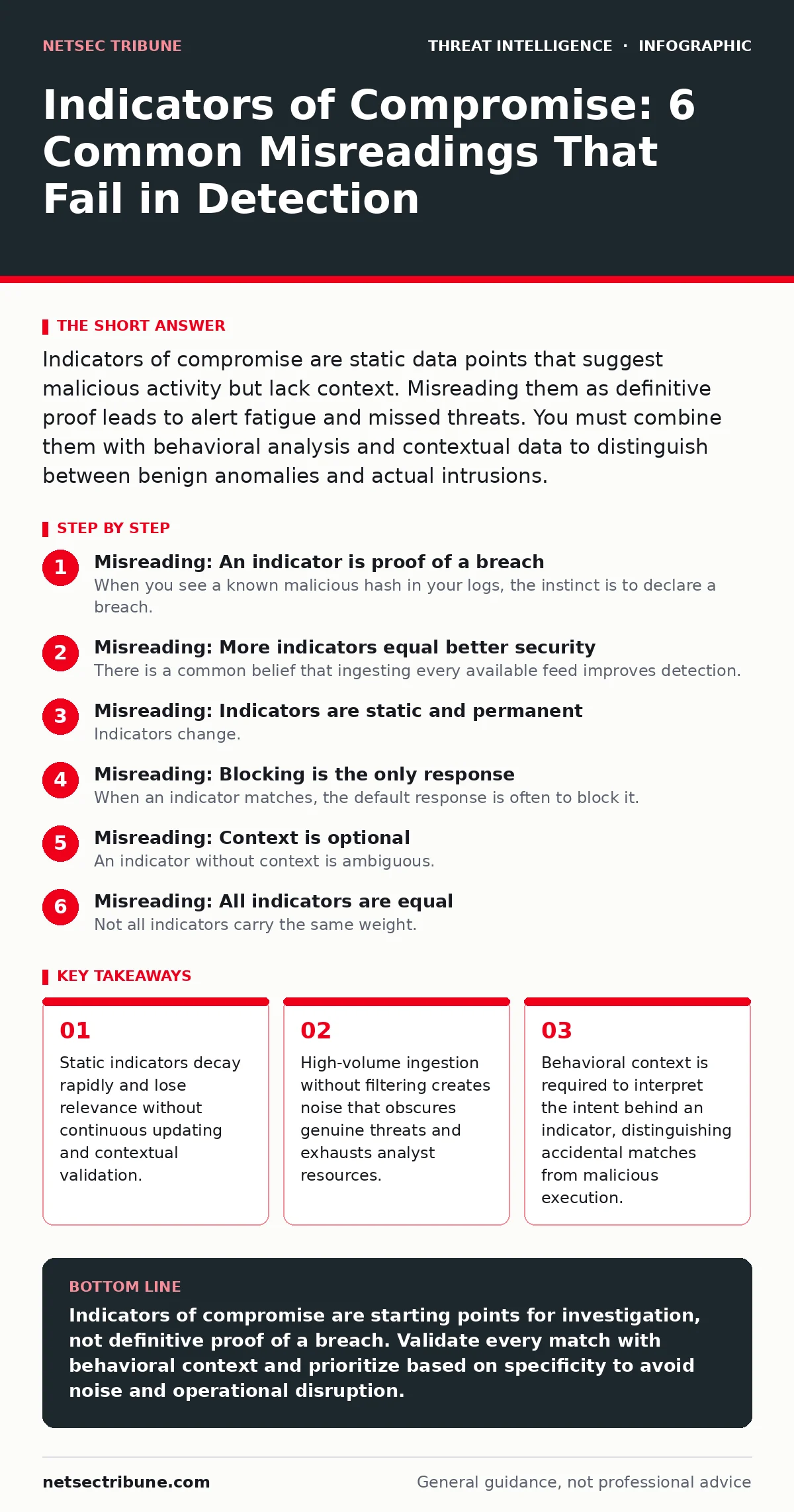
Misreading: More indicators equal better security
There is a common belief that ingesting every available feed improves detection. This is incorrect. Adding thousands of low-quality indicators increases noise. Your security tools will flag more events, many of which are irrelevant. This noise drowns out the few signals that actually matter. It also slows down your systems and confuses your analysts.
Correct reading: Quality matters more than quantity. Curate your feeds. Focus on indicators that are relevant to your industry, technology stack, and geographic location. Use threat intelligence feeds that provide context, such as the attacker’s tactics and techniques. A smaller, well-vetted set of indicators is more effective than a massive, unfiltered list. This reduces false positives and allows your team to focus on real threats.
Misreading: Indicators are static and permanent
Indicators change. Malware variants update their hashes. Command and control servers rotate their domains. IPs are reclaimed and reassigned. If you treat an indicator as permanent, your defenses become stale. You will miss new variants and block legitimate traffic that has taken over an old malicious IP. This drift reduces the effectiveness of your detection rules over time.
Correct reading: Indicators are ephemeral. They have a short shelf life. You must regularly review and update your indicator sets. Remove old entries that are no longer relevant. Add new ones based on current threat activity. This process requires automation and manual oversight. It ensures your detection capabilities remain aligned with the current threat environment. Stagnation leads to blindness.
Misreading: Blocking is the only response
When an indicator matches, the default response is often to block it. This is too simplistic. Blocking a domain might stop communication, but it does not remove the malware from your endpoints. Blocking an IP might disrupt legitimate services if the IP is shared. Aggressive blocking can cause outages and impact business operations. It also does not address the root cause of the intrusion.
Correct reading: Blocking is one tool among many. Use it sparingly and with caution. First, verify the match. Then, determine the scope of the impact. Isolate affected systems. Remove the malicious artifacts. Investigate how the attacker gained access. Use this information to strengthen your defenses. This comprehensive approach addresses the entire incident, not just the symptom.
Misreading: Context is optional
An indicator without context is ambiguous. A file hash match tells you what the file is, but not what it is doing. A domain match tells you where traffic is going, but not why. Without context, you cannot determine if the activity is malicious. You might block a legitimate application that happens to use a known malicious domain for a benign purpose. This lack of context leads to errors.
Correct reading: Context is critical. Combine indicators with behavioral data. Use tools like Sysmon to monitor process creation, network connections, and file modifications. Look for patterns that indicate malicious activity, such as unexpected parent-child process relationships or unusual network destinations. This behavioral context helps you distinguish between accidental matches and deliberate attacks. It transforms raw data into actionable intelligence.
See also: Hybrid Warfare in Cyberspace: Correcting 6 Common Intelligence Errors · How the MITRE ATT&CK Framework Works for Detection
Misreading: All indicators are equal
Not all indicators carry the same weight. Some are highly specific, such as a unique cryptographic key used by a specific ransomware group. Others are generic, such as a common IP address range used by cloud providers. Treating them equally dilutes your focus. You will spend time on low-value matches while missing high-value threats. This imbalance reduces the efficiency of your security operations.
Correct reading: Prioritize indicators based on their specificity and relevance. Assign higher priority to indicators that are unique to a threat actor or campaign. Lower priority can be given to generic indicators. This prioritization helps your team focus on the most dangerous threats. It also helps you allocate resources more effectively. Understanding the value of each indicator improves your detection accuracy.
Misreading: Automation replaces human judgment
Automation is powerful, but it is not infallible. Automated systems can process vast amounts of data quickly. However, they lack the nuanced understanding of context that humans possess. They may flag benign activity as malicious or miss subtle signs of an advanced attack. Over-reliance on automation can lead to complacency and missed threats.
Correct reading: Use automation to augment human judgment, not replace it. Let automation handle the initial filtering and correlation. Then, have your analysts review the flagged events. They should apply their expertise to interpret the results. This hybrid approach combines the speed of automation with the depth of human analysis. It reduces errors and improves detection quality.
Misreading: Indicators work in isolation
Indicators are most effective when integrated into a broader security strategy. Using them in isolation limits their value. They should be part of a comprehensive approach that includes behavioral monitoring, threat hunting, and incident response. This integration allows you to see the full picture of an attack. It helps you understand the attacker’s goals and methods.
Correct reading: Integrate indicators with other security data sources. Correlate them with logs, network traffic, and endpoint data. Use frameworks like the MITRE ATT&CK framework to map indicators to specific tactics and techniques. This mapping helps you understand the attacker’s behavior and plan your response. It also helps you identify gaps in your defenses. A holistic approach is more effective than a fragmented one.
Key takeaways
- Static indicators decay rapidly and lose relevance without continuous updating and contextual validation.
- High-volume ingestion without filtering creates noise that obscures genuine threats and exhausts analyst resources.
- Behavioral context is required to interpret the intent behind an indicator, distinguishing accidental matches from malicious execution.
- Integration with frameworks like the MITRE ATT&CK framework provides the necessary structure for understanding attacker tactics.
Indicators of compromise are starting points for investigation, not definitive proof of a breach. Validate every match with behavioral context and prioritize based on specificity to avoid noise and operational disruption.
Frequently asked questions
How do I distinguish between a false positive and a true positive for an indicator?
Investigate the context. Check if the associated file executed, if it communicated with external servers, and if it matches known malicious behavior. Use behavioral data to confirm the intent.
What is the best way to manage indicator decay?
Implement a regular review process. Remove old indicators that are no longer relevant. Add new ones based on current threat activity. Use automation to flag stale entries for review.
Can I use indicators from public sources without validation?
No. Public sources may contain outdated or incorrect data. Validate indicators against your environment and current threat intelligence. Prioritize sources that provide context and reliability.
How do I integrate indicators with the MITRE ATT&CK framework?
Map each indicator to a specific tactic, technique, or procedure. This helps you understand the attacker’s behavior and identify gaps in your detection capabilities. Use this mapping to guide your threat hunting efforts.
How this guide was produced: written by the NetSec Tribune editorial team with AI assistance, checked against the public references listed below, and reviewed when the facts change. See our editorial policy or report an error.