
Threat Actor Profiling: 6 Common Misreadings and Correct Views
Profiling reveals operational habits rather than individual identities, turning noise into actionable context for detection engineering.
Threat actor profiling misleads when treated as identity verification. Correct usage maps behavioral patterns, tool preferences, and infrastructure reuse. These signals feed detection logic, not law enforcement dossiers. Focus on how attacks unfold, not who commits them, to improve defensive coverage.
Misreading: Profiling Reveals Individual Identities
Correct reading: Profiling maps operational habits rather than personal identities. Analysts often mistake technical artifacts for biographical data. This error assumes that code style or language choice identifies a specific person. In reality, these signals describe a group’s workflow. A shared coding standard may reflect a training program, not a single developer. Attribution to an individual remains speculative without direct evidence. Defense teams gain more value by understanding how a group operates. Knowing the method allows for detection. Knowing the name offers little protection.
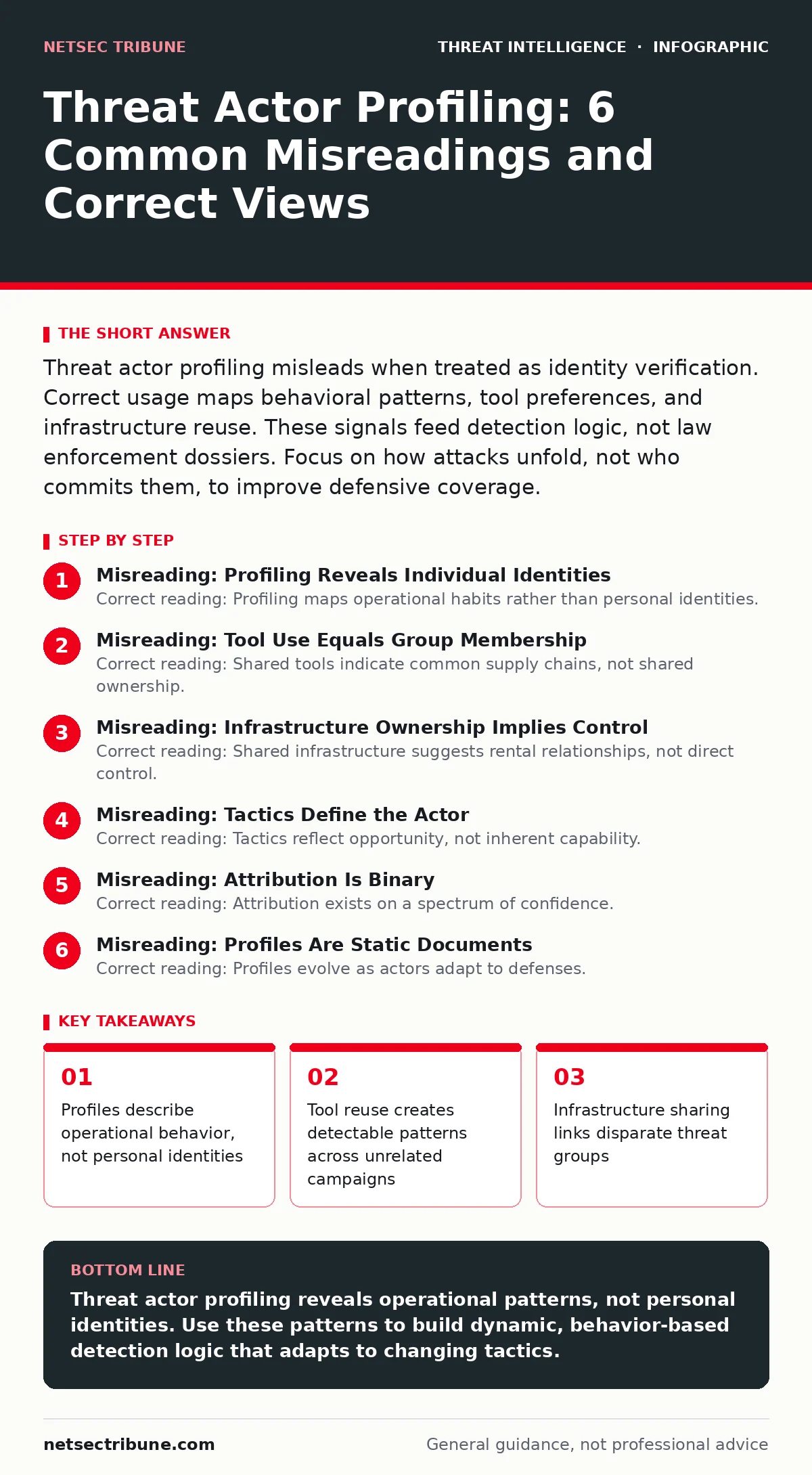
Misreading: Tool Use Equals Group Membership
Correct reading: Shared tools indicate common supply chains, not shared ownership. Many groups use the same commercial or open-source malware. This overlap creates false positives in attribution logic. A specific ransomware variant may appear in multiple campaigns. The developers of that variant are distinct from the deployers. Analysts must separate tool creation from tool usage. Tracking the software’s distribution reveals more than tracking the malware itself. This distinction prevents misdirected investigations. It also highlights the value of monitoring software repositories. Understanding supply chain dynamics matters more than naming the user.
Misreading: Infrastructure Ownership Implies Control
Correct reading: Shared infrastructure suggests rental relationships, not direct control. Threat actors often rent servers or use bulletproof hosting. These services cater to multiple unrelated groups. Seeing the same IP address in two campaigns does not link the attackers. It links them to the same service provider. Analysts must map the hosting ecosystem separately from the attacker. This separation clarifies the attack surface. It also reveals where defensive action is possible. Blocking the hosting provider affects many actors. Targeting the specific group requires deeper behavioral analysis. Infrastructure data supports context, not conclusion.
Misreading: Tactics Define the Actor
Correct reading: Tactics reflect opportunity, not inherent capability. Groups adapt their methods to the target environment. A group known for phishing may use exploit kits if email filters improve. This adaptation is rational, not contradictory. Analysts who rigidly link tactics to identity miss these shifts. They expect static behavior from dynamic opponents. Flexible detection logic accounts for tactical evolution. It monitors for deviations from baseline activity. This approach captures new methods early. It also prevents blind spots when actors change their playbook. Behavioral flexibility is a feature, not a bug.
Misreading: Attribution Is Binary
Correct reading: Attribution exists on a spectrum of confidence. Analysts often seek definitive answers in uncertain data. The reality is probabilistic. Evidence points to likely culprits, not certain ones. This uncertainty requires layered verification. Multiple independent data points strengthen the case. Single indicators remain weak evidence. Defense teams should use attribution to prioritize risk. High-confidence matches warrant immediate action. Low-confidence matches warrant monitoring. This gradation prevents overreaction to noise. It also conserves resources for high-impact threats. Probabilistic thinking improves decision quality under uncertainty.
See also: Indicators of Compromise: 6 Common Misreadings That Fail in Detection · How the MITRE ATT&CK Framework Works for Detection
Misreading: Profiles Are Static Documents
Correct reading: Profiles evolve as actors adapt to defenses. A static profile becomes obsolete quickly. Threat actors change tools, infrastructure, and tactics. They respond to detection efforts by altering their behavior. Analysts must update profiles continuously. This requires ongoing monitoring of new campaigns. It also demands integration with current threat intelligence feeds. Static documents create a false sense of security. They suggest that past knowledge covers future threats. Dynamic profiling acknowledges the moving target. It treats each new incident as data. This continuous improvement keeps defenses relevant.
Misreading: Profiling Replaces Detection Engineering
Correct reading: Profiling informs detection, it does not replace it. Analysts sometimes assume that knowing the actor solves the problem. This assumption ignores the need for technical implementation. Profiles provide context for rule creation. They highlight likely targets and methods. Detection engineers translate this context into queries. They map behaviors to logs and events. This translation step is critical. Without it, profiles remain abstract. With it, they drive actionable alerts. The synergy between intelligence and engineering creates effective defenses. One provides the why, the other the how.
Misreading: All Groups Are Nation-State Sponsored
Correct reading: Many groups operate for profit, not ideology. Analysts often overestimate state involvement. Cybercrime markets thrive on commercial incentives. These actors prioritize financial gain over political goals. Their methods differ from state-sponsored groups. They use ransomware, data theft, and fraud. They avoid high-profile targets that attract attention.
Misidentifying them as state actors wastes resources. It also leads to incorrect defensive priorities. Commercial groups care about ROI. State actors care about objectives. Distinguishing between these motives clarifies the threat. It also guides response strategy. Profit-driven actors respond to cost increases. State actors do not.
Misreading: Profiling Ignores Defensive Context
Correct reading: Profiling must account for the target environment. Analysts often view attacks in isolation. This ignores how defenses shape attacker behavior. A group may simplify its attack if defenses are weak. It may complicate it if defenses are strong. This adaptation affects the observable indicators. Profiles that ignore this context miss key signals. They fail to explain why certain tactics appear. Integrating defensive context improves accuracy. It also highlights areas of weakness. Attackers exploit gaps in coverage. Profiling should identify these gaps. This feedback loop strengthens overall security. It turns intelligence into improvement.
Misreading: Single Indicators Suffice for Attribution
Correct reading: Attribution requires multiple corroborating indicators. Analysts sometimes rely on a single IOCs for identification. This approach is fragile. Indicators can be spoofed or reused. A single IP address or domain offers weak evidence. Combining multiple indicators strengthens the case. Code similarity, infrastructure reuse, and timing all matter.
This triangulation reduces false positives. It also increases confidence in the profile. Defense teams should build detection logic around clusters. Single-indicator alerts generate noise. Cluster-based alerts provide context. This shift improves signal-to-noise ratio. It also reduces analyst fatigue. Correlation is key to accuracy.
Misreading: Profiling Is Only for Offense
Correct reading: Profiling enhances defensive operations significantly. Analysts often view profiling as an offensive tool. This view limits its utility. Defense teams use profiles to tune detection. They prioritize alerts based on likelihood. They allocate resources to high-risk areas. This proactive use improves efficiency. It also reduces response times. Profiling helps anticipate next steps. It guides hunting efforts. It informs patching priorities. The defensive application of profiling is vast. It transforms raw data into strategy. This shift from reactive to proactive is vital. It turns intelligence into resilience.
Key takeaways
- Profiles describe operational behavior, not personal identities
- Tool reuse creates detectable patterns across unrelated campaigns
- Infrastructure sharing links disparate threat groups
- Misunderstandings waste resources on unactionable attribution
Threat actor profiling reveals operational patterns, not personal identities. Use these patterns to build dynamic, behavior-based detection logic that adapts to changing tactics.
Frequently asked questions
How do I know if a threat actor profile is accurate?
Verify accuracy by cross-referencing multiple independent data sources. Look for consistent behavioral patterns across different campaigns. High-confidence profiles rely on corroborating evidence, not single indicators.
Can profiling help with incident response?
Yes, profiling speeds up response by providing context. It helps analysts understand the attacker’s goals and methods. This knowledge guides containment and remediation efforts effectively.
What is the role of IOC enrichment in profiling?
IOC enrichment adds context to raw indicators. It links IPs, domains, and hashes to known campaigns. This process strengthens attribution and improves detection logic.
How often should I update threat actor profiles?
Update profiles continuously as new data emerges. Threat actors adapt quickly to defenses. Regular updates ensure that detection logic remains relevant and effective.
How this guide was produced: written by the NetSec Tribune editorial team with AI assistance, checked against the public references listed below, and reviewed when the facts change. See our editorial policy or report an error.