
Hybrid Warfare in Cyberspace: Correcting 6 Common Intelligence Errors
Hybrid warfare blends technical intrusions with narrative manipulation, requiring analysts to track information flow rather than just network traffic to identify true intent.
Hybrid warfare is not a single attack vector but a synchronized campaign of technical intrusion, psychological operations, and economic pressure. Analysts often fail because they isolate network events from the broader narrative context. You must correlate indicator of compromise data with public messaging to see the full operational picture and attribute strategic goals accurately.
Misreading: Hybrid warfare is primarily a technical cyber attack
Correct reading: Hybrid warfare uses technical intrusions as one component of a broader strategy that includes psychological operations, economic pressure, and political influence. The digital breach is rarely the end goal. It serves to generate data for disinformation, disrupt critical infrastructure to create chaos, or validate a narrative of weakness in the target nation. You must view network intrusions as tools for narrative shaping rather than standalone events. Focusing only on the exploit misses the strategic intent behind the timing and target selection.
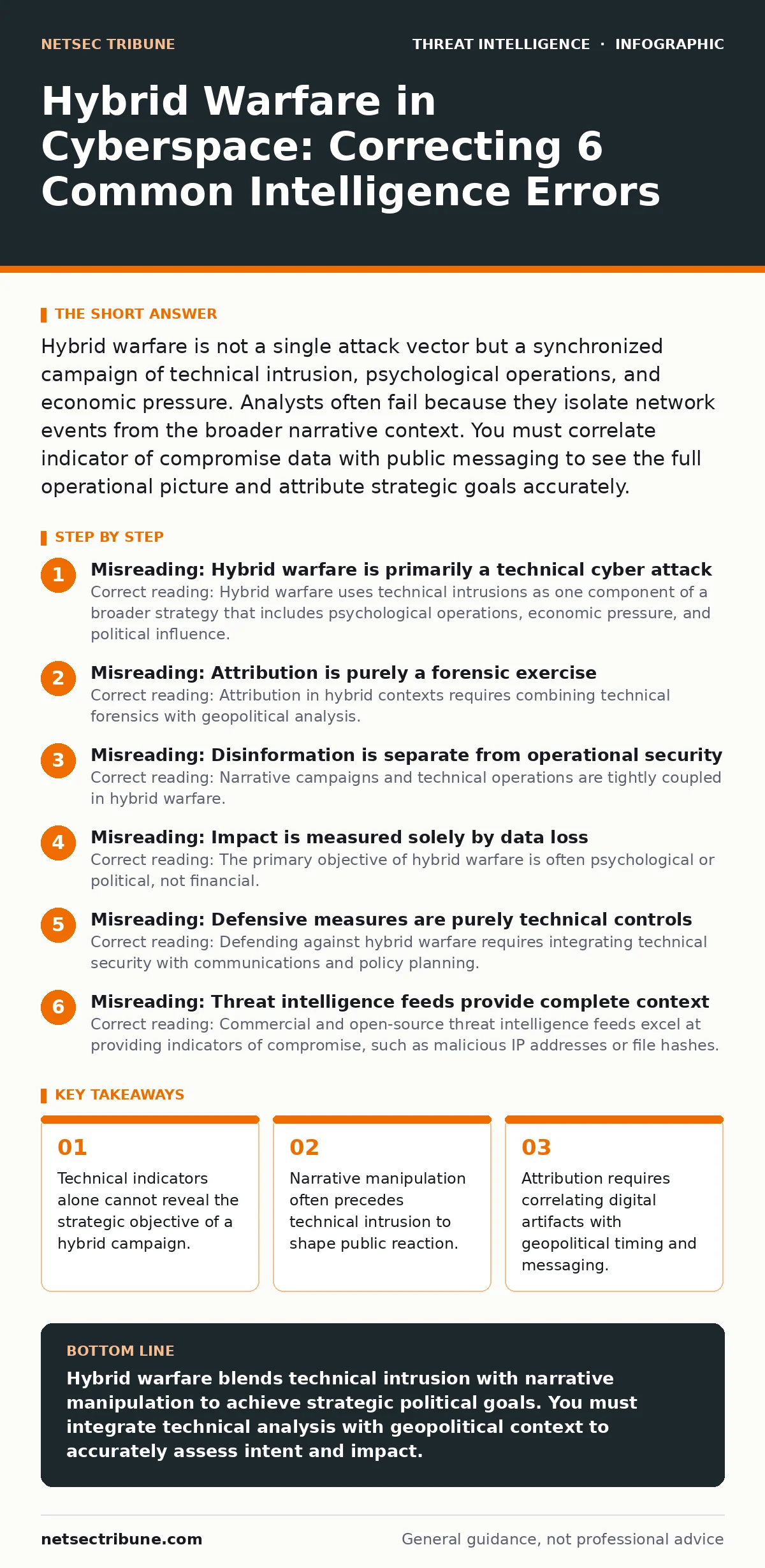
Misreading: Attribution is purely a forensic exercise
Correct reading: Attribution in hybrid contexts requires combining technical forensics with geopolitical analysis. Code reuse and infrastructure overlap provide strong hints, but they do not prove state sponsorship definitively. Adversaries often use proxy groups or compromised infrastructure to create plausible deniability. You must analyze the timing of the attack relative to political events, diplomatic tensions, or military maneuvers. The motivation behind the attack often reveals the actor more clearly than the code itself. Technical evidence supports the hypothesis, but context confirms it.
Misreading: Disinformation is separate from operational security
Correct reading: Narrative campaigns and technical operations are tightly coupled in hybrid warfare. Disinformation prepares the ground for technical attacks by lowering trust in official channels or creating confusion during an incident. Conversely, a successful cyber intrusion provides exclusive content for disinformation campaigns. You cannot analyze one without the other. If you see a surge in false narratives about grid instability, you must assume technical probing of energy systems is occurring or imminent. The information environment is a battlefield that supports and amplifies digital intrusions.
Misreading: Impact is measured solely by data loss
Correct reading: The primary objective of hybrid warfare is often psychological or political, not financial. Stealing sensitive data is valuable, but the greater damage comes from eroding public trust, destabilizing institutions, or forcing policy changes. A small technical breach that fuels a large political crisis achieves more strategic value than a massive data exfiltration that remains unnoticed. You must measure impact by the change in public sentiment or policy response, not just by the volume of data accessed. The success metric is influence, not just intrusion.
Misreading: Defensive measures are purely technical controls
Correct reading: Defending against hybrid warfare requires integrating technical security with communications and policy planning. Firewalls and endpoint detection prevent intrusion, but they do not mitigate the impact of a coordinated narrative attack. You need pre-planned communication strategies to address potential disinformation before it spreads. Incident response plans must include public relations and legal teams, not just IT staff. Technical resilience buys time, but narrative resilience prevents the attack from achieving its strategic goal of societal disruption.
See also: Indicators of Compromise: 6 Common Misreadings That Fail in Detection · How the MITRE ATT&CK Framework Works for Detection
Misreading: Threat intelligence feeds provide complete context
Correct reading: Commercial and open-source threat intelligence feeds excel at providing indicators of compromise, such as malicious IP addresses or file hashes. They rarely capture the strategic context or the narrative component of hybrid campaigns. You must enrich these indicators with your own analysis of current events and geopolitical trends. Relying solely on automated feeds leaves you blind to the "why" and "when" of an attack. Manual analysis is required to connect technical indicators to broader strategic objectives. The feed gives you the pieces; you must build the puzzle.
Misreading: Proxy actors are independent from state objectives
Correct reading: Proxy groups often operate with significant autonomy, but their activities align with state strategic goals. They may use different tactics, techniques, and procedures than direct state actors, making attribution harder. However, their targets and timing usually reflect state priorities. You should monitor proxy activity as a leading indicator of state intent. Even if the state denies involvement, the pattern of attacks reveals the strategic direction. Treat proxy actions as extensions of state policy, not as random criminal activity.
Misreading: Resilience is about preventing all attacks
Correct reading: Complete prevention is impossible in a hybrid environment. The goal is resilience: the ability to absorb, adapt, and recover from attacks while maintaining core functions. This requires redundancy in critical systems and clear protocols for operating under degraded conditions. You must plan for scenarios where technical controls fail and narrative attacks succeed. Resilience includes the ability to maintain public trust and operational continuity despite ongoing pressure. Accept that some intrusion will occur and focus on limiting strategic impact.
Key takeaways
- Technical indicators alone cannot reveal the strategic objective of a hybrid campaign.
- Narrative manipulation often precedes technical intrusion to shape public reaction.
- Attribution requires correlating digital artifacts with geopolitical timing and messaging.
Hybrid warfare blends technical intrusion with narrative manipulation to achieve strategic political goals. You must integrate technical analysis with geopolitical context to accurately assess intent and impact.
Frequently asked questions
How do I distinguish hybrid warfare from traditional cybercrime?
Cybercrime is motivated by financial gain and typically avoids publicity. Hybrid warfare aims for political or strategic influence, often using publicity and narrative manipulation to amplify the impact of technical intrusions.
Can small organizations contribute to hybrid warfare defense?
Yes, by reporting indicators of compromise and sharing threat intelligence. Small organizations often provide early warning signs of broader campaigns. Their data helps build a more complete picture of adversary activity.
What role does the MITRE ATT&CK framework play in hybrid analysis?
It provides a standardized language for describing adversary tactics and techniques. This helps correlate technical activities across different incidents and identify patterns that suggest coordinated hybrid campaigns.
How do I validate threat intelligence about hybrid campaigns?
Correlate technical indicators with open-source intelligence on political events and narrative trends. Look for alignment between technical activity and strategic objectives. Independent verification from multiple sources increases confidence.
How this guide was produced: written by the NetSec Tribune editorial team with AI assistance, checked against the public references listed below, and reviewed when the facts change. See our editorial policy or report an error.