
How the MITRE ATT&CK Framework Works for Detection
The framework maps adversary behavior to specific techniques, allowing you to build detection logic that survives tool changes and obfuscation efforts.
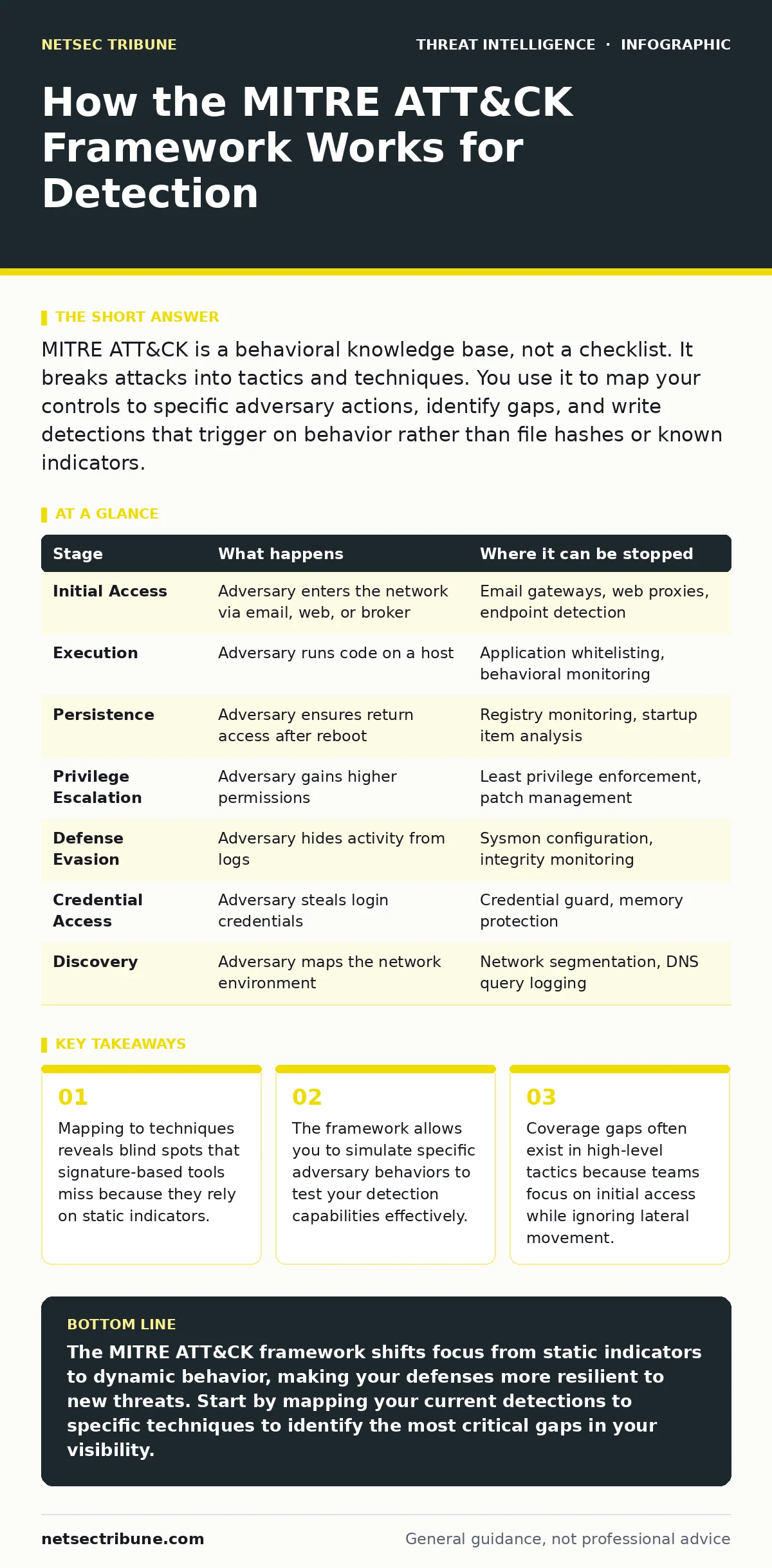
MITRE ATT&CK is a behavioral knowledge base, not a checklist. It breaks attacks into tactics and techniques. You use it to map your controls to specific adversary actions, identify gaps, and write detections that trigger on behavior rather than file hashes or known indicators.
Understanding the Behavioral Model
Most security tools rely on indicators of compromise. These are static artifacts like file hashes, IP addresses, or domain names. Adversaries change these artifacts with every campaign. The MITRE ATT&CK framework takes a different approach. It catalogs what adversaries do, not who they are or what tools they use.
This distinction matters for long-term resilience. If you detect a specific malware variant, you are safe until the next variant appears. If you detect the behavior of process injection, you catch any tool that uses that method. The framework organizes these behaviors into a matrix. This structure helps you see the full path an attacker might take through your environment.
The Core Components
The framework consists of three main layers. Tactics represent the why. They are the tactical goals an adversary wants to achieve, such as stealing data or maintaining access. Techniques represent the how. They are the specific methods used to achieve those tactics. Sub-techniques break down complex techniques into smaller, more granular actions.
Procedures are optional descriptions of how specific groups implement a technique. You generally ignore procedures when building broad detections. They are too specific. Techniques are the correct level of granularity for most defensive work. They are specific enough to be actionable but general enough to remain relevant across different threat actors.
Mapping Your Defenses
You cannot protect what you cannot see. The first practical step is to map your existing controls to the framework. This is not a passive exercise. It requires you to verify that your tools actually detect the behavior. Many organizations assume they have coverage because they bought a product that claims to support the framework.
Verification requires evidence. You must prove that your system generates an alert when a specific technique occurs. If you cannot demonstrate detection, you have a gap. This process often reveals that you have strong visibility into initial access but weak visibility into lateral movement. Adversaries frequently exploit these blind spots once they are inside the network.
| Stage | What happens | Where it can be stopped |
|---|---|---|
| Initial Access | Adversary enters the network via email, web, or broker | Email gateways, web proxies, endpoint detection |
| Execution | Adversary runs code on a host | Application whitelisting, behavioral monitoring |
| Persistence | Adversary ensures return access after reboot | Registry monitoring, startup item analysis |
| Privilege Escalation | Adversary gains higher permissions | Least privilege enforcement, patch management |
| Defense Evasion | Adversary hides activity from logs | Sysmon configuration, integrity monitoring |
| Credential Access | Adversary steals login credentials | Credential guard, memory protection |
| Discovery | Adversary maps the network environment | Network segmentation, DNS query logging |
| Lateral Movement | Adversary moves between hosts | Network segmentation, lateral movement detection |
| Collection | Adversary gathers target data | Data loss prevention, file integrity monitoring |
| Exfiltration | Adversary steals data out of the network | Egress filtering, anomaly detection |
Applying the Framework to Detections
Writing effective detections requires translating technique IDs into observable events. A technique ID is a unique identifier like T1053.003. This ID refers to a specific method of scheduled task creation. You do not look for a specific file name. You look for the system call that creates a scheduled task.
This approach reduces false positives over time. Signature-based alerts degrade as attackers modify their tools. Behavioral alerts remain valid as long as the underlying operating system mechanism remains the same. You must tune these alerts carefully. Legitimate administrative activity often mimics adversary behavior. The key is context. Is the scheduled task created by a known service account? Is it running during business hours?
Identifying Coverage Gaps
Once you map your detections, look for empty cells in the matrix. These are techniques you do not monitor. Prioritize gaps based on risk. Not all techniques are equally likely or damaging. Focus on the paths that lead to data exfiltration or ransomware deployment.
You will often find that high-level tactics have fewer detections than low-level ones. This is because initial access is easier to detect than lateral movement. Adversaries know this. They invest heavily in tools that help them move silently between hosts. Your detection strategy must match their investment. If you only watch the front door, you will miss the intruder walking through the back window.
See also: Fix IOC Enrichment Errors: 6 Common Misunderstandings · Hybrid Warfare in Cyberspace: Correcting 6 Common Intelligence Errors
Validating with Simulation
Mapping and writing detections is theoretical until you test them. You need to simulate the behavior to confirm your alerts fire. This is where purple teaming becomes valuable. It involves collaborating with offensive security teams to test specific techniques.
Do not simulate every technique. That is inefficient and disruptive. Select a few critical paths. For instance, simulate how an adversary might use pass-the-hash attacks to move laterally. Verify that your network logs capture the authentication attempts. If they do not, your detection is useless. Fix the logging configuration before fixing the alert.
The Hidden Cost of Coverage
This is impossible and economically irrational. Some techniques require invasive monitoring that degrades system performance. Others generate so much noise that analysts ignore the alerts.
Focus on the techniques that matter most to your organization. If you do not store credit card data, card skimming techniques are low priority. If you rely heavily on cloud infrastructure, cloud-specific techniques are high priority. Tailor your coverage to your assets. This focused approach yields better results than a broad, shallow strategy.
Integrating with Intelligence
The framework is a language. It allows you to consume threat intelligence feeds that reference ATT&CK IDs. Instead of reading vague reports about "advanced persistent threats," you receive specific technique IDs. This tells you exactly what to look for.
You can also use the framework to understand strategic threat intelligence. High-level reports often describe adversary intent. The framework translates that intent into technical actions. This bridge between strategy and operation is where the framework provides its greatest value. It aligns the boardroom's concerns with the SOC analyst's daily work.
Key takeaways
- Mapping to techniques reveals blind spots that signature-based tools miss because they rely on static indicators.
- The framework allows you to simulate specific adversary behaviors to test your detection capabilities effectively.
- Coverage gaps often exist in high-level tactics because teams focus on initial access while ignoring lateral movement.
The MITRE ATT&CK framework shifts focus from static indicators to dynamic behavior, making your defenses more resilient to new threats. Start by mapping your current detections to specific techniques to identify the most critical gaps in your visibility.
Frequently asked questions
Does the framework tell me how to stop an attack?
No, the framework describes what adversaries do. It does not provide mitigation steps, though it links to external resources that offer defensive guidance.
How often is the framework updated?
The framework is updated regularly as new techniques are discovered. You should review updates periodically to ensure your detections cover new behaviors.
Can I use the framework for cloud environments?
Yes, the framework includes matrices for cloud platforms like AWS, Azure, and GCP. These matrices cover tactics and techniques specific to cloud infrastructure.
Is the framework free to use?
Yes, the framework is an open standard available for free. Many commercial products integrate with it, but the knowledge base itself is public.
How this guide was produced: written by the NetSec Tribune editorial team with AI assistance, checked against the public references listed below, and reviewed when the facts change. See our editorial policy or report an error.