
Kubernetes Admission Controllers: How They Enforce Policy at Scale
Admission controllers act as a gatekeeper that validates and mutates requests before objects are persisted to the cluster storage layer, preventing misconfigurations from ever becoming reality.
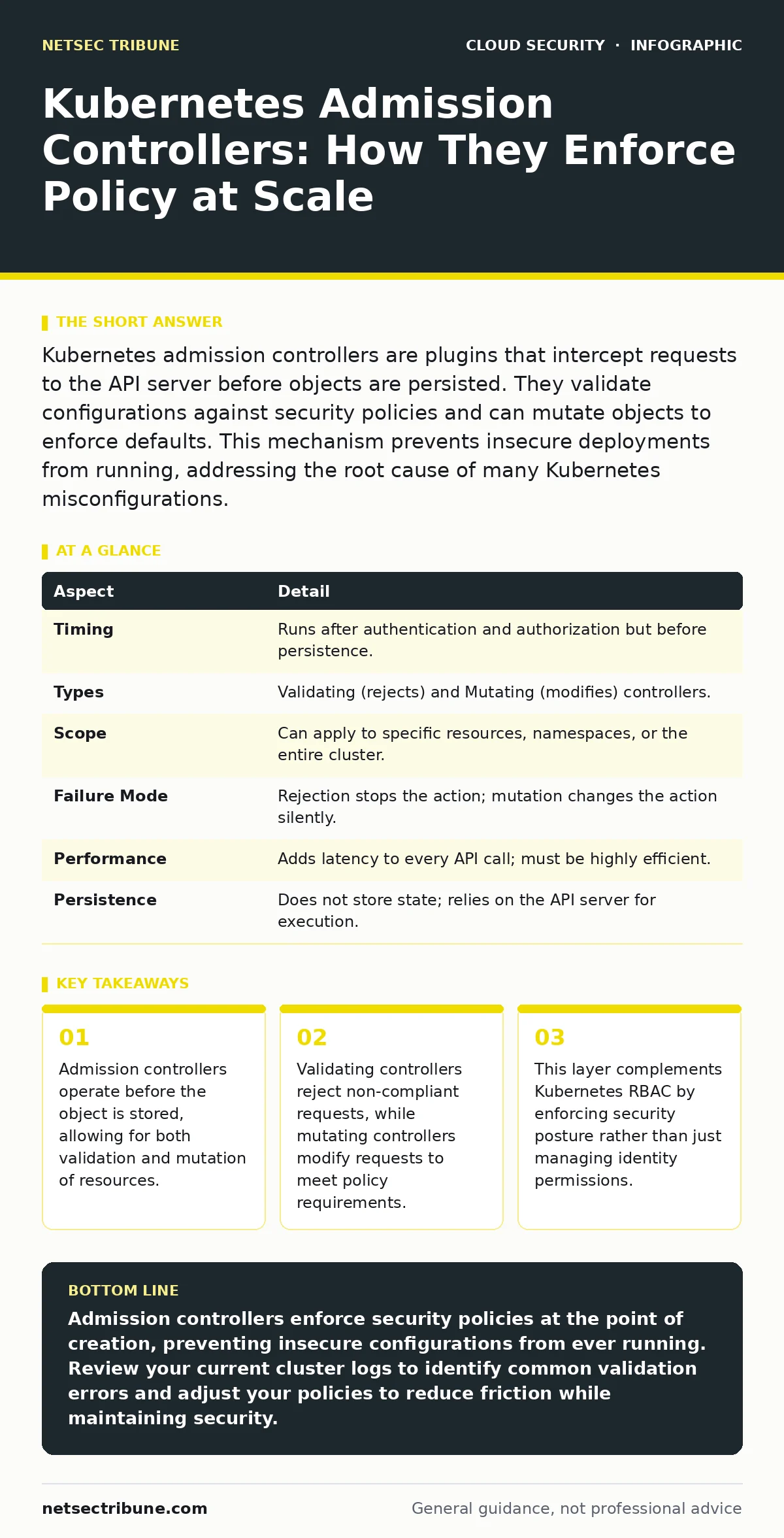
Kubernetes admission controllers are plugins that intercept requests to the API server before objects are persisted. They validate configurations against security policies and can mutate objects to enforce defaults. This mechanism prevents insecure deployments from running, addressing the root cause of many Kubernetes misconfigurations.
The Gatekeeper Analogy
Imagine an airport security checkpoint. You have a boarding pass, which proves you are allowed to be on the plane. This is similar to authentication. You have a ticket for a specific seat, which is similar to authorization. However, before you board, an agent checks your carry-on luggage. They ensure you are not bringing prohibited items. They might also tag your bag with a tracking label if you forgot to check in online. This inspection and modification process is what an admission controller does for a Kubernetes cluster. It sits between the request and the final state of the system.
What the Problem Is
Kubernetes is designed to be flexible. It allows users to define almost any configuration for containers. This flexibility is a double-edged sword. A user might accidentally deploy a container with root privileges or expose a database port to the public internet. If the cluster accepts this request, the insecure state becomes the new truth. Fixing it later requires deleting and recreating the resource, which causes downtime. The problem is not just that bad things happen, but that the default state often permits them. Admission controllers solve this by intercepting the request before the cluster accepts it as valid.
How Admission Controllers Work
An admission controller is a piece of code that runs within the Kubernetes API server. When a user sends a request to create, update, or delete a resource, the API server pauses before persisting the change. It sends the request to the admission controllers. These controllers examine the request. They can either reject the request or modify it. If the request passes all checks, the API server saves the object to etcd, the distributed key-value store that backs the cluster. If any controller rejects it, the user receives an error message and the object is never created.
| Aspect | Detail |
|---|---|
| Timing | Runs after authentication and authorization but before persistence. |
| Types | Validating (rejects) and Mutating (modifies) controllers. |
| Scope | Can apply to specific resources, namespaces, or the entire cluster. |
| Failure Mode | Rejection stops the action; mutation changes the action silently. |
| Performance | Adds latency to every API call; must be highly efficient. |
| Persistence | Does not store state; relies on the API server for execution. |
Validating Versus Mutating
There are two distinct types of admission controllers. Validating admission controllers check the request against a set of rules. If the request violates a rule, the controller returns an error. This is useful for enforcing strict security policies, such as blocking privileged containers. Mutating admission controllers, on the other hand, change the request. They can add labels, set default resource limits, or inject sidecar containers. This is useful for enforcing consistency without requiring the user to specify every detail. You often need both. Validation ensures security, while mutation ensures operational consistency.
Integration With Other Defenses
Admission controllers do not work in isolation. They sit behind authentication and Kubernetes RBAC. RBAC determines if a user has permission to create a resource. Admission controllers determine if the resource itself is safe. Think of RBAC as the bouncer checking your ID, and admission controllers as the security guard checking your bag. You can have the right ID but still be turned away for carrying prohibited items. This layer also works with container runtime security. Admission controllers prevent bad configurations from starting, while runtime security detects malicious behavior after the container is running. They address different phases of the attack lifecycle.
See also: Serverless Security Myths: Why Code Is Not Enough · Difference Between Cloud Logging and Monitoring: Operational Reality
Common Misconceptions
Many teams believe that admission controllers replace the need for secure coding practices. This is incorrect. Admission controllers enforce policy, but they cannot fix a vulnerable application. If an application has a buffer overflow, no admission controller can prevent an exploit from running inside the container. Another common mistake is overloading the API server with complex logic. Admission controllers run synchronously. If a controller takes too long to process a request, the entire cluster slows down. Users experience lag when deploying applications. Keep admission controller logic simple and fast. Offload heavy data processing to external services if necessary.
Operational Risks
Implementing admission controllers introduces a new point of failure. If the admission controller logic is buggy, it can block legitimate operations. This can halt deployments or break critical services. You must test admission controllers in a staging environment before applying them to production. Another risk is the complexity of debugging. When a request is rejected, the error message must be clear. If the message is vague, users will struggle to understand what changed. Poorly designed policies lead to frustration and workaround behaviors. Users might bypass the policy by using lower-level APIs or by disabling the controller temporarily. This defeats the purpose of the control.
Designing Effective Policies
Effective policies are specific and actionable. Avoid broad rules that block too much. If you block all privileged containers, you might break system components that require root access. Instead, allow privileged containers only in specific namespaces, such as the system namespace. Use labels to tag resources that are exempt from certain rules. This provides flexibility without compromising security. Regularly review your admission controller logs. Look for patterns in rejected requests. These logs reveal where your policies are too strict or where users are struggling to comply. Adjust the policies based on this feedback.
The Role in Zero Trust
A zero trust network access model assumes no entity is trusted by default. Admission controllers support this by verifying every request, regardless of its source. Even internal services must comply with the defined policies. This prevents lateral movement. If an attacker compromises a service account, they cannot deploy a malicious container that violates the admission policy. This limits the blast radius of a compromise. It forces the attacker to work within the constraints of the allowed configurations. This makes exploitation harder and detection easier.
Key takeaways
- Admission controllers operate before the object is stored, allowing for both validation and mutation of resources.
- Validating controllers reject non-compliant requests, while mutating controllers modify requests to meet policy requirements.
- This layer complements Kubernetes RBAC by enforcing security posture rather than just managing identity permissions.
- Poorly written controllers can introduce significant latency to the API server, impacting cluster performance.
Admission controllers enforce security policies at the point of creation, preventing insecure configurations from ever running. Review your current cluster logs to identify common validation errors and adjust your policies to reduce friction while maintaining security.
Frequently asked questions
Can admission controllers encrypt data at rest?
No, admission controllers validate and mutate requests. Encryption at rest is handled by the storage backend and the Kubernetes encryption configuration, not by admission logic.
Do admission controllers slow down the cluster?
Yes, they add latency to every API call. Complex logic or external dependencies can significantly impact performance. Keep controller logic simple and efficient to minimize this overhead.
How do I debug a rejected request?
Check the API server logs and the admission controller logs. The error message should indicate which rule was violated. If the message is unclear, review the controller code to improve error reporting.
Are admission controllers part of Kubernetes RBAC?
No, they are separate mechanisms. RBAC handles identity and permissions, while admission controllers handle the content and configuration of the resources being requested.
How this guide was produced: written by the NetSec Tribune editorial team with AI assistance, checked against the public references listed below, and reviewed when the facts change. See our editorial policy or report an error.