
Zero Trust Network Access Mistakes and How to Avoid Them
Misconfigured policies often grant more access than intended, turning zero trust into a complex permission system that fails during incident response.
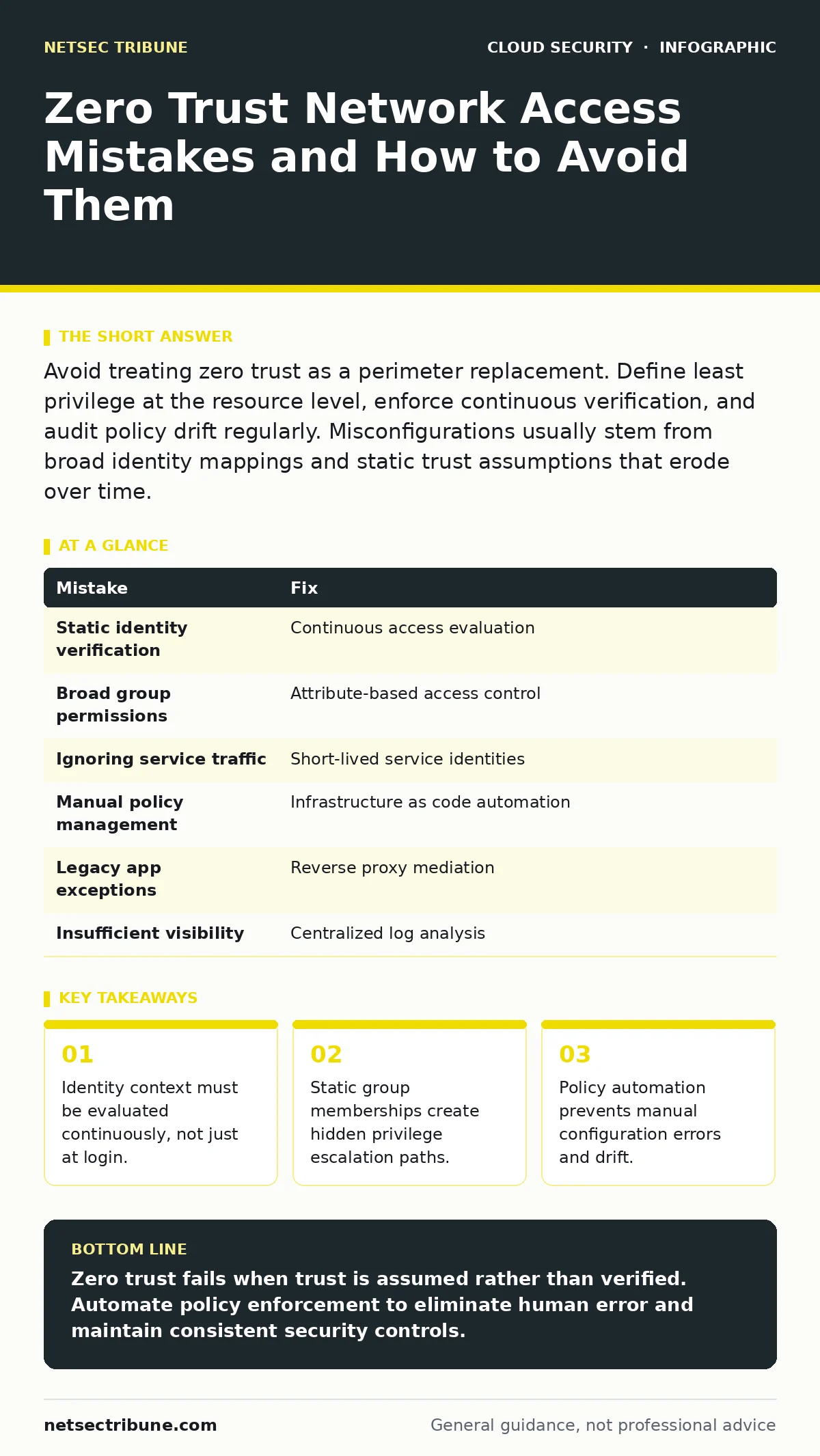
Avoid treating zero trust as a perimeter replacement. Define least privilege at the resource level, enforce continuous verification, and audit policy drift regularly. Misconfigurations usually stem from broad identity mappings and static trust assumptions that erode over time.
Mistake 1: Treating Identity as a Static Credential
Organizations often assume that once a user authenticates, their identity remains constant for the session duration. This approach ignores the dynamic nature of risk. A user may move to an untrusted network, change devices, or exhibit anomalous behavior after the initial login. Static authentication fails to capture these shifts.
Why it hurts:
Threat actors who compromise credentials maintain access until the session expires. The system cannot react to environmental changes or behavioral anomalies. This creates a window of opportunity for lateral movement. The zero trust model collapses into a traditional perimeter defense.
The fix:
Implement continuous access evaluation. Reassess trust signals at each request or at short intervals. Evaluate device health, location, and user behavior in real time. Integrate these signals into your policy engine to allow, deny, or challenge access dynamically. This ensures that trust is never assumed, only verified.
Mistake 2: Relying on Broad Group Permissions
Administrators frequently assign access based on broad organizational units or departments. This simplifies initial configuration but violates the principle of least privilege. A user in the "Finance" group may receive access to resources they never need. Over time, these groups accumulate excessive permissions.
Why it hurts:
Privilege creep occurs naturally as roles change. Users retain old permissions while gaining new ones. This expands the attack surface significantly. If one account is compromised, the attacker inherits all associated group privileges. Remediation becomes difficult because permissions are tangled in large groups.
The fix:
Move to attribute-based access control. Define policies based on specific attributes like job role, project assignment, and data sensitivity. Avoid nested groups that obscure the actual permission set. Regularly audit group memberships to ensure they align with current responsibilities. This granular approach limits the blast radius of any single compromise.
Mistake 3: Ignoring Service-to-Service Traffic
Many implementations focus heavily on user access while neglecting machine identities. Services and applications require access to databases, APIs, and storage. These interactions are often secured with static keys or certificates that are rarely rotated. This blind spot undermines the entire zero trust architecture.
Why it hurts:
Compromised service accounts provide direct access to critical data. Attackers often target these identities because they lack the monitoring applied to human users. Static credentials persist even after the service is decommissioned or the threat is detected. This creates persistent backdoors within your infrastructure.
The fix:
Implement strict service identity management. Use short-lived certificates or tokens for service communication. Enforce mutual TLS between services to verify both parties. Integrate with a service mesh to manage these identities at scale. Monitor service traffic for anomalies just as you would user traffic. This closes the gap in your security posture.
Mistake 4: Manual Policy Management
Teams often write and update access policies manually. This process is error-prone and slow. As the number of resources and users grows, manual management becomes unscalable. Inconsistencies arise between different teams and environments. Policies become outdated quickly.
Why it hurts:
Configuration drift leads to security gaps. Policies may conflict or overlap, causing unexpected access denials or grants. Incident response is delayed because identifying the root cause of a policy error takes time. The lack of version control makes it difficult to audit changes or roll back mistakes.
The fix:
Automate policy management using infrastructure as code. Define policies in version-controlled repositories. Use automated pipelines to deploy and validate policies. This ensures consistency across environments and provides an audit trail. Automated testing can catch conflicts before they reach production. This approach reduces human error and improves agility.
Mistake 5: Overlooking Legacy Application Compatibility
Legacy applications often rely on legacy authentication methods. They may not support modern protocols like OAuth or SAML. Forcing these applications into a zero trust model can break functionality. Teams often create exceptions to keep these systems running.
Why it hurts:
Exceptions bypass the zero trust controls. These legacy systems become weak links in the security chain. Attackers target them knowing they lack modern protections. The cost of securing these applications is often underestimated, leading to deferred remediation.
The fix:
Deploy a reverse proxy or gateway to mediate access to legacy applications. This layer can enforce modern authentication and authorization without modifying the application. It translates modern protocols into legacy formats. This allows you to extend zero trust controls to older systems. Plan for eventual modernization or retirement of these applications.
See also: CIS Benchmarks Explained: How to Build a Secure Baseline · Cloud Penetration Testing: Seven Practices for Realistic Assessment
Mistake 6: Insufficient Visibility and Logging
Zero trust generates significant amounts of telemetry data. Without proper logging and monitoring, this data is useless. Teams often collect logs but lack the tools to analyze them effectively. Alerts are noisy, and true threats are buried in the noise.
Why it hurts:
You cannot detect anomalies if you do not have a baseline. Incident response is hampered by incomplete data. Forensic investigations fail due to missing context. The investment in zero trust technology yields little value if you cannot see what is happening.
The fix:
Centralize log collection from all zero trust components. Normalize data formats for easier analysis. Implement automated correlation rules to reduce noise. Focus on key indicators of compromise. Regularly tune your monitoring to reflect current business operations. This ensures you can detect and respond to threats quickly.
| Mistake | Fix |
|---|---|
| Static identity verification | Continuous access evaluation |
| Broad group permissions | Attribute-based access control |
| Ignoring service traffic | Short-lived service identities |
| Manual policy management | Infrastructure as code automation |
| Legacy app exceptions | Reverse proxy mediation |
| Insufficient visibility | Centralized log analysis |
Key takeaways
- Identity context must be evaluated continuously, not just at login.
- Static group memberships create hidden privilege escalation paths.
- Policy automation prevents manual configuration errors and drift.
Zero trust fails when trust is assumed rather than verified. Automate policy enforcement to eliminate human error and maintain consistent security controls.
Frequently asked questions
Does zero trust replace a firewall?
No, zero trust complements firewalls by adding identity and context to access decisions. Firewalls still provide network segmentation and perimeter defense.
How do I handle privileged access in zero trust?
Use just-in-time access for privileged accounts. Grant elevated rights only when needed and for a limited duration. Log all privileged actions for audit.
Is zero trust expensive to implement?
Costs vary based on existing infrastructure. Automation and cloud-native tools can reduce long-term operational costs. Focus on high-value assets first.
Can I implement zero trust in a hybrid environment?
Yes, zero trust principles apply to on-premises and cloud resources. Use consistent identity providers and policy engines across both environments.
How this guide was produced: written by the NetSec Tribune editorial team with AI assistance, checked against the public references listed below, and reviewed when the facts change. See our editorial policy or report an error.