
Access Key Rotation: Real Security Gains vs Operational Drag
Rotating access keys reduces the window of compromise but often fails to stop attacks that exploit permissions or configuration errors rather than stolen credentials.
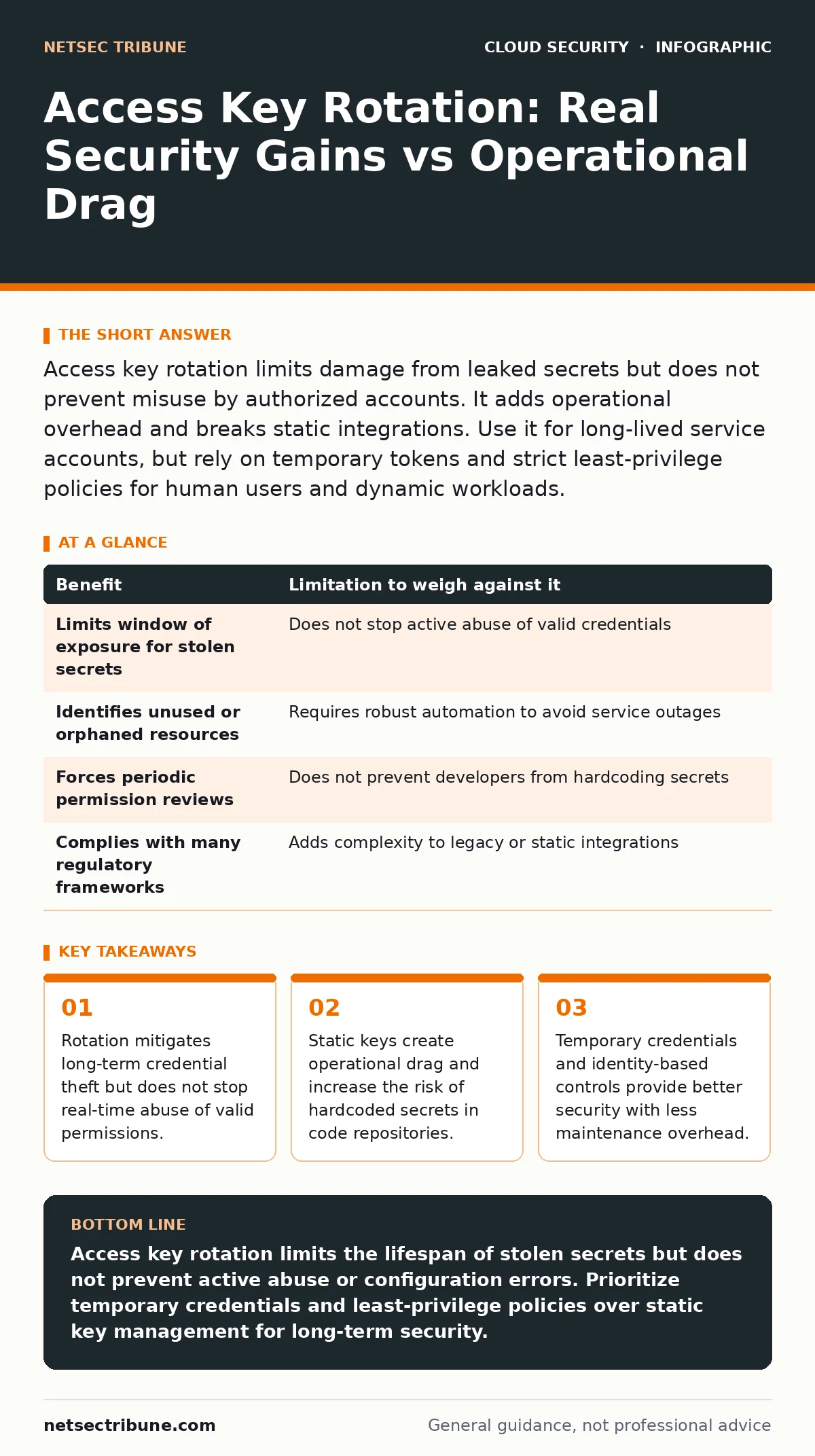
Access key rotation limits damage from leaked secrets but does not prevent misuse by authorized accounts. It adds operational overhead and breaks static integrations. Use it for long-lived service accounts, but rely on temporary tokens and strict least-privilege policies for human users and dynamic workloads.
The Mechanism of Credential Expiry
Access key rotation is the process of generating new authentication secrets and retiring old ones within a defined timeframe. In cloud environments, these keys act as the digital equivalent of a physical keycard, granting access to resources based on attached permission policies. The core assumption behind rotation is that a compromised secret has a limited lifespan before it becomes useless.
This mechanism works only if the old key is immediately invalidated. If the system allows a grace period where both keys function, an attacker who steals the old key can continue operations until the window closes. You must ensure your identity provider enforces hard deactivation of the previous key the moment the new one is generated.
Concrete Benefits of Regular Rotation
The primary benefit of rotation is damage containment. If an attacker exfiltrates a long-lived access key, they can operate silently for months or years. Rotation shrinks this window, forcing the attacker to steal a new key before the old one expires. This increases the difficulty of maintaining persistent access.
Rotation also surfaces unused credentials. When you attempt to rotate a key used by a forgotten script or an abandoned service, the system breaks. This failure acts as a detector for orphaned cloud resources. You discover these hidden dependencies before an attacker does, allowing you to decommission them safely.
It encourages a review of permissions. Each rotation cycle offers a natural checkpoint to verify that the key still needs its current level of access. You can downgrade privileges or remove the key entirely if the associated workload no longer exists.
Honest Limitations and Hidden Costs
Rotation does not stop an attacker who is actively using the key. If a malicious actor has the current valid key, they can execute commands, exfiltrate data, or deploy malware regardless of your rotation policy. The key is valid until it is revoked, not until the rotation timer hits zero.
The operational cost of rotation is often underestimated. You must update configuration files, environment variables, and application code every time a key changes. This creates a dependency on your deployment pipeline. If your CI/CD system fails during a rotation, your services go offline.
Static keys are prone to being hardcoded in source code. Developers often embed keys in scripts for quick testing, forgetting to remove them later. Rotation policies do not prevent this behavior. They simply ensure that the hardcoded key eventually stops working, which may break production systems unexpectedly.
| Benefit | Limitation to weigh against it |
|---|---|
| Limits window of exposure for stolen secrets | Does not stop active abuse of valid credentials |
| Identifies unused or orphaned resources | Requires robust automation to avoid service outages |
| Forces periodic permission reviews | Does not prevent developers from hardcoding secrets |
| Complies with many regulatory frameworks | Adds complexity to legacy or static integrations |
When It Is Worth It
You should enforce strict rotation for long-lived service accounts that cannot use temporary credentials. These are often legacy applications or third-party integrations that require static keys for authentication. In these cases, the risk of a leaked secret persisting indefinitely outweighs the operational friction of updating configurations.
Rotation is also valuable for administrative accounts with broad permissions. These keys are high-value targets for attackers. Limiting their lifespan reduces the impact of a successful phishing attack or credential stuffing attempt. You should pair this with multi-factor authentication and strict logging to detect misuse.
For environments with poor visibility into resource usage, rotation acts as a discovery tool. The process of updating keys forces you to map out which services depend on which credentials. This mapping is critical for maintaining a clean cloud attack surface and understanding your dependencies.
When It Is Not Worth It
Do not use static key rotation for human users. People should log in with identity providers that support multi-factor authentication and session management. Rotating API keys for individuals is cumbersome and encourages insecure workarounds, such as sharing keys or writing them down. Use zero trust network access principles to manage human access instead.
Avoid rotation for workloads that can use temporary credentials. Modern cloud platforms allow you to assume roles or generate short-lived tokens. These tokens expire automatically and do not require manual rotation. They are more secure because they are tied to the specific session or task, reducing the blast radius of a compromise.
See also: CIS Benchmarks Explained: How to Build a Secure Baseline · Cloud Penetration Testing: Seven Practices for Realistic Assessment
The Superior Alternative: Temporary Credentials
The most effective way to manage access in cloud environments is to eliminate static keys altogether. Use role-based access control to assign permissions to roles rather than individual keys. Services then assume these roles to generate temporary credentials. These credentials are valid for minutes or hours, not months.
This approach aligns with the principle of least privilege. A service gets only the permissions it needs for the duration of its task. If the service is compromised, the attacker has a very short window to act. You do not need to rotate these keys because they are already ephemeral.
This model reduces the attack surface significantly. There are fewer static secrets to steal, and no need for complex rotation schedules. It also simplifies auditing because you can trace actions back to the role and the temporary credential, rather than a shared static key.
Integrating Rotation into Your Strategy
If you must use static keys, treat rotation as part of a broader security strategy. Combine it with strict logging and monitoring. Detect anomalies in usage patterns, such as access from unusual locations or at odd hours. Respond to these alerts by revoking the key immediately, regardless of the rotation schedule.
Ensure your deployment processes are resilient. Test your rotation procedures in non-production environments first. Verify that all dependent services update their configurations automatically. Use infrastructure as code to manage keys and permissions, ensuring that changes are tracked and reversible.
Review your permissions regularly. Rotation is not a substitute for least privilege. A rotated key with excessive permissions is still a security risk. Regularly audit who has access to what and remove unnecessary privileges. This reduces the impact of any future compromise.
Key takeaways
- Rotation mitigates long-term credential theft but does not stop real-time abuse of valid permissions.
- Static keys create operational drag and increase the risk of hardcoded secrets in code repositories.
- Temporary credentials and identity-based controls provide better security with less maintenance overhead.
Access key rotation limits the lifespan of stolen secrets but does not prevent active abuse or configuration errors. Prioritize temporary credentials and least-privilege policies over static key management for long-term security.
Frequently asked questions
How often should I rotate access keys?
There is no universal standard. Rotate based on risk assessment and operational capacity. High-risk accounts may need monthly rotation, while low-risk ones can go longer. Focus on automation to reduce friction.
Does rotation protect against insider threats?
No. Rotation does not stop an authorized user from misusing their valid credentials. You need strict permission policies, monitoring, and auditing to detect and prevent insider misuse.
Can I automate key rotation for all services?
Only if your services support dynamic configuration updates. Legacy applications or hardcoded integrations may break. Assess each service’s ability to handle new credentials without manual intervention.
What is the difference between rotating keys and revoking permissions?
Rotation replaces the authentication secret. Revoking permissions removes the authorization to perform actions. Both are necessary. Rotation limits the time a secret is valid; revocation limits what the secret can do.
How this guide was produced: written by the NetSec Tribune editorial team with AI assistance, checked against the public references listed below, and reviewed when the facts change. See our editorial policy or report an error.