Cloud Metadata Service Attacks: Response and Recovery Steps
Automated scripts harvest cloud credentials within seconds of exposure, forcing responders to isolate instances before rotating keys to prevent lateral movement.
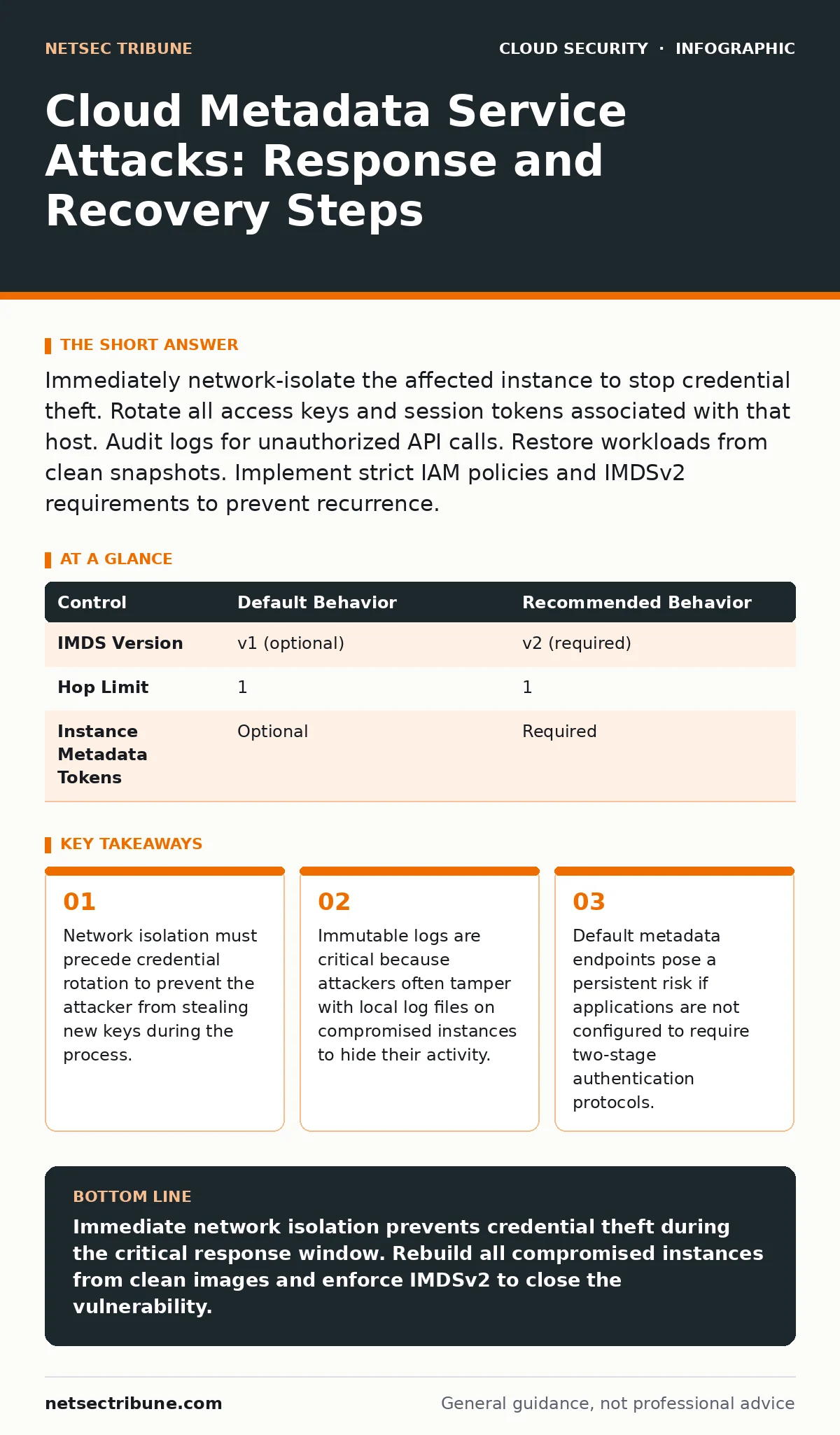
Immediately network-isolate the affected instance to stop credential theft. Rotate all access keys and session tokens associated with that host. Audit logs for unauthorized API calls. Restore workloads from clean snapshots. Implement strict IAM policies and IMDSv2 requirements to prevent recurrence.
First hour
The initial response phase focuses on stopping the bleed. You must assume the attacker has already harvested credentials from the instance metadata service. The metadata service provides configuration data, including temporary security credentials, to cloud instances. Attackers exploit this endpoint to gain persistent access.
- Identify the affected instance and its unique identifier.
- Block all inbound and outbound network traffic to the instance.
- Check for active sessions using the compromised credentials.
- Document the timeline of detection and initial actions.
Network isolation is the single most effective containment step. You must sever the instance’s connection to the rest of the environment. This prevents the attacker from using stolen credentials to pivot to other resources. If you rotate keys before isolating the network, the attacker may capture the new keys in transit. The metadata service responds to requests from the local host. If the attacker controls the host, they control the requests.
Check for active sessions immediately. Cloud providers issue temporary credentials that remain valid for a specific duration. An attacker can use these credentials even after you revoke the source instance’s permissions. You must revoke any tokens issued by the compromised identity. Consult your cloud incident response plan for specific revocation commands.
First day
Containment shifts from network isolation to credential hygiene. You must rotate all access keys, secret keys, and session tokens associated with the compromised instance. This includes any roles the instance assumed. The metadata service often returns temporary credentials that grant broad permissions. Attackers use these to escalate privileges or move laterally.
Rotate credentials in a strict order. First, isolate the network. Second, revoke existing sessions. Third, generate new credentials. Fourth, update configuration files with the new credentials. This sequence prevents a race condition where the attacker captures new keys during rotation.
Audit the account for unauthorized changes. Attackers often create new administrative users or modify security groups to allow remote access. Check for new instances launched by the compromised role. These instances may serve as persistence mechanisms or exfiltration points. Terminate any unauthorized resources.
Review the permissions attached to the compromised role. The principle of least privilege dictates that roles should have only the permissions necessary for their function. Overly broad permissions increase the blast radius of a compromise. Identify any permissions that allowed the attacker to perform unexpected actions. Document these gaps for remediation.
First week
Recovery involves restoring services from known good states. You cannot trust the compromised instance. You must rebuild it from a clean image or snapshot. This ensures no malware or backdoors remain. Verify the integrity of the source image before deployment.
Implement stricter controls for metadata access. The default configuration for many cloud environments allows any process on the instance to query the metadata service. This is a significant risk. Enforce IMDSv2, which requires a session token before returning data. This adds a layer of protection against server-side request forgery attacks.
| Control | Default Behavior | Recommended Behavior |
|---|---|---|
| IMDS Version | v1 (optional) | v2 (required) |
| Hop Limit | 1 | 1 |
| Instance Metadata Tokens | Optional | Required |
Monitor for anomalous behavior. Look for unusual API calls, unexpected network connections, or changes to security groups. Automated detection systems can alert on these indicators. Integrate these alerts into your cloud logging and monitoring framework. This provides visibility into ongoing threats.
Review your cloud attack surface. Identify any other instances that may be vulnerable to similar attacks. Ensure all instances enforce IMDSv2 and follow CIS Benchmarks for security configuration. Regular audits help maintain a strong security posture.
Who to tell
Communication is critical during recovery. You must inform internal stakeholders about the impact and timeline. This includes management, legal, and compliance teams. External communication may be required depending on data exposure.
Inform affected customers if personal data was accessed. Transparency builds trust and may be legally required. Coordinate with legal counsel to determine notification obligations. Provide clear information about the incident and steps taken to secure data.
Engage with cloud provider support. They can provide logs and insights into the attack. They may also assist with forensic analysis. Maintain a professional relationship with support teams for future incidents.
See also: Cloud Penetration Testing: Seven Practices for Realistic Assessment · Cloud Incident Response for Small Teams: Low-Cost Setup
How to stop a repeat
Prevention requires architectural changes. You must eliminate the ability of untrusted code to access the metadata service. This involves enforcing IMDSv2 and restricting network access to the metadata endpoint.
Implement least privilege IAM roles. Each instance should have only the permissions it needs. Regularly review and update these permissions. Remove unused permissions to reduce the attack surface.
Use container runtime security to protect workloads. Containers often share the host’s metadata service. Ensure container isolation prevents access to sensitive data. Configure security contexts to restrict capabilities.
Regularly test your defenses. Simulate metadata service attacks to verify controls. This helps identify gaps before real attackers exploit them. Incorporate these tests into your security validation program.
Review tenant isolation practices. Ensure that resources in different tenants are properly segregated. This prevents attackers from moving between tenants after compromising one. Verify network segmentation and IAM policies.
Key takeaways
- Network isolation must precede credential rotation to prevent the attacker from stealing new keys during the process.
- Immutable logs are critical because attackers often tamper with local log files on compromised instances to hide their activity.
- Default metadata endpoints pose a persistent risk if applications are not configured to require two-stage authentication protocols.
Immediate network isolation prevents credential theft during the critical response window. Rebuild all compromised instances from clean images and enforce IMDSv2 to close the vulnerability.
Frequently asked questions
How do I know if my instance is compromised by a metadata attack?
Look for unauthorized API calls, unexpected network connections, or changes to security groups. Monitor logs for queries to the metadata endpoint from unexpected processes.
What is IMDSv2 and why is it important?
IMDSv2 requires a session token before returning metadata. This prevents server-side request forgery attacks where malicious code tricks the application into querying the metadata service.
Can I reuse the compromised instance after recovery?
No. You must rebuild the instance from a clean image. The compromised instance may contain hidden backdoors or malware that remain after credential rotation.
How this guide was produced: written by the NetSec Tribune editorial team with AI assistance, checked against the public references listed below, and reviewed when the facts change. See our editorial policy or report an error.