
Difference Between Cloud Logging and Monitoring: Operational Reality
Logging records discrete events for forensic analysis, while monitoring aggregates metrics to trigger automated responses in real time.
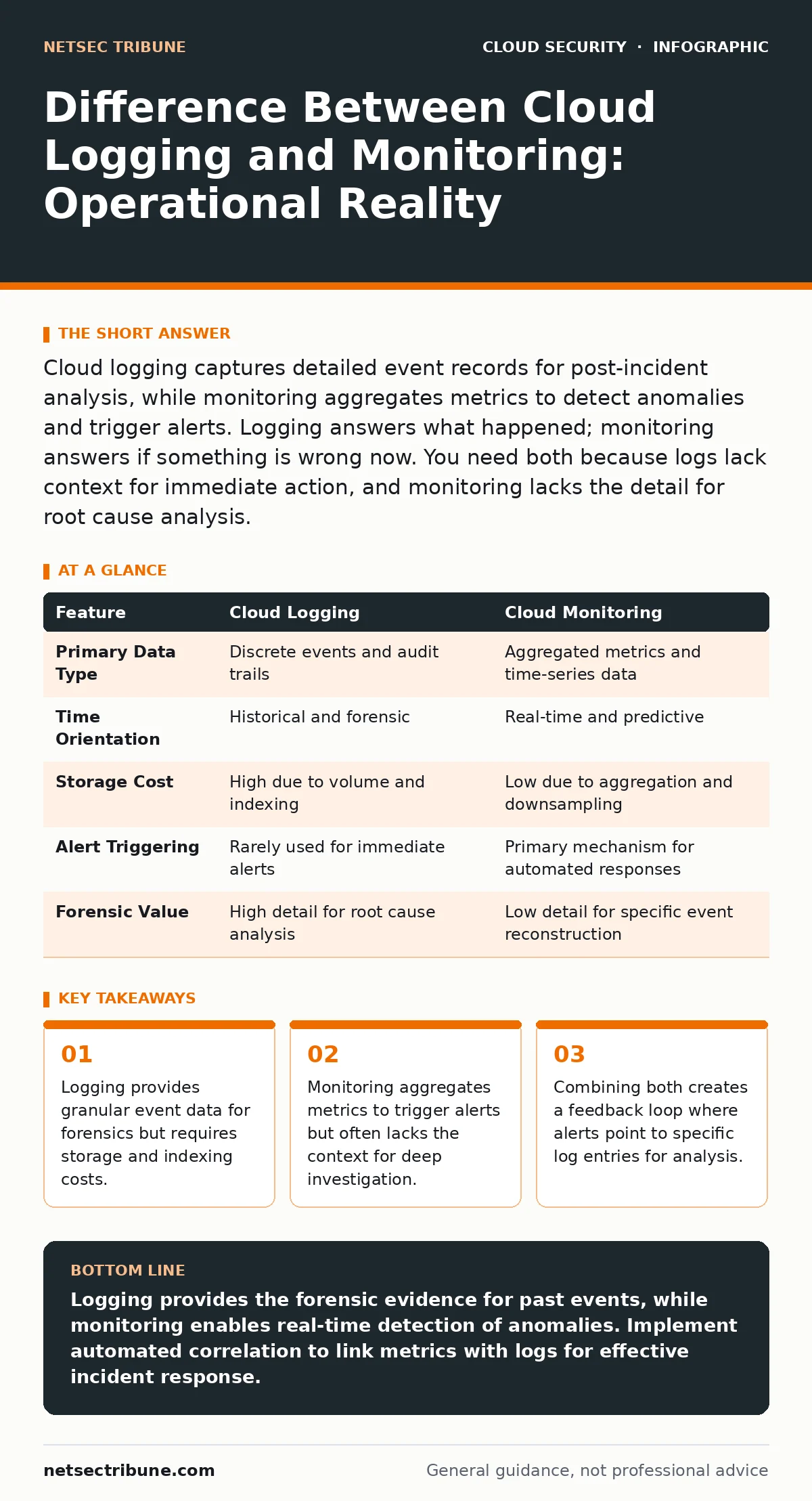
Cloud logging captures detailed event records for post-incident analysis, while monitoring aggregates metrics to detect anomalies and trigger alerts. Logging answers what happened; monitoring answers if something is wrong now. You need both because logs lack context for immediate action, and monitoring lacks the detail for root cause analysis.
What is the difference between cloud logging and monitoring?
Cloud logging and monitoring serve distinct functions within infrastructure security. Logging records discrete events, such as API calls or file changes, creating a historical audit trail. Monitoring aggregates metrics, such as CPU usage or latency, to assess system health in real time. Logging answers what happened after an event occurs. Monitoring answers if the system is currently behaving as expected.
Why does logging fail to detect active breaches?
Logging is inherently passive and retrospective. It records data only after an event has occurred. An attacker can execute commands and exfiltrate data between log collection intervals. If your log ingestion pipeline has latency, you see the breach hours later. Logging provides the evidence for forensics, not the trigger for containment. You cannot stop an active intrusion using only historical records.
How does monitoring miss subtle configuration drift?
Monitoring focuses on quantitative metrics and thresholds. It detects when values exceed predefined limits, such as high error rates or resource exhaustion. It often misses qualitative changes, such as a security group opening port 22 to the world. This is configuration drift. The system remains healthy metric-wise, but the security posture degrades silently. Monitoring sees the car driving fast; it does not see the driver removing the seatbelt.
What is the hidden cost of high-volume log retention?
Storing every log entry indefinitely creates significant financial and operational overhead. Search performance degrades as dataset size grows. Investigating a specific incident becomes slower due to noise. You pay for storage, indexing, and compute resources to query irrelevant data. Retaining everything dilutes the signal-to-noise ratio. You must define retention policies based on compliance needs and investigation likelihood, not just availability.
| Feature | Cloud Logging | Cloud Monitoring |
|---|---|---|
| Primary Data Type | Discrete events and audit trails | Aggregated metrics and time-series data |
| Time Orientation | Historical and forensic | Real-time and predictive |
| Storage Cost | High due to volume and indexing | Low due to aggregation and downsampling |
| Alert Triggering | Rarely used for immediate alerts | Primary mechanism for automated responses |
| Forensic Value | High detail for root cause analysis | Low detail for specific event reconstruction |
How do you correlate metrics with event details?
Effective security operations require linking monitoring alerts to logging data. When a monitoring system detects anomalous behavior, it must reference specific log entries. This correlation provides context. For example, a spike in outbound network traffic triggers an alert. The associated logs reveal which process initiated the connection. Without this link, responders waste time identifying the source. Automation tools can pre-fetch relevant logs when alerts fire.
See also: Data Breach Response: Containment, Recovery and Prevention Steps · Decoding Ransom Notes: Evidence Handling and Negotiation Realities
When does standard advice fail in serverless environments?
Serverless architectures abstract infrastructure management, changing how you collect data. Traditional monitoring agents cannot install on ephemeral functions. You rely on provider-native metrics and logs. These often lack granularity for application-level debugging. You may see function invocations but miss internal errors. This gap increases serverless security risks. You must instrument code explicitly to emit custom logs and metrics.
How do you handle data consistency across regions?
Multi-region deployments introduce latency in data synchronization. Logs generated in one region may arrive at the central repository later than metrics from another. This temporal mismatch complicates correlation. An alert may fire before the corresponding logs are available. You must design your pipeline to handle asynchronous data arrival. Buffering and time-window queries help align disparate data streams.
What is the impact of access key rotation on logging?
Rotating credentials changes the identity context in logs. Old keys stop working, generating access denied errors. These errors clutter logs and trigger false positives in monitoring. You must filter out expected rotation noise. Failure to do so creates alert fatigue. Responders ignore legitimate alerts because they are buried in credential churn. Automate the filtering of known rotation events in your alerting pipeline.
How do you secure the logging pipeline itself?
The logging pipeline becomes a high-value target. Attackers may delete or alter logs to cover tracks. You must treat log data with the same security as production workloads. Use immutable storage for final log archives. Restrict write access to the pipeline. Monitor the monitoring system. If attackers compromise the logging agent, they can suppress evidence. This is a cloud metadata service attack vector.
Why is zero trust network access relevant to logging?
Zero trust principles require verifying every request. This generates massive amounts of authentication and authorization logs. Traditional logging systems may struggle with this volume. You must prioritize logs that indicate policy violations. Focus on failed access attempts and privilege escalations. Ignore successful, expected connections to reduce noise. This aligns with zero trust network access best practices.
Key takeaways
- Logging provides granular event data for forensics but requires storage and indexing costs.
- Monitoring aggregates metrics to trigger alerts but often lacks the context for deep investigation.
- Combining both creates a feedback loop where alerts point to specific log entries for analysis.
Logging provides the forensic evidence for past events, while monitoring enables real-time detection of anomalies. Implement automated correlation to link metrics with logs for effective incident response.
Frequently asked questions
Can I use monitoring instead of logging for compliance?
No, compliance frameworks require detailed audit trails that monitoring aggregates away. Monitoring lacks the granularity to prove who did what.
How much log data should I keep?
Retain data based on legal requirements and investigation needs. Keep high-value security logs longer than operational debug logs.
What is the first step in setting up logging?
Identify critical data sources and ensure they emit structured logs. Unstructured text is difficult to parse and correlate automatically.
Does monitoring prevent data breaches?
Monitoring detects anomalies that may indicate a breach. It does not prevent the initial compromise. Prevention requires configuration hardening and access controls.
How this guide was produced: written by the NetSec Tribune editorial team with AI assistance, checked against the public references listed below, and reviewed when the facts change. See our editorial policy or report an error.