
Serverless Security Myths: Why Code Is Not Enough
Serverless architecture shifts the attack surface from infrastructure to configuration and data, rendering traditional perimeter defenses obsolete.
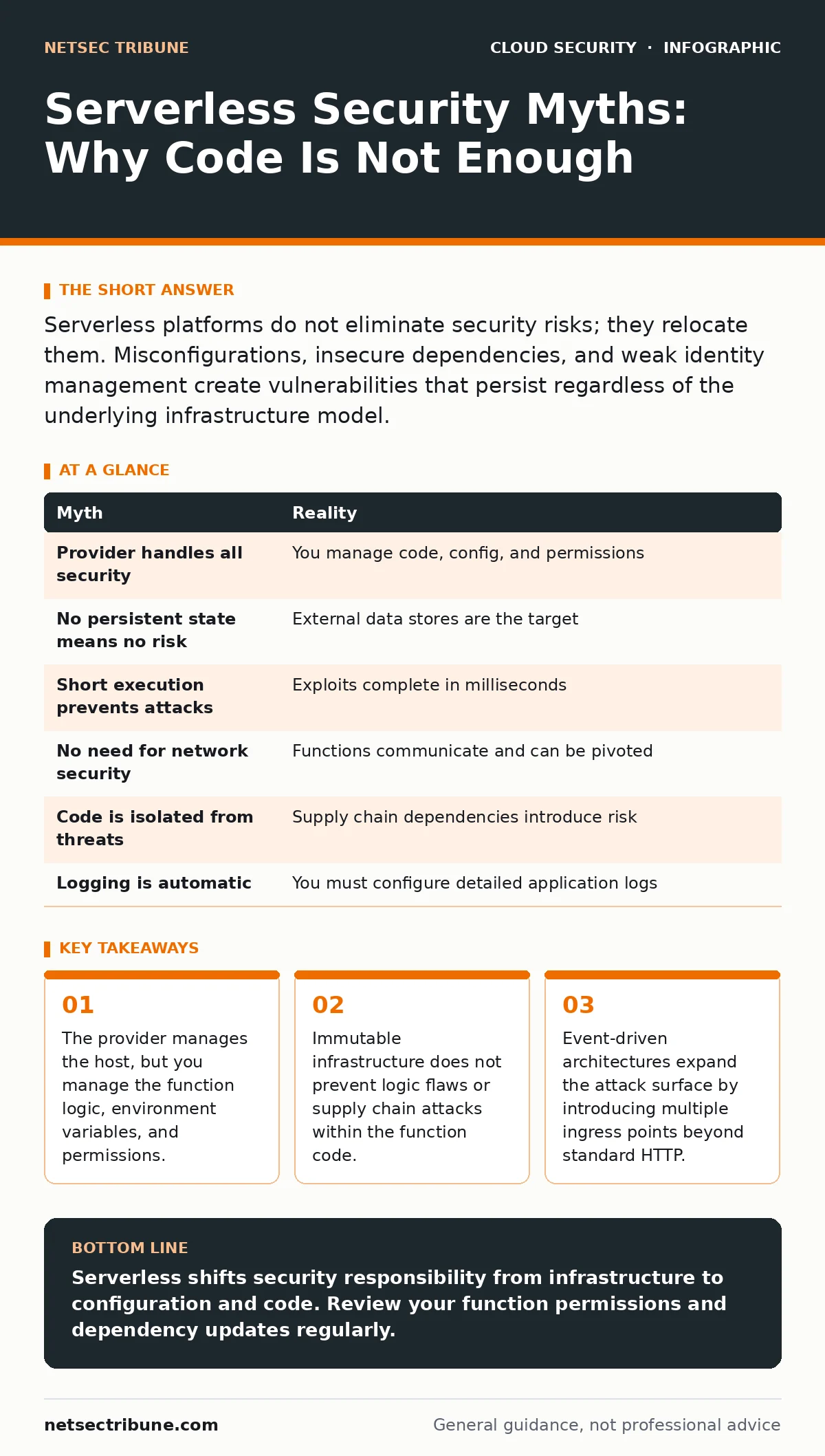
Serverless platforms do not eliminate security risks; they relocate them. Misconfigurations, insecure dependencies, and weak identity management create vulnerabilities that persist regardless of the underlying infrastructure model.
Myth: The Cloud Provider Handles All Security
Reality: The cloud provider secures the underlying hardware, hypervisor, and operating system. You remain responsible for the function code, environment variables, and identity permissions. This division is known as the shared responsibility model.
Imagine a scenario where an attacker finds a vulnerability in the function library. The provider’s patching schedule does not apply to your application code. You must update dependencies manually or through automated pipelines. Neglecting this step leaves known vulnerabilities exposed to exploitation.
The provider ensures the server stays online and patched. They do not validate whether your function grants excessive access to other services. A misconfigured role can allow a function to read sensitive data from unrelated buckets. This is a configuration error, not a platform failure.
Myth: Serverless Functions Have No Persistent State
Reality: Functions are stateless by design, but the data they process is not. State resides in external services like databases, object storage, or message queues. These external dependencies become the primary targets for attackers.
Suppose a function processes user uploads. The function itself holds no data after execution. However, the storage bucket receiving the file might have public read permissions. An attacker can exfiltrate data by querying the storage service directly.
The lack of local state reduces the risk of file-based malware persistence. It does not eliminate the risk of data leakage. Attackers pivot from compromised functions to the connected resources. Securing the function is only half the battle. Securing the data store is equally critical.
Myth: Short Execution Time Prevents Attacks
Reality: Execution windows are brief, but they are sufficient for exploitation. Many attacks, such as SQL injection or server-side request forgery, complete in milliseconds. The short lifespan of a function does not negate the impact of a successful exploit.
Consider a function that validates input. If the validation logic is flawed, an attacker can inject malicious commands. The function executes, performs the action, and terminates. The damage is done before the function disappears.
Short execution times also complicate detection. Traditional intrusion detection systems look for long-lived connections or persistent processes. Serverless attacks are ephemeral. They leave fewer forensic artifacts. This makes incident response more challenging.
Myth: Serverless Removes the Need for Network Security
Reality: Functions still communicate over networks. They send and receive data from APIs, databases, and third-party services. These network paths can be intercepted or abused if not properly secured.
Imagine a function that calls an internal microservice. If the network policy allows any function to reach any service, an attacker who compromises one function can pivot to others. This is lateral movement.
Network segmentation is still required. You must define which functions can talk to which resources. Default deny policies are essential. Without strict network rules, the attack surface expands to include every connected service.
Myth: Code Is Isolated From Other Tenants
Reality: While functions run in isolated environments, the supply chain is not. Functions often rely on third-party libraries and dependencies. A vulnerability in a shared library can affect multiple applications.
Suppose your function uses a popular logging library. If that library contains a remote code execution flaw, your function is vulnerable. The isolation of the runtime does not protect against compromised dependencies.
This is a supply chain risk. You must verify the integrity of every package you import. Using a software bill of materials helps track dependencies. Regular scanning for known vulnerabilities is necessary.
See also: Tenant Isolation for Small Business: Practical Cloud Security Steps
Myth: Logging Is Automatic and Sufficient
Reality: Cloud providers capture basic execution metrics. They do not capture detailed application logs by default. You must explicitly configure logging to capture security-relevant events.
Imagine a brute-force attack on an API endpoint. The provider logs that the function was invoked. It does not log the failed authentication attempts unless you code it to do so. Without detailed logs, you cannot detect or investigate the attack.
Proper logging requires effort. You must structure logs for machine readability. You must send them to a centralized system for analysis. Refer to our guide on cloud logging and monitoring for best practices in structuring and retaining these records.
Summary of Myths and Realities
| Myth | Reality |
|---|---|
| Provider handles all security | You manage code, config, and permissions |
| No persistent state means no risk | External data stores are the target |
| Short execution prevents attacks | Exploits complete in milliseconds |
| No need for network security | Functions communicate and can be pivoted |
| Code is isolated from threats | Supply chain dependencies introduce risk |
| Logging is automatic | You must configure detailed application logs |
Key takeaways
- The provider manages the host, but you manage the function logic, environment variables, and permissions.
- Immutable infrastructure does not prevent logic flaws or supply chain attacks within the function code.
- Event-driven architectures expand the attack surface by introducing multiple ingress points beyond standard HTTP.
Serverless shifts security responsibility from infrastructure to configuration and code. Review your function permissions and dependency updates regularly.
Frequently asked questions
Does serverless eliminate DDoS risks?
No. Attackers can still overwhelm API gateways or trigger expensive function executions, leading to denial of service or financial loss.
How do I secure serverless functions?
Use least privilege permissions, validate all inputs, scan dependencies, and implement comprehensive logging and monitoring.
Is serverless harder to audit?
It requires different tools. Traditional network audits are less effective. You must audit code, configurations, and data flows instead.
Can serverless functions be reverse engineered?
Yes. If an attacker gains access to the deployment package, they can analyze the code. Protect your intellectual property with obfuscation.
How this guide was produced: written by the NetSec Tribune editorial team with AI assistance, checked against the public references listed below, and reviewed when the facts change. See our editorial policy or report an error.