
Kubernetes Misconfigurations Explained: Why Defaults Fail
Most container failures stem from silent defaults that grant excessive permissions, turning minor oversights into systemic risks.
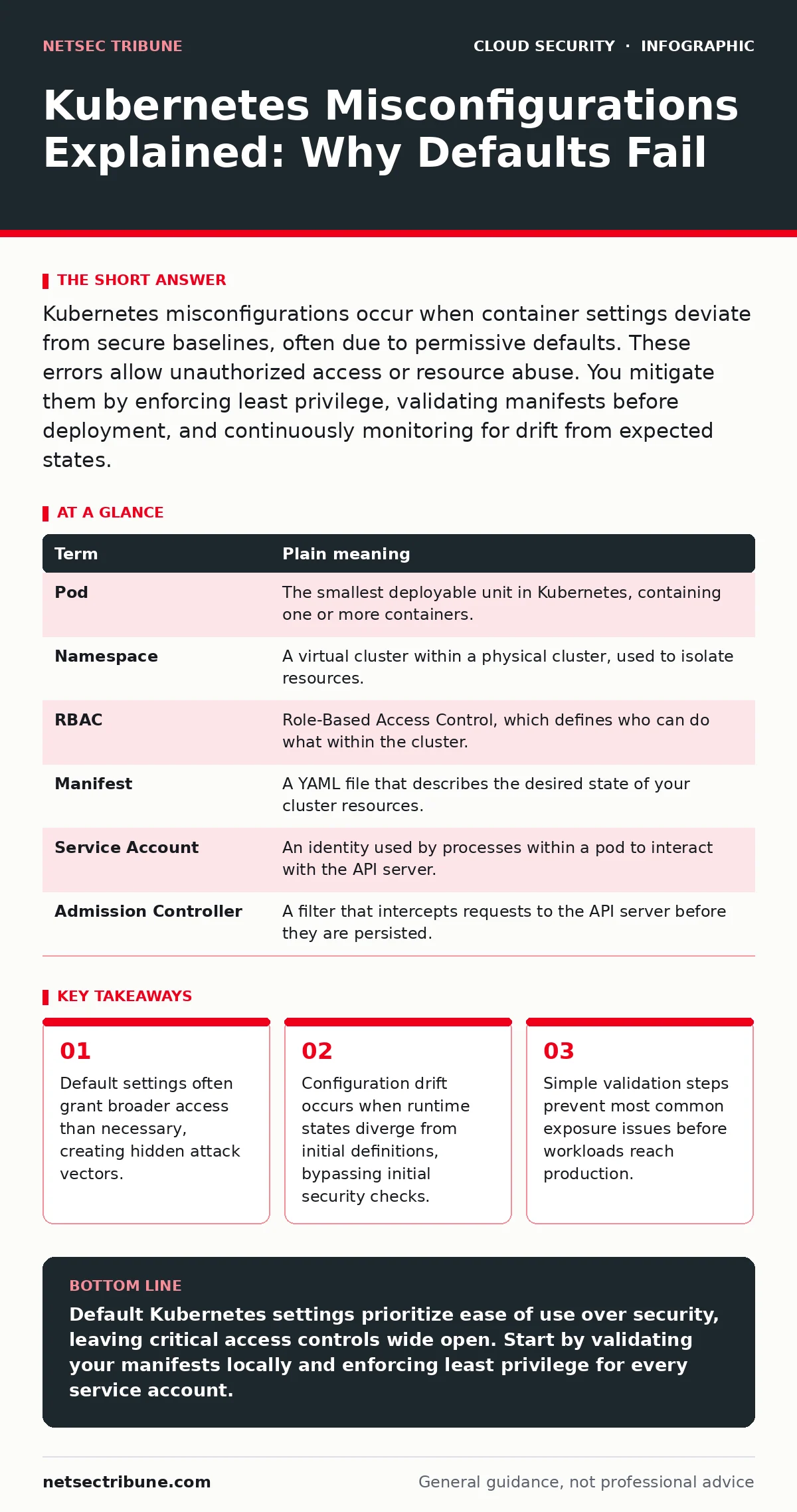
Kubernetes misconfigurations occur when container settings deviate from secure baselines, often due to permissive defaults. These errors allow unauthorized access or resource abuse. You mitigate them by enforcing least privilege, validating manifests before deployment, and continuously monitoring for drift from expected states.
The Unlocked Storage Unit
Imagine you rent a self-storage unit. The facility provides a standard lock, but the manager leaves the key under the mat for convenience. Most tenants never check the lock. They assume the gate is secure. A misconfiguration in Kubernetes is like leaving that key under the mat. It is not a broken lock. It is a correct lock used incorrectly. The system works as designed, but the design assumes a level of caution that rarely exists in practice.
You might think you are protected because the facility has a fence. The fence is the perimeter. The key under the mat is the internal access control. Attackers do not always climb the fence. They walk in through the side door because you left it unlocked. This analogy holds throughout the rest of this guide. The storage unit is your cluster. The items inside are your workloads.
Core Terms Defined
Understanding the mechanics requires precise language. Ambiguity in terminology leads to ambiguity in configuration. Below is a plain-language translation of the terms you will encounter.
| Term | Plain meaning |
|---|---|
| Pod | The smallest deployable unit in Kubernetes, containing one or more containers. |
| Namespace | A virtual cluster within a physical cluster, used to isolate resources. |
| RBAC | Role-Based Access Control, which defines who can do what within the cluster. |
| Manifest | A YAML file that describes the desired state of your cluster resources. |
| Service Account | An identity used by processes within a pod to interact with the API server. |
| Admission Controller | A filter that intercepts requests to the API server before they are persisted. |
These terms are not just jargon. They are the levers you pull to secure the environment. If you do not know what a service account is, you cannot secure it. If you do not understand namespaces, you cannot isolate breaches.
The Cost of Convenience
Kubernetes defaults are designed for ease of use, not security. This is a deliberate trade-off. The system assumes you will harden it later. You rarely do. The default service account in a pod often has permissions to read secrets from the entire namespace. This is like giving every tenant a master key to every other unit in the building.
Suppose you deploy a simple web application. You do not change the default settings. You assume the application only needs to serve traffic. It does not need to list all other pods. It does not need to read environment variables from unrelated services. Yet, the default configuration allows it. This is not a bug. It is a feature of flexibility. But flexibility is the enemy of security when left unchecked.
How Drift Compounds Risk
Configuration drift is the silent killer. You deploy a secure manifest. It passes validation. Weeks later, someone changes a setting manually to fix a bug. They do not update the manifest. The cluster state now differs from the defined state. This is drift.
Imagine the storage unit manager changes the lock code to open a unit for a customer. They forget to change it back. The next customer uses the old code. The unit is no longer secure. In Kubernetes, this happens constantly. Operators tweak configurations to unblock deployments. They forget to revert changes. The security posture degrades incrementally.
This is why static analysis is insufficient. You must monitor the live state. Tools that compare the live cluster against the expected manifest can detect this drift. Without this, you are securing a snapshot of the past, not the reality of the present.
Simple Safety Habits
You do not need complex tools to start. You need discipline. The following steps are low-effort but high-impact. They address the most common misconfigurations found in production environments.
- Validate manifests locally. Use a tool to scan your YAML files before you apply them. Check for privileged containers, host network access, and missing resource limits. This catches errors before they reach the cluster.
- Enforce least privilege. Do not use the default service account. Create a dedicated account for each workload. Grant it only the permissions it needs. This limits the blast radius if a container is compromised.
- Use admission controllers. Implement a policy engine that rejects non-compliant requests. If a developer tries to deploy a privileged container, the controller blocks it. This shifts security left, preventing bad configurations from ever landing.
These habits create a baseline. They do not guarantee security, but they remove the low-hanging fruit. Attackers look for the easy targets. Make their work harder.
See also: Serverless Security Myths: Why Code Is Not Enough · Difference Between Cloud Logging and Monitoring: Operational Reality
The Hidden Cost of Complexity
As you add layers of security, complexity increases. You might add a service mesh for encryption. You might implement zero trust network access for internal traffic. These are good ideas. But they add configuration surface area. More settings mean more places to misconfigure.
Suppose you implement a strict policy. It breaks a critical deployment. The team overrides the policy to get back online. The policy is now weakened. This is the hidden cost of security: operational friction. If security slows down delivery, teams will bypass it. You must balance security with usability.
What This Means for You
If you are not a Kubernetes administrator, this still affects you. You might deploy applications to a shared cluster. Your code runs in a pod. If that pod is misconfigured, your application is vulnerable. You might not control the cluster, but you control the manifests.
You can advocate for better practices. Ask your team to scan manifests. Ask for dedicated service accounts. Ask for admission controllers. These are not requests for more work. They are requests for fewer incidents. Security is not a product you buy. It is a process you follow.
Next Steps
Start with one namespace. Audit the service accounts. Check the permissions. Fix the drift. Then move to the next. Do not try to secure everything at once. Small, consistent improvements yield better results than large, sporadic overhauls.
Refer to the guide on Kubernetes RBAC for detailed permission structures. Review cloud incident response plans to ensure you can react if a misconfiguration is exploited. Consider cloud penetration testing to validate your defenses. These resources provide the depth you need once you have the basics in place.
Key takeaways
- Default settings often grant broader access than necessary, creating hidden attack vectors.
- Configuration drift occurs when runtime states diverge from initial definitions, bypassing initial security checks.
- Simple validation steps prevent most common exposure issues before workloads reach production.
Default Kubernetes settings prioritize ease of use over security, leaving critical access controls wide open. Start by validating your manifests locally and enforcing least privilege for every service account.
Frequently asked questions
Do I need to change all my configurations at once?
No. Prioritize high-risk workloads first. Focus on those with external exposure or access to sensitive data. Gradually apply changes to other namespaces.
Can automated tools fix misconfigurations?
Tools can detect and sometimes remediate issues, but they require proper configuration. They cannot understand business context. Human review remains necessary for complex decisions.
Is Kubernetes inherently insecure?
No. It is flexible. That flexibility allows for both secure and insecure configurations. The platform itself is secure by design, but defaults are permissive.
How do I know if I have configuration drift?
Use a policy engine or monitoring tool that compares the live cluster state against your stored manifests. Alerts on divergence indicate drift.
How this guide was produced: written by the NetSec Tribune editorial team with AI assistance, checked against the public references listed below, and reviewed when the facts change. See our editorial policy or report an error.