Blast Radius: Contain Breaches Before They Spread
Mapping blast radius reveals hidden attack paths that standard perimeter defenses miss, turning containment into a precise engineering task rather than a reactive scramble.
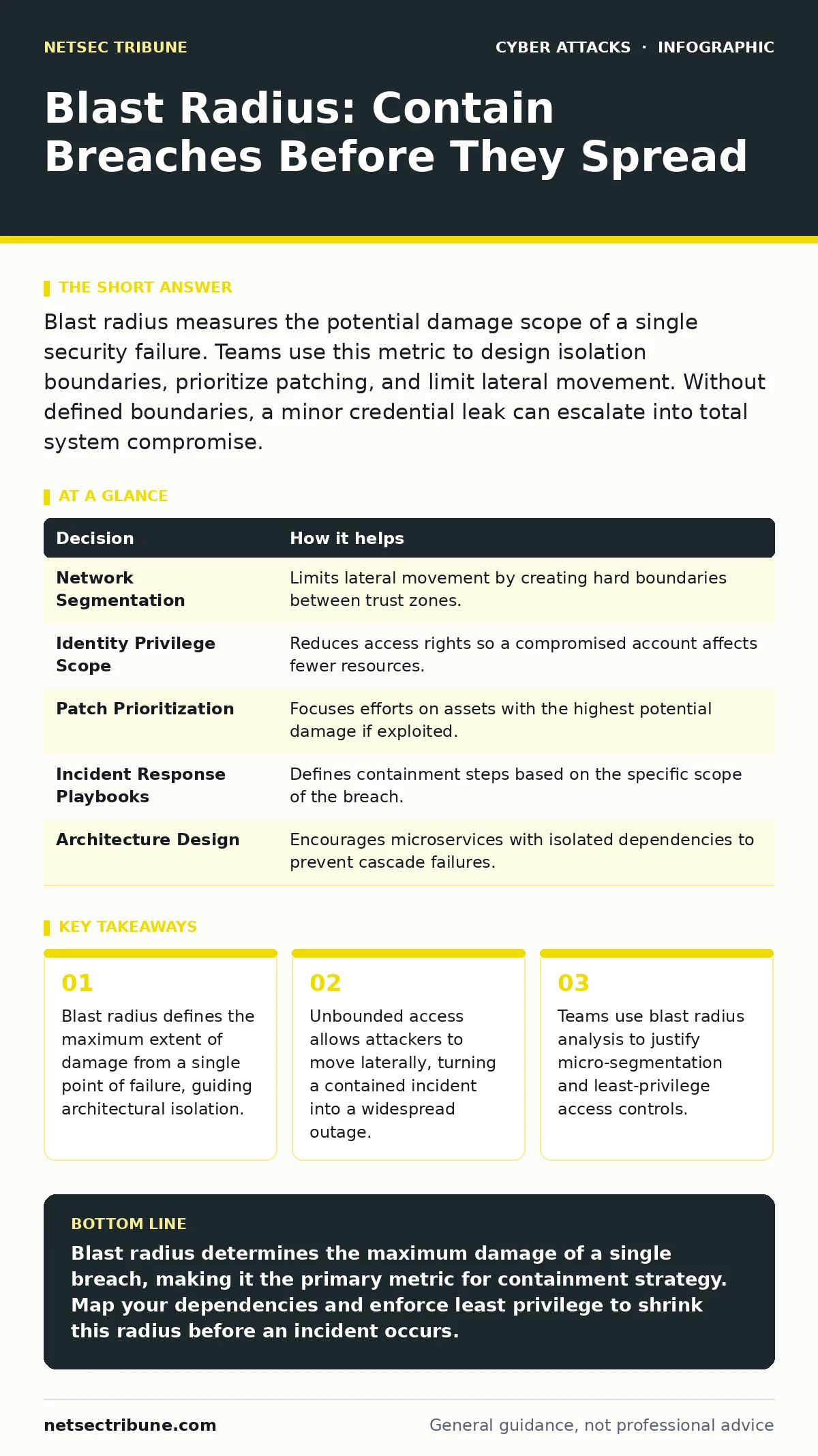
Blast radius measures the potential damage scope of a single security failure. Teams use this metric to design isolation boundaries, prioritize patching, and limit lateral movement. Without defined boundaries, a minor credential leak can escalate into total system compromise.
Defining the Scope of Failure
Blast radius is the measure of potential impact when a specific component fails or is compromised. It answers the question of how much of your infrastructure falls if one piece breaks. This concept applies to servers, user accounts, network segments, and application dependencies. A small blast radius means a failure remains contained. A large blast radius means a single breach can cascade across the entire organization. Security teams calculate this metric to understand risk exposure before an incident occurs.
The metric is not about probability. It is about consequence. You can have a low-probability event with a massive blast radius. You can also have a high-probability event with a tiny blast radius. Both require different mitigation strategies. Understanding the distinction prevents wasted effort on low-impact threats while ensuring critical assets are protected against high-impact scenarios.
The Hidden Cost of Shared Credentials
Shared service accounts create the largest blast radius in most environments. When ten applications use the same database credential, compromising one application grants access to all ten. This is a classic case of correlated failure. The security team often views shared credentials as an efficiency gain. The attacker views it as a force multiplier.
Imagine a web server with a minor vulnerability. An attacker exploits this flaw and extracts the database connection string. Because that string uses shared credentials for the entire production cluster, the attacker now has read access to every customer record. The initial vulnerability was low severity. The resulting data exposure is catastrophic. The blast radius expanded from one server to the entire data store.
Decisions Informed by Radius Analysis
Teams use blast radius calculations to make architectural and operational decisions. These decisions reduce the distance an attacker must travel to reach critical data. The following table outlines common decisions and how radius analysis informs them.
| Decision | How it helps |
|---|---|
| Network Segmentation | Limits lateral movement by creating hard boundaries between trust zones. |
| Identity Privilege Scope | Reduces access rights so a compromised account affects fewer resources. |
| Patch Prioritization | Focuses efforts on assets with the highest potential damage if exploited. |
| Incident Response Playbooks | Defines containment steps based on the specific scope of the breach. |
| Architecture Design | Encourages microservices with isolated dependencies to prevent cascade failures. |
Each decision reduces the number of systems an attacker can reach after the initial breach. This reduction buys time for detection and response. It also limits the financial and reputational damage. The goal is to make the cost of further exploitation higher than the value of the data gained.
What Goes Wrong Without Boundaries
Without explicit blast radius limits, systems default to maximum connectivity. This is often a legacy of early network design where ease of access was prioritized over security. In such environments, a compromised endpoint can communicate with any other endpoint. Attackers exploit this freedom to move laterally.
Lateral movement is the process of moving from one system to another within a network. It is the primary method attackers use to escalate privileges and access sensitive data. If the blast radius is unbounded, lateral movement is unrestricted. The attacker treats the network as a single host. This is similar to how a botnet operates, where many compromised devices act in unison. The difference is that your internal network is controlled by a single attacker rather than a distributed command structure.
Teams Use Radius for Containment
Security operations teams use blast radius data to contain incidents quickly. When an alert fires, the team identifies the affected component. They then check the predefined blast radius for that component. This tells them exactly which systems might be compromised. They isolate only those systems. This prevents unnecessary downtime for unaffected parts of the infrastructure.
This approach contrasts with reactive containment, where teams shut down entire networks or data centers to stop a threat. Reactive containment is blunt and costly. Proactive containment, based on known blast radius, is surgical. It relies on prior work to map dependencies and access paths. If you have not mapped these paths, you cannot perform surgical containment. You are forced to use blunt instruments.
See also: Difference Between Cloud Logging and Monitoring: Operational Reality · Decoding Ransom Notes: Evidence Handling and Negotiation Realities
The Role of Identity and Access
Identity is the new perimeter. Traditional firewalls protect network boundaries. They do not protect against insiders or compromised credentials. If an attacker has valid credentials, the firewall sees legitimate traffic. The blast radius of a compromised identity is determined by the permissions assigned to that identity.
Least privilege is the primary control for limiting identity blast radius. It ensures that users and services have only the access they need to perform their tasks. No more, no less. Implementing least privilege is difficult because it requires detailed knowledge of how applications and users interact. Many organizations fail to implement it fully. They leave default permissions open. This creates hidden paths for attackers.
Insider threats are a significant risk when blast radius is large. A disgruntled employee with broad access can cause as much damage as an external attacker. Limiting the blast radius of internal accounts reduces this risk. It also limits the damage from accidental mistakes. A user who accidentally deletes a file only affects the files they can access.
Integrating with Broader Security Controls
Blast radius analysis works in tandem with other security controls. Secure email gateways prevent initial credential theft via phishing. If a user clicks a malicious link, the gateway may block it. If it does not, the blast radius of that user account becomes the concern. Session hijacking attacks can steal active user sessions. If the session has broad permissions, the blast radius is large.
DDoS protection focuses on availability. It does not directly address data confidentiality. However, a DDoS attack can be used as a distraction while an attacker exploits a vulnerability. If the vulnerability has a small blast radius, the distraction is less effective. If the blast radius is large, the distraction allows the attacker to access critical data before the DDoS is mitigated.
Rainbow table attacks are used to crack password hashes. If an attacker obtains a hash database, they can attempt to reverse the hashes. If the organization uses unique salts for each password, the attack is slower. If they use weak hashing algorithms, the attack is faster. The blast radius here is the number of accounts compromised if the hashes are leaked. Strong hashing reduces the likelihood of compromise, but limiting access to the hash database reduces the blast radius.
Bot protection prevents automated attacks. It helps reduce the noise in security logs. This allows teams to focus on genuine threats. When a genuine threat is detected, knowing the blast radius helps prioritize the response. Teams can ignore automated scans that have no path to critical assets. They can focus on attacks that target high-value components with large blast radii.
Practical Steps for Reduction
Reducing blast radius is an ongoing process. It starts with inventory. You must know what you have. Then you must map how these assets connect. This mapping reveals the paths an attacker can take. Once the paths are known, you can add controls to break them.
Network segmentation is the most effective technical control. It places firewalls between segments. These firewalls enforce strict rules. Only necessary traffic is allowed. This limits lateral movement. Identity and access management is the second control. It ensures that users and services have minimal permissions. This limits the damage from compromised credentials.
Monitoring is the third control. You must detect when an attacker moves laterally. Anomaly detection tools can identify unusual traffic patterns. These patterns often indicate lateral movement. When detected, the team can isolate the affected segment. This stops the attack before it spreads.
The combination of segmentation, least privilege, and monitoring creates a defense in depth. Each layer reduces the blast radius. No single layer is sufficient. Together, they make it difficult for an attacker to cause widespread damage. This approach aligns with zero trust principles. It assumes breach and focuses on limiting impact.
Key takeaways
- Blast radius defines the maximum extent of damage from a single point of failure, guiding architectural isolation.
- Unbounded access allows attackers to move laterally, turning a contained incident into a widespread outage.
- Teams use blast radius analysis to justify micro-segmentation and least-privilege access controls.
Blast radius determines the maximum damage of a single breach, making it the primary metric for containment strategy. Map your dependencies and enforce least privilege to shrink this radius before an incident occurs.
Frequently asked questions
How do I calculate blast radius for a specific server?
Identify all systems that trust or connect to that server. Map the data flow and access permissions. The sum of these connected systems and their data defines the blast radius.
Can blast radius be zero?
No. Every system has some dependency. The goal is to minimize it, not eliminate it. A single server with no connections still has a blast radius of one. Focus on reducing the number of connected systems.
How this guide was produced: written by the NetSec Tribune editorial team with AI assistance, checked against the public references listed below, and reviewed when the facts change. See our editorial policy or report an error.