
Orphaned Cloud Resources: Myths That Hide Attack Surfaces
Orphaned resources often remain active and billable long after their owning application is deleted, creating silent security gaps that standard cleanup scripts miss.
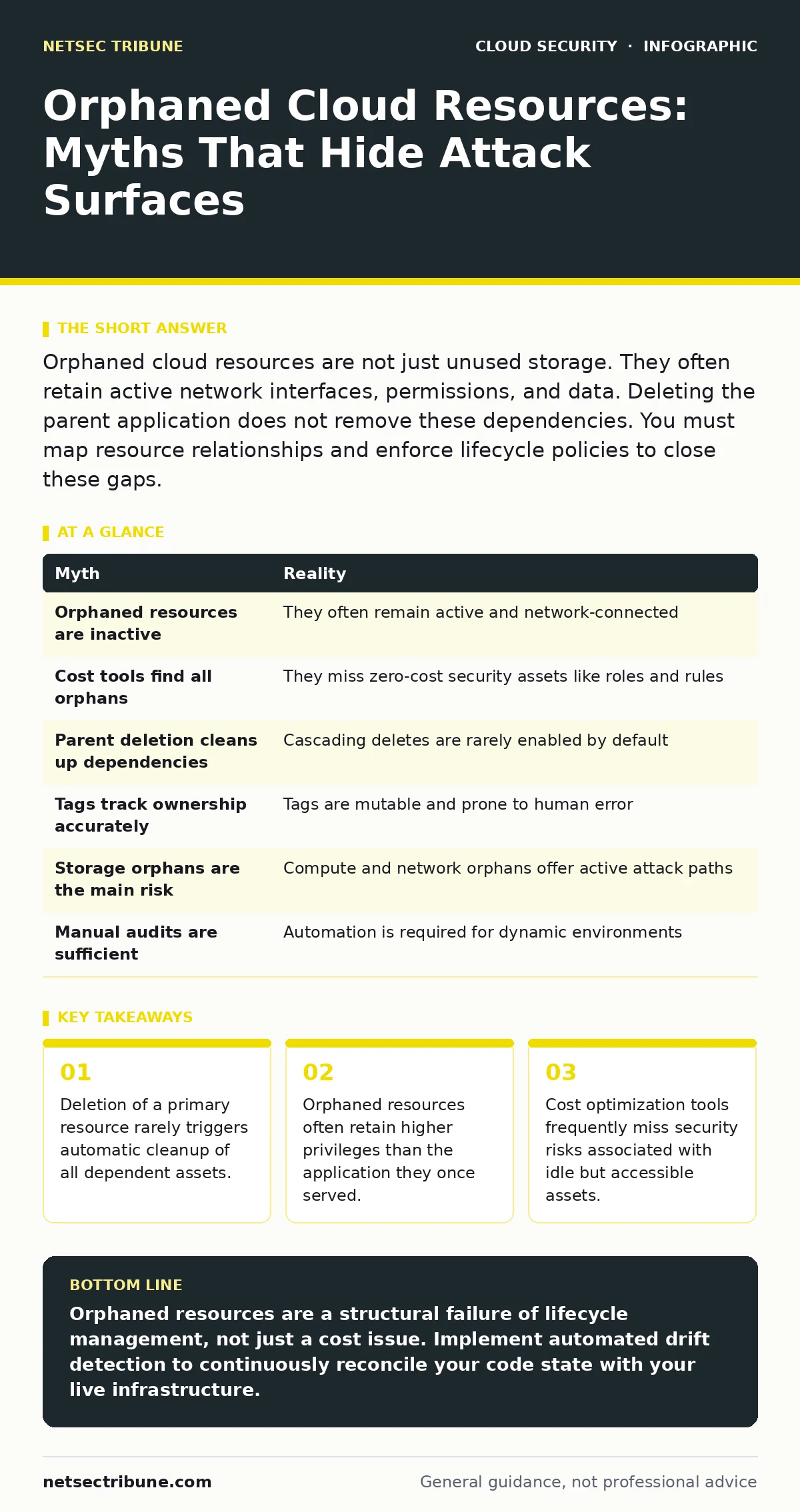
Orphaned cloud resources are not just unused storage. They often retain active network interfaces, permissions, and data. Deleting the parent application does not remove these dependencies. You must map resource relationships and enforce lifecycle policies to close these gaps.
Myth: Orphaned resources are always inactive
Reality: An orphaned resource is often fully active and connected to your network. When you delete a virtual machine or a container, the associated storage volumes, network interfaces, or load balancers may persist. These assets continue to consume compute cycles or bandwidth if they are not explicitly terminated.
Imagine a scenario where you decommission a web server. The server instance vanishes, but the attached database volume remains mounted and accessible via its private IP address. If that volume contains unencrypted data, it is now a standalone target. Attackers scanning for open ports will find the database listener active, even though the application that managed it is gone.
This persistence is not a bug; it is a safety feature designed to prevent accidental data loss. However, it creates a hidden attack surface. The resource is no longer monitored by the application’s logging stack. It sits outside the usual security telemetry, making intrusion detection significantly harder. You must treat any resource without a clear parent process as a potential breach point.
Myth: Cost optimization tools find all orphans
Reality: Financial tools identify waste, not risk. A cloud cost management dashboard looks for resources that incur charges. It flags an idle virtual private server because it costs money. It often ignores a security group, an IAM role, or a DNS record because they are free or negligible in cost.
These zero-cost assets are critical infrastructure components. An orphaned security group might still allow inbound traffic on port 22 from any IP address. A forgotten DNS record could point to an IP address controlled by an attacker, facilitating domain hijacking. Cost tools do not care about network connectivity or permission scopes.
Relying on financial audits for security hygiene leaves the most dangerous assets untouched. You need a separate inventory process that maps technical dependencies, not just billing lines. This approach aligns with the principles of managing your cloud attack surface, where visibility extends beyond cost centers to include every network-adjacent object.
Myth: Deleting the parent application cleans up dependencies
Reality: Cloud platforms rarely implement cascading deletes by default. If you delete a Kubernetes deployment, the persistent volume claims may remain. If you tear down a cloud formation stack, the underlying virtual private cloud routes might persist if they were shared.
This design prevents accidental destruction of shared infrastructure. However, it means your cleanup responsibility extends far beyond the initial resource. You must explicitly define dependency chains in your infrastructure-as-code templates. Without this, resources become detached from their management lifecycle.
Suppose you use a script to spin up a test environment. The script creates a network interface and a security group. When the test ends, the script deletes the instance. The network interface remains, potentially retaining the security group’s permissive rules. This leftover interface can be attached to a new, malicious instance, bypassing network segmentation. This is why understanding Kubernetes misconfigurations and resource lifecycle policies is necessary for any automated environment.
Myth: Tags accurately track ownership and lifecycle
Reality: Tags are metadata, not enforcement mechanisms. They are easily misapplied, omitted, or overwritten. A resource tagged "Project-X" does not mean Project-X owns it, nor does it mean the resource should be deleted when Project-X ends.
Human error is the primary driver of tag inconsistency. An engineer might forget to tag a new resource, or use a slightly different naming convention. Automated systems that rely on tags for cleanup will either miss these resources or delete the wrong ones. This fragility makes tags a poor single source of truth for security posture.
You need structural tracking, not just labels. Infrastructure-as-code state files provide a reliable record of what was created and by whom. By relying on the state file rather than tags, you can identify resources that exist in the cloud but not in the code. These discrepancies are the true orphans. This method supports zero trust network access by ensuring every resource has a verified, code-defined origin.
Myth: Orphans are only a problem for storage
Reality: Compute and network orphans are often more dangerous than storage orphans. A forgotten virtual private server can be compromised and used as a pivot point. An orphaned API endpoint might still accept requests and execute legacy code with outdated dependencies.
Storage volumes are passive. They hold data but do not process it. A compute instance, however, can run processes, make network connections, and exfiltrate data. If an orphaned server retains administrative credentials, it provides a direct path into your core infrastructure.
Consider an old development environment that was never fully decommissioned. The servers were stopped to save money, but not terminated. They remain in a suspended state, retaining their network configuration and IAM roles. An attacker who compromises one of these suspended instances can wake it up and use its existing permissions to access production systems. This risk is similar to those found in container runtime security, where dormant containers can be exploited if their privileges are not strictly limited.
See also: CIS Benchmarks Explained: How to Build a Secure Baseline · Cloud Penetration Testing: Seven Practices for Realistic Assessment
Myth: Manual audits are sufficient for cleanup
Reality: Manual audits are slow, error-prone, and cannot keep pace with dynamic cloud environments. In a modern infrastructure, resources are created and destroyed multiple times a day. A monthly manual check leaves a window of weeks where orphans can accumulate and be exploited.
Automation is the only viable control. You need continuous reconciliation between your infrastructure-as-code state and the actual cloud environment. This process should flag any resource that exists in the cloud but not in the code, or vice versa.
This continuous verification is similar to the approach used in cloud penetration testing, where the environment is constantly probed for weaknesses. By automating the detection of orphaned resources, you reduce the time an attacker has to exploit a detached asset. You should also review CIS Benchmarks for specific configuration requirements that help automate the detection of non-compliant or orphaned states.
| Myth | Reality |
|---|---|
| Orphaned resources are inactive | They often remain active and network-connected |
| Cost tools find all orphans | They miss zero-cost security assets like roles and rules |
| Parent deletion cleans up dependencies | Cascading deletes are rarely enabled by default |
| Tags track ownership accurately | Tags are mutable and prone to human error |
| Storage orphans are the main risk | Compute and network orphans offer active attack paths |
| Manual audits are sufficient | Automation is required for dynamic environments |
Key takeaways
- Deletion of a primary resource rarely triggers automatic cleanup of all dependent assets.
- Orphaned resources often retain higher privileges than the application they once served.
- Cost optimization tools frequently miss security risks associated with idle but accessible assets.
- Manual tagging is an unreliable method for tracking resource ownership and lifecycle.
Orphaned resources are a structural failure of lifecycle management, not just a cost issue. Implement automated drift detection to continuously reconcile your code state with your live infrastructure.
Frequently asked questions
How do I identify orphaned resources in my cloud account?
Use infrastructure-as-code state files to compare defined resources against actual cloud assets. Any resource present in the cloud but absent from the code is a candidate for review.
Can orphaned resources be exploited remotely?
Yes, if they retain network connectivity or public IP addresses. Attackers can scan for open ports on these detached assets and attempt to access legacy services.
Should I delete orphaned resources immediately?
Review them first to ensure they are not shared dependencies. Deleting a shared security group or network interface can disrupt active services.
Does automation prevent all orphaned resource risks?
Automation reduces the window of exposure but requires accurate initial configuration. If your infrastructure-as-code templates are flawed, automation will replicate those flaws at scale.
How this guide was produced: written by the NetSec Tribune editorial team with AI assistance, checked against the public references listed below, and reviewed when the facts change. See our editorial policy or report an error.