
CIS Benchmarks Explained: How to Build a Secure Baseline
CIS Benchmarks provide a consensus-driven configuration baseline that reduces your cloud attack surface by hardening default settings.
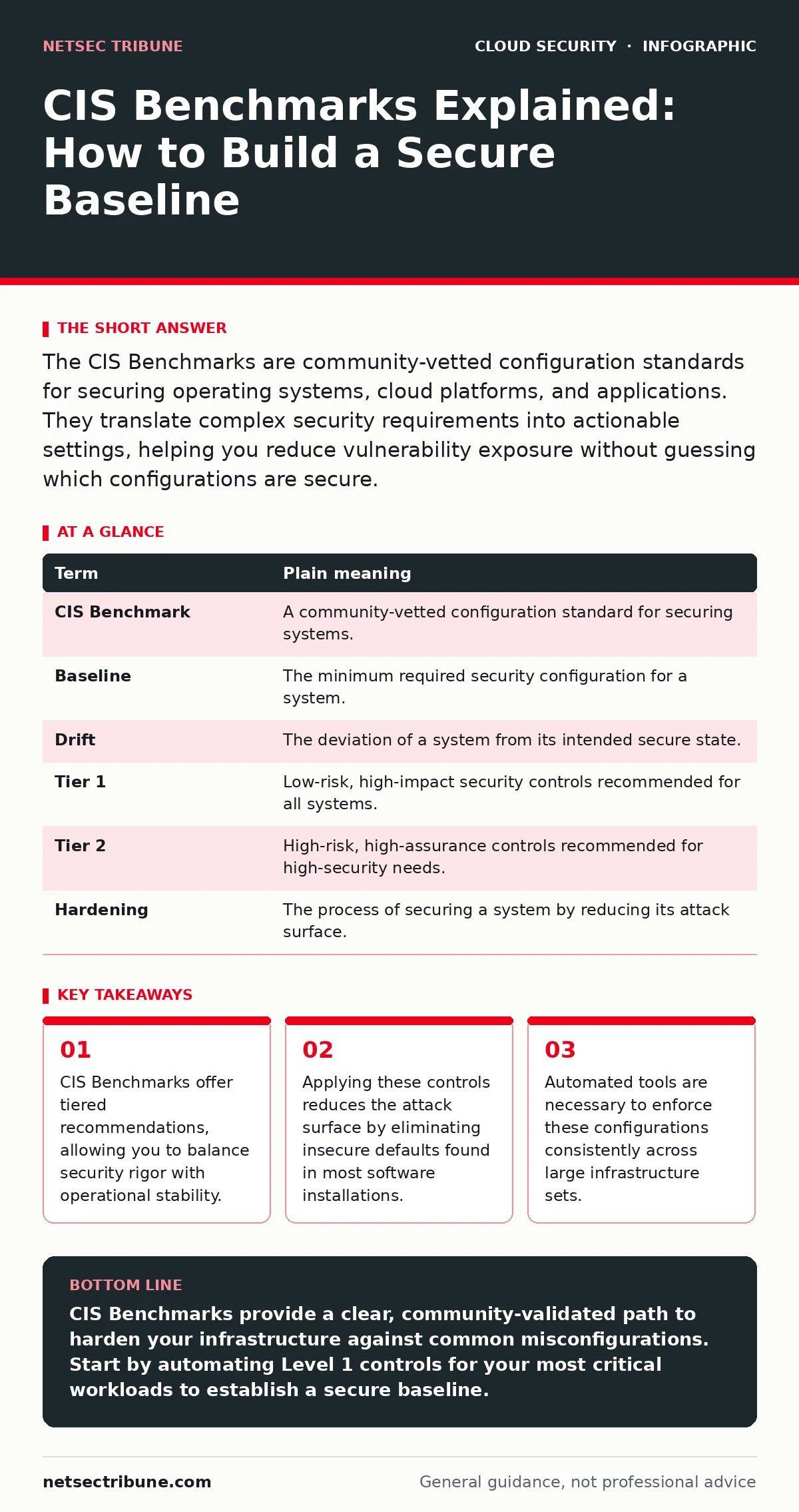
The CIS Benchmarks are community-vetted configuration standards for securing operating systems, cloud platforms, and applications. They translate complex security requirements into actionable settings, helping you reduce vulnerability exposure without guessing which configurations are secure.
The Digital House Inspection
Imagine you have just purchased a new house. The builder provided it with all windows open, the front door unlocked, and the alarm system disabled. This is the default state of most software and cloud infrastructure. The CIS Benchmarks act as a detailed inspection checklist. They tell you exactly which locks to install, which windows to secure, and which alarm settings to enable. You do not need to be a security architect to know this house is vulnerable. You simply need the checklist.
Most vendors ship products with features enabled by default to ensure immediate usability. This convenience creates significant risk. The benchmarks strip away unnecessary functionality and harden the remaining features. This process transforms a permissive environment into a restricted one.
Understanding the Tiered Approach
Not every recommendation in the benchmarks carries the same weight. The document splits controls into two tiers. Level 1 represents the minimum baseline. These changes are low-risk and easy to implement. They provide the greatest reduction in risk for the least amount of effort. Level 2 builds on Level 1. These controls are more stringent and may impact performance or usability. You apply Level 2 when you need higher assurance.
Choosing between tiers depends on your risk appetite. A public-facing web server might require Level 2. An internal development server might only need Level 1. Mixing tiers within the same environment creates inconsistency. Consistency is the foundation of effective security.
Common Points of Confusion
Many teams mistake the benchmarks for a certification. They are not. Passing a compliance audit does not mean you are secure. It means you followed a specific set of instructions. The benchmarks are a starting point, not an endpoint. They do not account for your specific application logic or business requirements.
Another common error is applying every control blindly. Some recommendations disable services you actually need. Before disabling a service, verify that no application depends on it. Disabling a necessary service causes outages. These outages distract your team from real threats. This dynamic often undermines cloud incident response efforts when systems fail unexpectedly during an investigation.
The Cost of Manual Enforcement
Applying these settings manually is possible for a single server. It is unmanageable for hundreds. Human error introduces drift. Drift occurs when a system deviates from its secure configuration over time. Without automation, you cannot guarantee that every instance matches the benchmark.
Infrastructure as Code allows you to define the desired state. You write the configuration once and deploy it everywhere. This approach ensures that every new instance starts secure. It also makes it easier to detect when something changes. If a setting drifts, the code alerts you. This discipline is critical for managing Kubernetes misconfigurations where container definitions change frequently.
Mini Glossary of Terms
| Term | Plain meaning |
|---|---|
| CIS Benchmark | A community-vetted configuration standard for securing systems. |
| Baseline | The minimum required security configuration for a system. |
| Drift | The deviation of a system from its intended secure state. |
| Tier 1 | Low-risk, high-impact security controls recommended for all systems. |
| Tier 2 | High-risk, high-assurance controls recommended for high-security needs. |
| Hardening | The process of securing a system by reducing its attack surface. |
See also: Cloud Penetration Testing: Seven Practices for Realistic Assessment · Cloud Incident Response for Small Teams: Low-Cost Setup
Try This Now
- Select one critical workload in your environment. Download the corresponding CIS Benchmark document for its operating system or platform.
- Identify three Level 1 recommendations that are currently not enforced. Evaluate the operational impact of enabling them.
- Implement these three changes using your infrastructure code. Verify that the workload remains functional after the change.
Integrating with Broader Security
Benchmarks secure the host, but they do not secure the network or the identity. You must combine configuration hardening with other controls. For example, hardening a server does not stop an attacker who steals credentials. You need zero trust network access to verify every request.
Similarly, strong host configuration does not prevent misconfigured storage buckets. You need to monitor your cloud attack surface continuously. The benchmarks are one layer of defense. They work best when combined with access key rotation and strict Kubernetes RBAC policies.
The Reality of Maintenance
Security is not a one-time task. Software updates change default settings. New vulnerabilities emerge. Your benchmarks become outdated if you do not review them. Regular reviews ensure your configurations remain effective.
Automated scanning tools can check your systems against the benchmarks. Run these scans frequently. Integrate them into your deployment pipeline. This ensures that no insecure configuration reaches production. This practice supports cloud penetration testing by ensuring your environment is hardened before external testers examine it.
Key takeaways
- CIS Benchmarks offer tiered recommendations, allowing you to balance security rigor with operational stability.
- Applying these controls reduces the attack surface by eliminating insecure defaults found in most software installations.
- Automated tools are necessary to enforce these configurations consistently across large infrastructure sets.
CIS Benchmarks provide a clear, community-validated path to harden your infrastructure against common misconfigurations. Start by automating Level 1 controls for your most critical workloads to establish a secure baseline.
Frequently asked questions
Are CIS Benchmarks free to use?
The core CIS Benchmarks are available for free. Some organizations offer paid services for automated scanning and reporting tools.
How often should I update my CIS Benchmark configurations?
You should review and update your configurations whenever you deploy major software updates or when new versions of the benchmarks are released.
Can I use CIS Benchmarks for containerized applications?
Yes, CIS provides specific benchmarks for container runtimes like Docker and container orchestrators like Kubernetes.
Do CIS Benchmarks cover application code security?
No, CIS Benchmarks focus on system and platform configuration. They do not address vulnerabilities within your custom application code.
How this guide was produced: written by the NetSec Tribune editorial team with AI assistance, checked against the public references listed below, and reviewed when the facts change. See our editorial policy or report an error.