
Cloud Attack Surface: Why Mapping It Changes Security Outcomes
The cloud attack surface shifts from network perimeters to identity and configuration, making traditional perimeter defenses ineffective against modern threats.
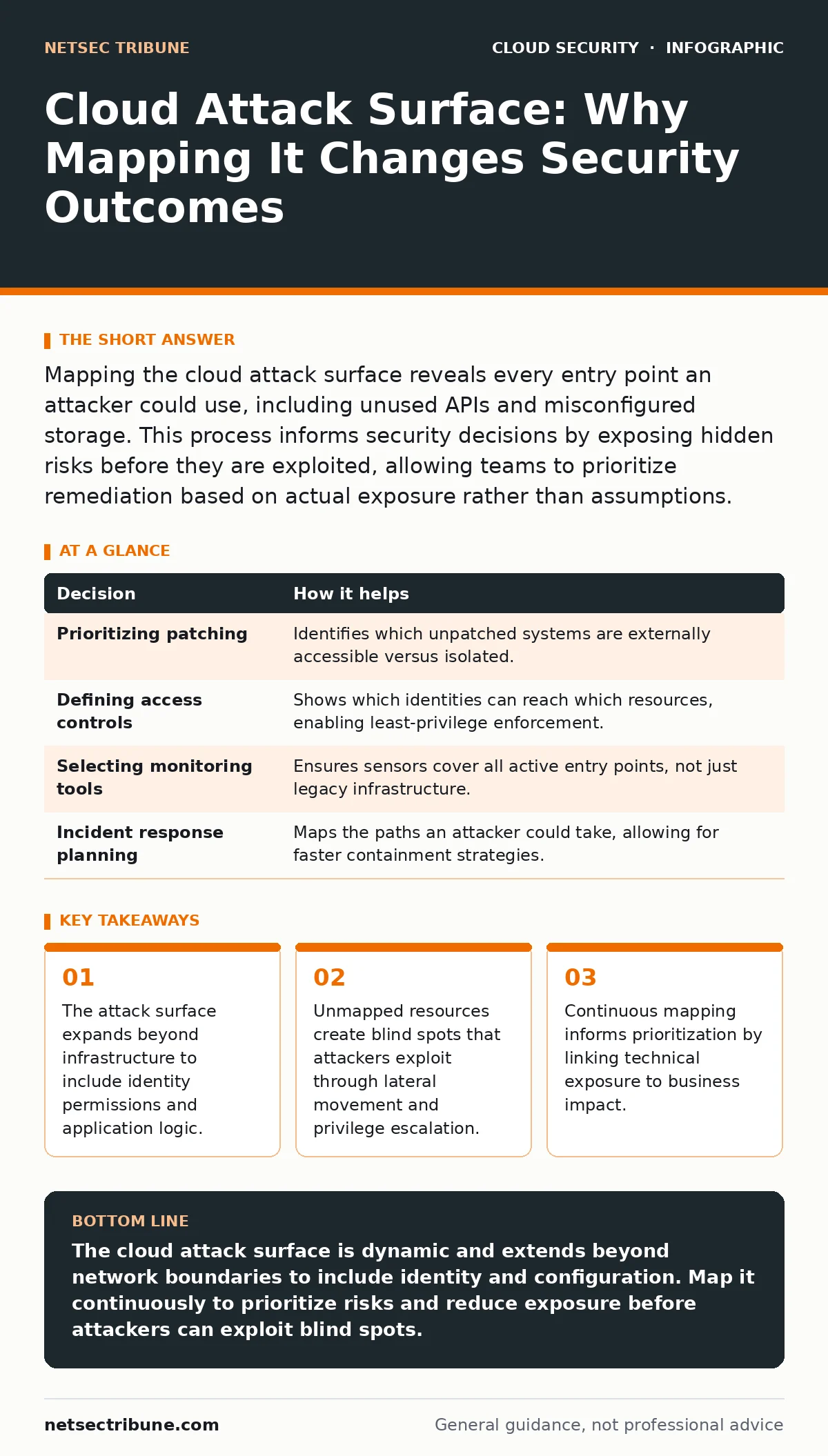
Mapping the cloud attack surface reveals every entry point an attacker could use, including unused APIs and misconfigured storage. This process informs security decisions by exposing hidden risks before they are exploited, allowing teams to prioritize remediation based on actual exposure rather than assumptions.
Defining the Boundaryless Edge
Traditional security models relied on a fixed perimeter. Firewalls protected a known set of servers behind a static IP address. The cloud dissolves this boundary. Your infrastructure exists in shared environments, accessed via software-defined networks and public APIs. The attack surface is no longer a wall; it is a collection of every interface, identity, and configuration that exposes your data.
This shift means that an open storage bucket or an overly permissive service account is as dangerous as an unpatched server. You must define the attack surface as the sum of all accessible endpoints. This includes virtual machines, containers, serverless functions, and the identities that interact with them. If you cannot see it, you cannot secure it.
The Cost of Blind Spots
When teams fail to map their cloud attack surface, they operate with incomplete visibility. They assume that because a resource is internal, it is safe. This assumption fails in cloud environments where internal networks are often flat and highly interconnected. An attacker who compromises a low-privilege account can move laterally to high-value assets if the paths between them are not monitored.
Blind spots also accumulate over time. Developers spin up resources for testing and forget to delete them. These orphaned cloud resources remain connected to the network, often with default permissions. They become silent entry points. Without a map, you do not know these resources exist until an attacker does. The cost is not just the breach, but the time spent searching for the origin of the compromise.
Decisions Informed by Visibility
Mapping the attack surface is not an end in itself. It is a tool for decision-making. It answers specific questions about risk and resource allocation. You use the data to determine which controls to implement first. It helps you distinguish between noise and signal in your security alerts.
The following table shows how specific decisions rely on an accurate understanding of the attack surface.
| Decision | How it helps |
|---|---|
| Prioritizing patching | Identifies which unpatched systems are externally accessible versus isolated. |
| Defining access controls | Shows which identities can reach which resources, enabling least-privilege enforcement. |
| Selecting monitoring tools | Ensures sensors cover all active entry points, not just legacy infrastructure. |
| Incident response planning | Maps the paths an attacker could take, allowing for faster containment strategies. |
Without this data, you prioritize based on guesswork. You might patch a server that no one can reach while leaving a vulnerable API exposed to the internet. The map forces you to align security efforts with actual risk.
Identity as the New Perimeter
In the cloud, identity replaces the network as the primary control plane. Every request to a cloud service must be authenticated and authorized. This means that user accounts, service principals, and application roles are part of the attack surface. A leaked access key is equivalent to a broken lock on a physical door.
Teams often focus on network security while neglecting identity hygiene. They configure firewalls but leave service accounts with broad administrative rights. This creates a fragile security posture. An attacker who bypasses the network controls can still operate freely if they possess valid credentials. You must treat identity permissions as part of the surface area. Regular audits of access key rotation and role assignments are necessary to shrink this surface.
Configuration as Exposure
Cloud resources are defined by code and configuration. A misconfigured setting can expose sensitive data or allow unauthorized access. These are not bugs in the software; they are errors in how the service is set up. The attack surface includes every configuration parameter that deviates from secure defaults.
Common misconfigurations include public access to databases, unrestricted cross-origin resource sharing, and disabled logging. These errors are often introduced during rapid development cycles. Developers focus on functionality, not security. The result is a growing number of vulnerable configurations. You need automated checks to detect these drifts. Relying on manual reviews is too slow and error-prone. See our guide on Kubernetes misconfigurations for specific patterns to watch for in container orchestration environments.
See also: CIS Benchmarks Explained: How to Build a Secure Baseline · Cloud Penetration Testing: Seven Practices for Realistic Assessment
Operationalizing the Map
A static map becomes outdated quickly. Cloud environments change constantly. New resources are deployed, permissions are updated, and services are retired. Your attack surface management must be continuous. You need tools that scan your environment regularly and update the map in real time.
This process integrates with your development pipeline. Security checks run before code is deployed. This prevents new exposures from being introduced. It also helps in post-incident analysis. When a breach occurs, you can trace the attacker’s path through your mapped surface. This informs your cloud incident response procedures. You learn not just what happened, but how the environment allowed it.
The Limits of Automation
Automation helps, but it does not replace human judgment. Scanning tools can identify open ports and public buckets. They cannot always determine if a resource is critical to business operations. Context matters. A public-facing web server has a different risk profile than a public-facing test server.
You must combine technical data with business context. This means tagging resources with their purpose and owner. It means understanding which data resides where. Without this context, you cannot prioritize effectively. You will spend time fixing low-risk issues while high-risk exposures remain. This is where frameworks like CIS Benchmarks provide a baseline, but you must adapt them to your specific environment.
Building a Resilient Posture
Reducing the attack surface is an ongoing process. You cannot eliminate all risks. You can only manage them. The goal is to make it difficult for attackers to find and exploit vulnerabilities. This requires a combination of technical controls, process discipline, and continuous monitoring.
You should integrate security into every stage of the lifecycle. From design to deployment to retirement. This approach, often called security by design, reduces the number of surprises. It also supports zero trust network access principles by verifying every request regardless of origin. By treating every component as potentially compromised, you limit the damage of any single breach.
Key takeaways
- The attack surface expands beyond infrastructure to include identity permissions and application logic.
- Unmapped resources create blind spots that attackers exploit through lateral movement and privilege escalation.
- Continuous mapping informs prioritization by linking technical exposure to business impact.
The cloud attack surface is dynamic and extends beyond network boundaries to include identity and configuration. Map it continuously to prioritize risks and reduce exposure before attackers can exploit blind spots.
Frequently asked questions
How often should I scan my cloud attack surface?
You should scan continuously or at least daily. Cloud environments change rapidly, and static scans become outdated quickly. Continuous monitoring ensures you detect new exposures as soon as they appear.
Does a smaller attack surface mean better security?
Generally, yes. A smaller surface means fewer entry points for attackers. However, size is not the only factor. The security of each remaining entry point matters. A small surface with weak controls is still vulnerable.
Can I automate the entire mapping process?
You can automate the discovery and scanning parts. However, you still need human oversight to interpret the results and prioritize remediation. Automation helps with scale, but context requires human judgment.
How does this relate to compliance requirements?
Most compliance frameworks require you to know what assets you have and how they are protected. Mapping the attack surface provides the evidence needed for audits. It shows you have visibility and control over your environment.
How this guide was produced: written by the NetSec Tribune editorial team with AI assistance, checked against the public references listed below, and reviewed when the facts change. See our editorial policy or report an error.