
Cloud Penetration Testing: Seven Practices for Realistic Assessment
Most cloud penetration tests fail because they treat infrastructure like traditional servers, ignoring the unique attack surface of APIs and identity services.
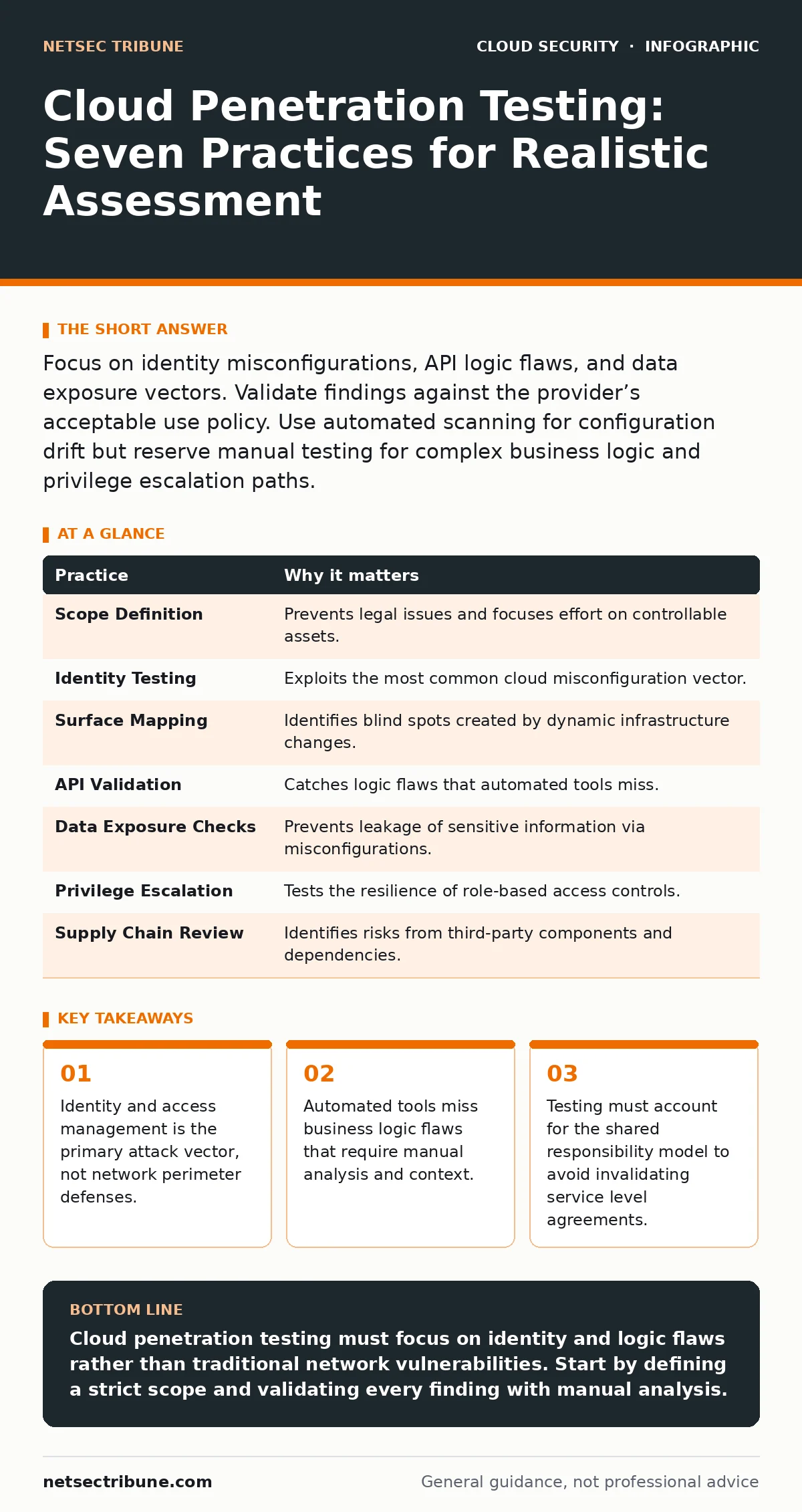
Focus on identity misconfigurations, API logic flaws, and data exposure vectors. Validate findings against the provider’s acceptable use policy. Use automated scanning for configuration drift but reserve manual testing for complex business logic and privilege escalation paths.
Defining the Scope Within Shared Responsibility
Cloud environments operate under a shared responsibility model. The provider secures the underlying hardware and hypervisor, while you secure your data, configurations, and access controls. A penetration test that attempts to attack the provider’s infrastructure is not only ineffective but often violates terms of service. You must clearly define which components fall under your control. This includes virtual machines, storage buckets, serverless functions, and application code.
Imagine you are testing a web application hosted on a platform as a service. The network layer is abstracted away by the provider. If your scope includes the network gateway, you will waste time scanning ports that do not exist in the traditional sense. Instead, focus on the application layer and the identity layer. This shift requires a different mindset than traditional infrastructure testing.
Prioritizing Identity Over Network Perimeter
In traditional data centers, the firewall was the first line of defense. In the cloud, the perimeter is defined by identity and access management. Attackers rarely bypass firewalls in modern cloud environments; they compromise credentials or exploit overly permissive roles. You must test how your system handles authentication and authorization. This includes checking for broken object-level authorization, where a user can access another user’s data by changing an ID parameter.
Suppose a developer creates a role that allows read access to all storage buckets in an account. An attacker who gains access to a low-privilege service account can escalate privileges to that role. Automated scanners often miss these logical flaws. You must manually trace the path of least privilege. Check for roles that grant excessive permissions, such as administrative access to resources that should be isolated.
Mapping the Cloud Attack Surface
Your cloud attack surface extends beyond your owned infrastructure. It includes third-party integrations, public APIs, and misconfigured services exposed to the internet. Many organizations focus on their primary application but neglect the supporting services. A misconfigured database or a debug endpoint can provide an entry point into the core system. You need to map all external-facing assets.
This mapping must be dynamic. Cloud environments change rapidly due to automated deployments and infrastructure as code. A static list of assets becomes outdated quickly. Use continuous discovery tools to identify new resources. Compare these resources against your approved inventory. Any resource that appears without authorization represents a blind spot in your security posture. Refer to guides on cloud attack surface management for deeper strategies on maintaining visibility.
| Practice | Why it matters |
|---|---|
| Scope Definition | Prevents legal issues and focuses effort on controllable assets. |
| Identity Testing | Exploits the most common cloud misconfiguration vector. |
| Surface Mapping | Identifies blind spots created by dynamic infrastructure changes. |
| API Validation | Catches logic flaws that automated tools miss. |
| Data Exposure Checks | Prevents leakage of sensitive information via misconfigurations. |
| Privilege Escalation | Tests the resilience of role-based access controls. |
| Supply Chain Review | Identifies risks from third-party components and dependencies. |
Validating API Business Logic
Application programming interfaces drive most cloud interactions. Standard vulnerability scanners check for common input validation errors. They do not understand the business rules that govern your application. You must test the logic of your APIs manually. This involves understanding the workflow and attempting to bypass it. For example, try to complete a transaction without passing through the payment step.
Imagine an API that allows users to update their profile. The endpoint accepts a JSON payload. An attacker might add a field for "admin status" and set it to true. If the backend does not validate this field against the user’s actual role, the attacker escalates privileges. This is a business logic flaw. It does not trigger traditional security alerts because the input is syntactically correct. You must think like a user who wants to bypass rules, not just break syntax.
Checking for Data Exposure Misconfigurations
Data exposure often results from simple configuration errors rather than sophisticated exploits. Storage buckets, databases, and compute instances can be accidentally left public. You must verify that data at rest and in transit is properly encrypted and access-controlled. Check for default credentials and unused services that may still be exposed.
Suppose a development team creates a storage bucket for temporary files. They forget to set the access policy to private. The bucket becomes accessible to anyone on the internet. An attacker can download sensitive data or upload malicious files. Automated tools can detect open buckets, but you must verify that the data inside is not sensitive. Context matters. A public bucket containing marketing images is less risky than one containing customer records.
See also: CIS Benchmarks Explained: How to Build a Secure Baseline · Cloud Incident Response for Small Teams: Low-Cost Setup
Testing Privilege Escalation Paths
Privilege escalation allows an attacker with low-level access to gain higher privileges. In cloud environments, this often involves exploiting misconfigured identity and access management policies. You should test whether a compromised service account can assume more powerful roles. Check for trust relationships that allow external accounts to assume roles within your environment.
This testing is particularly critical in environments using multiple accounts. An attacker might move laterally from a compromised account to a management account. If the management account has administrative access to all resources, the breach becomes total. You must map the trust relationships between accounts. Look for overly broad trust policies that allow any principal to assume a role. Refer to CIS Benchmarks for standard configurations that help reduce these risks.
Reviewing Supply Chain and Dependencies
Your cloud environment likely relies on third-party libraries, containers, and infrastructure templates. These components introduce supply chain risks. A vulnerable library in your application can be exploited even if your code is secure. You must test your dependencies for known vulnerabilities. This includes container images and infrastructure as code templates.
Imagine you use a public container image for your application. The base image contains an outdated operating system library with a known remote code execution vulnerability. An attacker can exploit this vulnerability to gain access to your container. You cannot control the security of the upstream provider, but you can control which versions you use. Implement a process to scan and update dependencies regularly. This is part of a broader zero trust network access strategy, where no component is trusted by default.
Documenting and Validating Findings
A penetration test is only valuable if the findings are actionable. You must document each finding with clear steps to reproduce it. This allows your development and operations teams to understand the risk and fix it. Include the potential impact of the vulnerability. A finding that allows an attacker to read data is more critical than one that only allows them to crash a service.
Validation is the final step. After the team applies fixes, you must re-test to confirm the vulnerability is closed. Some fixes introduce new issues. For example, blocking a specific input might break legitimate functionality. You must balance security with usability. Use automated tools to monitor for regressions. This ensures that new code does not reintroduce old vulnerabilities.
Key takeaways
- Identity and access management is the primary attack vector, not network perimeter defenses.
- Automated tools miss business logic flaws that require manual analysis and context.
- Testing must account for the shared responsibility model to avoid invalidating service level agreements.
Cloud penetration testing must focus on identity and logic flaws rather than traditional network vulnerabilities. Start by defining a strict scope and validating every finding with manual analysis.
Frequently asked questions
How often should cloud penetration testing be performed?
Perform tests after significant changes to the architecture or infrastructure. Continuous monitoring should supplement periodic manual testing.
Can automated tools replace manual cloud penetration testing?
No. Automated tools miss business logic flaws and complex privilege escalation paths that require human intuition and context.
What is the difference between cloud pentesting and traditional pentesting?
Cloud pentesting focuses on identity, APIs, and configuration drift, whereas traditional pentesting focuses on network perimeter and server vulnerabilities.
Is it safe to test production environments?
Only with explicit permission and careful scoping. Testing can cause outages. Use staging environments that mirror production for most tests.
How this guide was produced: written by the NetSec Tribune editorial team with AI assistance, checked against the public references listed below, and reviewed when the facts change. See our editorial policy or report an error.