WebSocket Vulnerabilities: 8 Critical Questions Answered
WebSocket connections bypass traditional web security controls, allowing attackers to exploit authenticated sessions with minimal detection overhead.
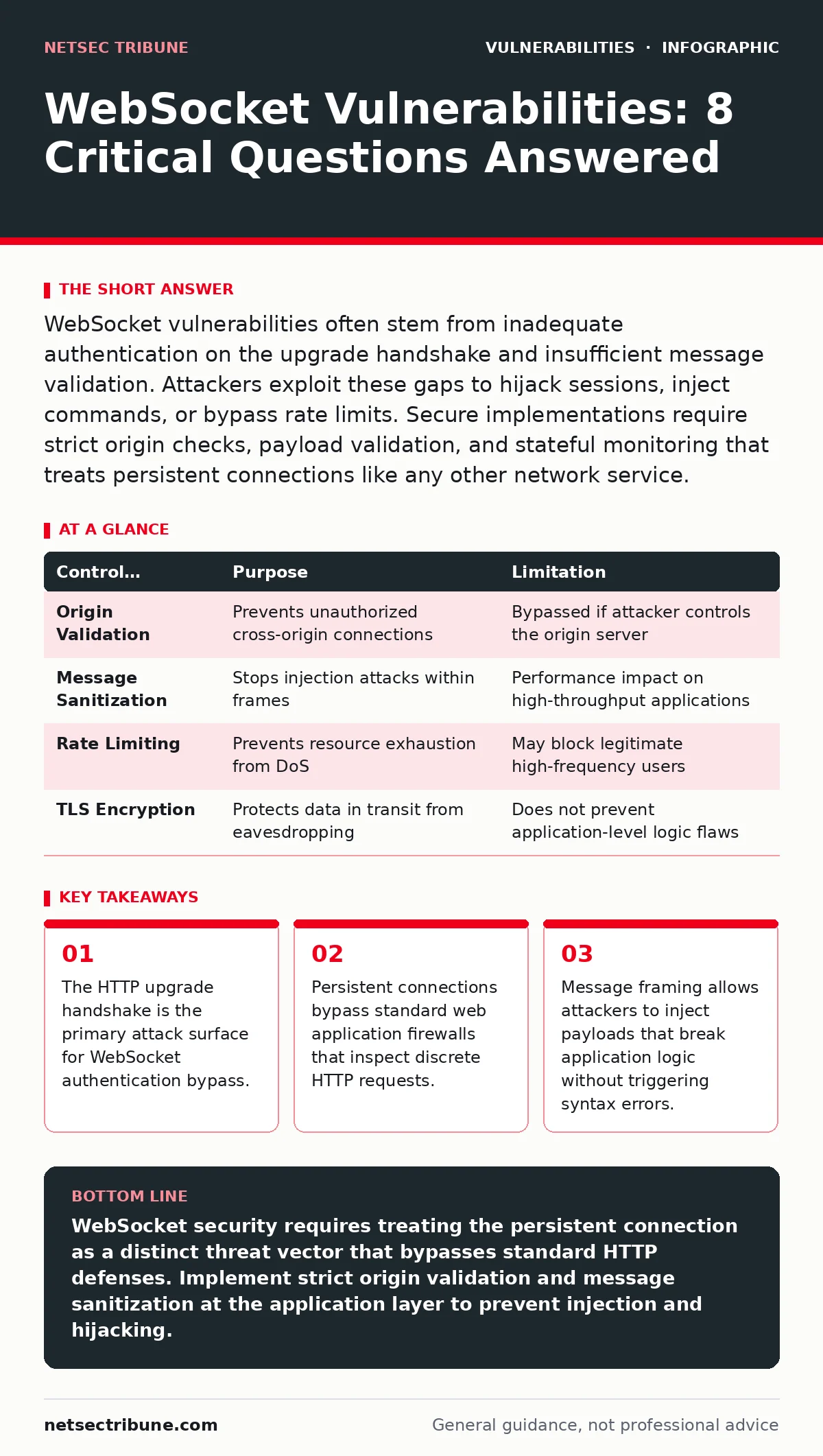
WebSocket vulnerabilities often stem from inadequate authentication on the upgrade handshake and insufficient message validation. Attackers exploit these gaps to hijack sessions, inject commands, or bypass rate limits. Secure implementations require strict origin checks, payload validation, and stateful monitoring that treats persistent connections like any other network service.
Does WebSocket bypass traditional HTTP security controls?
WebSocket connections bypass traditional HTTP security controls because they establish a persistent, full-duplex channel after the initial handshake. Once the connection upgrades from HTTP to the WebSocket protocol, the server no longer processes discrete request-response cycles. This means standard web application firewalls that inspect individual HTTP headers and bodies often stop inspecting traffic. The connection remains open, allowing data to flow in both directions without the overhead of new TCP handshakes. Security teams must treat this persistent tunnel as a distinct attack surface.
How do attackers exploit the WebSocket handshake?
Attackers exploit the WebSocket handshake by targeting the initial HTTP request that upgrades the connection to the WebSocket protocol. This handshake uses standard HTTP methods, making it vulnerable to injection attacks if the server improperly parses headers. An attacker can inject malicious headers or manipulate the Origin field to bypass security policies. If the server accepts the upgrade without validating the client's identity, the attacker gains a legitimate channel. This mirrors risks found in HTTP request smuggling, where ambiguous parsing allows attackers to confuse the server's view of the connection.
Can WebSocket connections be hijacked via session tokens?
WebSocket connections can be hijacked via session tokens if the application embeds authentication credentials in the handshake or the first message. Many developers assume that because the connection is persistent, the initial authentication suffices for the entire session. This assumption fails when the server does not re-validate tokens for subsequent messages. An attacker who steals a valid session cookie can initiate a new WebSocket connection. The server accepts the connection, believing the user is authenticated. This risk is similar to cross-site request forgery (CSRF) vulnerabilities, where stolen credentials are used to perform unauthorized actions.
Do WebSockets protect against cross-origin attacks?
WebSockets do not inherently protect against cross-origin attacks unless the server explicitly validates the Origin header during the handshake. The WebSocket specification allows servers to reject connections from unauthorized origins, but many implementations ignore this check. An attacker can host a malicious page on a different domain and initiate a WebSocket connection to your server. If the server accepts the connection, the attacker can send and receive data on behalf of the victim. This bypasses the browser's same-origin policy for data exchange. Proper configuration requires the server to whitelist allowed origins.
How does message framing create injection vulnerabilities?
Message framing creates injection vulnerabilities because WebSocket messages are sent as discrete frames that the application must parse. If the application concatenates these frames without proper validation, an attacker can inject malicious payloads. For example, a chat application might treat each WebSocket message as a new line of text. An attacker can send a message containing HTML or JavaScript code. If the server reflects this code back to other users without sanitization, it results in cross-site scripting. This is distinct from traditional HTTP injection because the framing layer handles the data boundaries.
See also: Compensating Controls: When Standard Fixes Fail
Can WebSockets be used for denial-of-service attacks?
WebSockets can be used for denial-of-service attacks by opening thousands of persistent connections that consume server resources. Unlike HTTP requests that close after a response, WebSocket connections remain open indefinitely. An attacker can open many connections and keep them alive, exhausting the server's file descriptors or memory. This is known as a slowloris-style attack but adapted for persistent protocols. The server must allocate resources for each active connection. Rate limiting the number of connections per IP address mitigates this risk.
What is the role of compression in WebSocket security?
Compression in WebSocket security introduces the risk of decompression bombs and side-channel attacks. The WebSocket extension permessage-deflate allows clients and servers to compress messages. An attacker can send small, crafted messages that expand to large sizes when decompressed. This consumes server CPU and memory, leading to denial of service. Additionally, compression can leak information about the content of messages through timing side channels. Disabling compression or limiting the expansion ratio prevents these attacks. This trade-off between performance and security is often overlooked.
How do security teams monitor WebSocket traffic?
Security teams monitor WebSocket traffic by implementing deep packet inspection that understands the WebSocket frame structure. Standard network monitors see only the initial HTTP upgrade and then a stream of encrypted or opaque data. Specialized tools must decode the WebSocket frames to inspect the payload. This allows detection of malicious patterns, such as repeated injection attempts or unusual data volumes. Integrating this monitoring with compensating controls ensures that even if perimeter defenses fail, internal detection systems alert the team. Visibility into the persistent channel is critical for incident response.
| Control Mechanism | Purpose | Limitation |
|---|---|---|
| Origin Validation | Prevents unauthorized cross-origin connections | Bypassed if attacker controls the origin server |
| Message Sanitization | Stops injection attacks within frames | Performance impact on high-throughput applications |
| Rate Limiting | Prevents resource exhaustion from DoS | May block legitimate high-frequency users |
| TLS Encryption | Protects data in transit from eavesdropping | Does not prevent application-level logic flaws |
Does TLS encryption solve all WebSocket vulnerabilities?
TLS encryption does not solve all WebSocket vulnerabilities because it only protects data in transit from eavesdropping and tampering. It does not validate the content of the messages or the identity of the sender. An attacker with a valid session can send malicious payloads over an encrypted channel. The server will decrypt and process them without raising an alarm. TLS prevents man-in-the-middle attacks but does not stop application-layer exploits. Security teams must implement additional controls beyond encryption.
How do WebSockets interact with exposure management?
WebSockets interact with exposure management by adding persistent channels to the attack surface inventory. Traditional exposure management tools scan for open ports and known services. They may miss WebSocket endpoints if they only look for standard HTTP responses. These endpoints can expose sensitive data if misconfigured. Including WebSocket endpoints in exposure management practices ensures that security teams know where these connections exist. This visibility helps prioritize remediation efforts for high-risk services.
What are the common security misconfigurations with WebSockets?
Common security misconfigurations with WebSockets include disabling origin checks, allowing unauthenticated connections, and failing to validate message sizes. Developers often prioritize performance over security, leaving these settings at default values. Default configurations may allow connections from any origin or accept excessively large messages. These misconfigurations make it easy for attackers to inject payloads or exhaust resources. Regular audits of WebSocket configurations identify these gaps. This aligns with broader efforts to reduce security misconfigurations across the infrastructure.
Key takeaways
- The HTTP upgrade handshake is the primary attack surface for WebSocket authentication bypass.
- Persistent connections bypass standard web application firewalls that inspect discrete HTTP requests.
- Message framing allows attackers to inject payloads that break application logic without triggering syntax errors.
WebSocket security requires treating the persistent connection as a distinct threat vector that bypasses standard HTTP defenses. Implement strict origin validation and message sanitization at the application layer to prevent injection and hijacking.
Frequently asked questions
Can a WebSocket connection be used to exfiltrate data silently?
Yes, because the persistent channel allows continuous data flow without the overhead of new connections, making it harder for standard network monitors to detect unusual traffic patterns.
Do WebSockets work over HTTP or only HTTPS?
WebSockets can work over both, but unencrypted WebSocket connections (ws://) expose data to eavesdropping. Secure implementations must use wss:// (WebSocket Secure) which runs over TLS.
How does WebSocket security differ from HTTP security?
HTTP security focuses on discrete request-response cycles, while WebSocket security must handle persistent, bidirectional streams. This requires different validation and monitoring strategies.
Are WebSockets vulnerable to replay attacks?
Yes, if messages are not uniquely identified or timestamped, an attacker can capture and resend valid messages to trigger unintended actions.
How this guide was produced: written by the NetSec Tribune editorial team with AI assistance, checked against the public references listed below, and reviewed when the facts change. See our editorial policy or report an error.