
Mass Assignment Prevention: How to Block Property Overwrites
Mass assignment fails when code trusts user input to update objects, allowing attackers to change roles or settings the application never intended to expose.
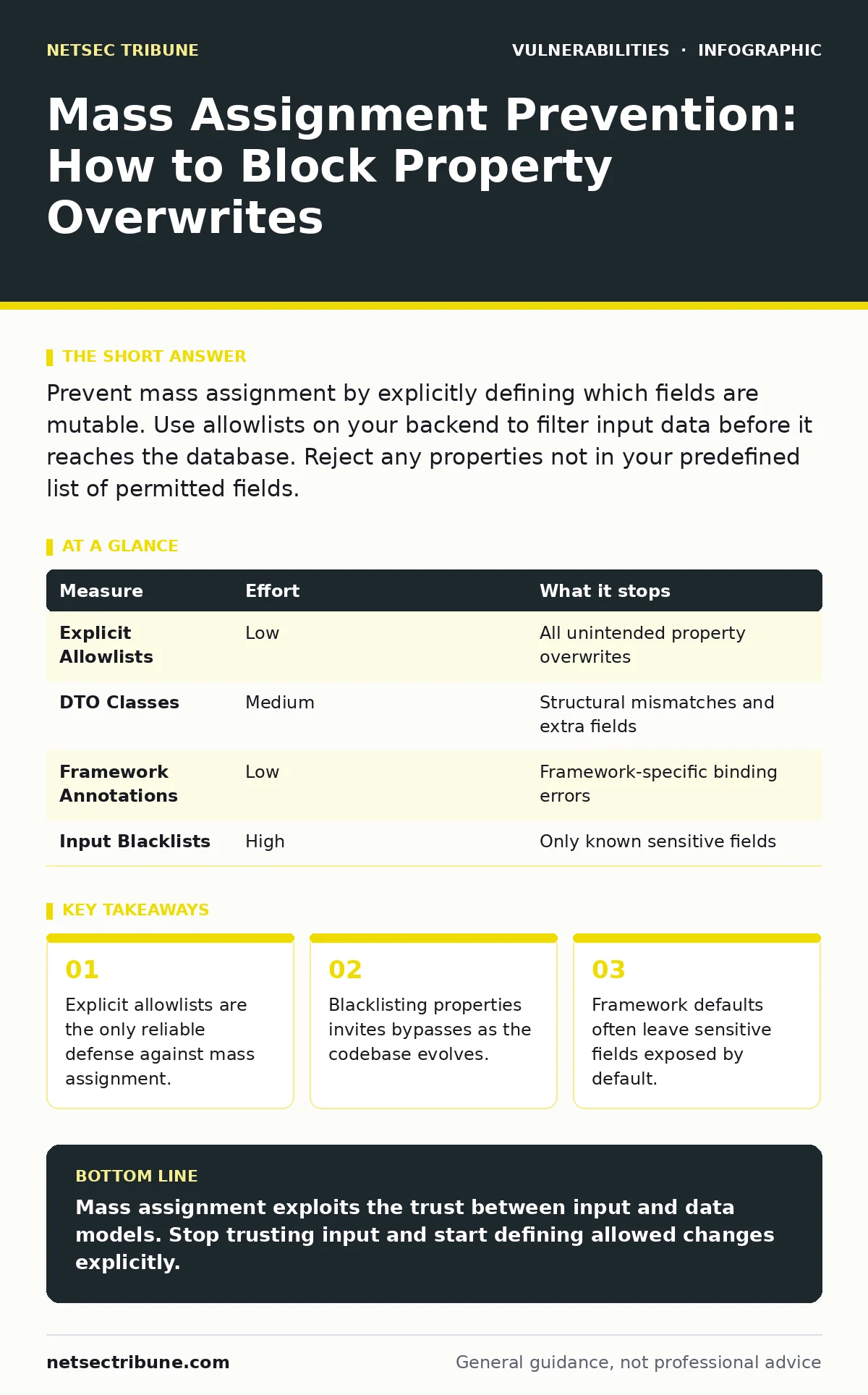
Prevent mass assignment by explicitly defining which fields are mutable. Use allowlists on your backend to filter input data before it reaches the database. Reject any properties not in your predefined list of permitted fields.
The Silent Data Overwrite
Mass assignment occurs when an application binds user input directly to a data object without filtering. The framework maps every submitted field to a corresponding property in the model. If the model includes a property like isAdmin or role, and the application accepts all input keys, an attacker can set those values. This is not a bug in the database. It is a logic error in how the application processes incoming requests.
The danger lies in the assumption that only visible form fields are sent. Browsers hide this detail. An attacker uses tools to modify the request body. They add extra parameters that the user never saw. The server processes them exactly as if they were part of the form. This bypasses user interface restrictions entirely.
Why Blacklists Fail
Many developers try to solve this by excluding specific fields. They create a list of properties to ignore, such as id, password, or role. This approach seems efficient. It requires less code to maintain than an allowlist. However, it is fundamentally fragile. New properties are added to models over time. A developer might add isDeleted or creditLimit later. If they forget to add these to the exclusion list, they become vulnerable.
This creates a race condition between code updates and security patches. Every new feature introduces a potential entry point. You must audit the exclusion list every time the schema changes. This adds cognitive load to every developer on the team. It shifts the burden of security to memory rather than code structure.
The Allowlist Mechanism
The correct approach is to define exactly which fields can be modified. You create a whitelist of permitted properties for each operation. When a request arrives, the application checks each key against this list. Any key not on the list is discarded before the object is updated. This ensures that only intended data changes. It also provides a clear contract for the API.
This method works because it assumes all input is hostile. It does not trust the source of the data. It only trusts the predefined structure. This aligns with the principle of least privilege. You grant access only to the specific attributes necessary for the action. Everything else is rejected by default.
| Measure | Effort | What it stops |
|---|---|---|
| Explicit Allowlists | Low | All unintended property overwrites |
| DTO Classes | Medium | Structural mismatches and extra fields |
| Framework Annotations | Low | Framework-specific binding errors |
| Input Blacklists | High | Only known sensitive fields |
Using Data Transfer Objects
Data Transfer Objects, or DTOs, provide a clean way to enforce boundaries. A DTO is a simple object that carries data between processes. It contains only the fields the client is allowed to modify. You map the incoming request to the DTO. Then you map the DTO to the internal domain model. This separation ensures that the internal model never receives raw user input.
This pattern adds a layer of indirection. It requires more code to write initially. However, it makes the code easier to audit. You can inspect the DTO definition to see exactly what data enters the system. If the DTO lacks a role field, the role cannot be changed. This removes ambiguity from the data flow. It also helps with documentation. The DTO acts as a self-documenting interface.
Framework Specifics and Pitfalls
Most modern frameworks provide mechanisms to control binding. Some use attributes or annotations to mark fields as ignored. Others require you to specify a list of included fields. It is critical to read the documentation for your specific stack. Some frameworks default to including all fields unless told otherwise. Others default to excluding all fields unless told otherwise.
Assuming the framework is secure by default is a common mistake. Many teams inherit codebases where the default settings were never reviewed. These settings might have been appropriate years ago. They may no longer reflect the current data model. You must verify the binding configuration in every service. Do not assume that a recent update fixed this. Configuration drift is a frequent cause of security misconfigurations.
See also: What Is Input Validation: How to Stop Bad Data From Breaking Systems
Edge Cases in Nested Objects
Mass assignment becomes more complex with nested objects. Suppose your API accepts a user profile that includes an address. The address object has its own properties. If the application uses deep binding, it will map all nested fields. An attacker can inject properties into the nested object. They might overwrite an internal audit timestamp or a reference ID.
You must apply the allowlist principle to nested structures. This means defining allowed fields for the parent and each child object. Some frameworks support this through nested DTOs. Others require manual validation. If you do not control the depth of binding, you leave the door open for deeper injection. This is similar to how path traversal vulnerabilities exploit nested directory references. You must restrict the scope at every level.
Validation Is Not Protection
Input validation checks if data is well-formed. It checks if an email looks like an email. It checks if a number is within a range. It does not check if the field should be updated at all. Validation runs after binding in many frameworks. By then, the damage may already be done. The object has already been updated with the malicious value.
Do not confuse validation with authorization. Validation ensures data quality. Authorization ensures data access rights. You need both. But validation alone cannot stop mass assignment. You must filter the input keys before any validation or processing occurs. This order of operations is critical. It prevents the application from ever seeing the unauthorized fields.
Closing Checklist
Implementing these controls reduces the attack surface significantly. It removes the reliance on developer memory. It enforces security through code structure. You should integrate these checks into your development workflow. Make them part of the code review process. Ensure that every new endpoint has a defined set of mutable fields.
- Audit all API endpoints for mass assignment risks.
- Implement allowlists for every write operation.
- Review framework binding defaults and override if necessary.
Key takeaways
- Explicit allowlists are the only reliable defense against mass assignment.
- Blacklisting properties invites bypasses as the codebase evolves.
- Framework defaults often leave sensitive fields exposed by default.
Mass assignment exploits the trust between input and data models. Stop trusting input and start defining allowed changes explicitly.
Frequently asked questions
Does using HTTPS prevent mass assignment?
No. HTTPS encrypts data in transit but does not filter which fields are accepted. The server still binds the decrypted input to the model.
Can client-side validation stop this attack?
No. Attackers bypass the browser and send requests directly to the server. Client-side checks are for user convenience, not security.
How does this relate to broken access control?
Mass assignment is a subset of broken access control. It allows unauthorized modification of data properties that should be restricted.
Should I disable dynamic binding in my framework?
Yes. Disabling dynamic binding forces you to define explicit mappings. This removes the default behavior that leads to mass assignment.
How this guide was produced: written by the NetSec Tribune editorial team with AI assistance, checked against the public references listed below, and reviewed when the facts change. See our editorial policy or report an error.