
Race Conditions Explained: How Timing Errors Compromise Security
Race conditions exploit the split-second gap between a system checking permissions and executing an action, allowing attackers to bypass security controls.
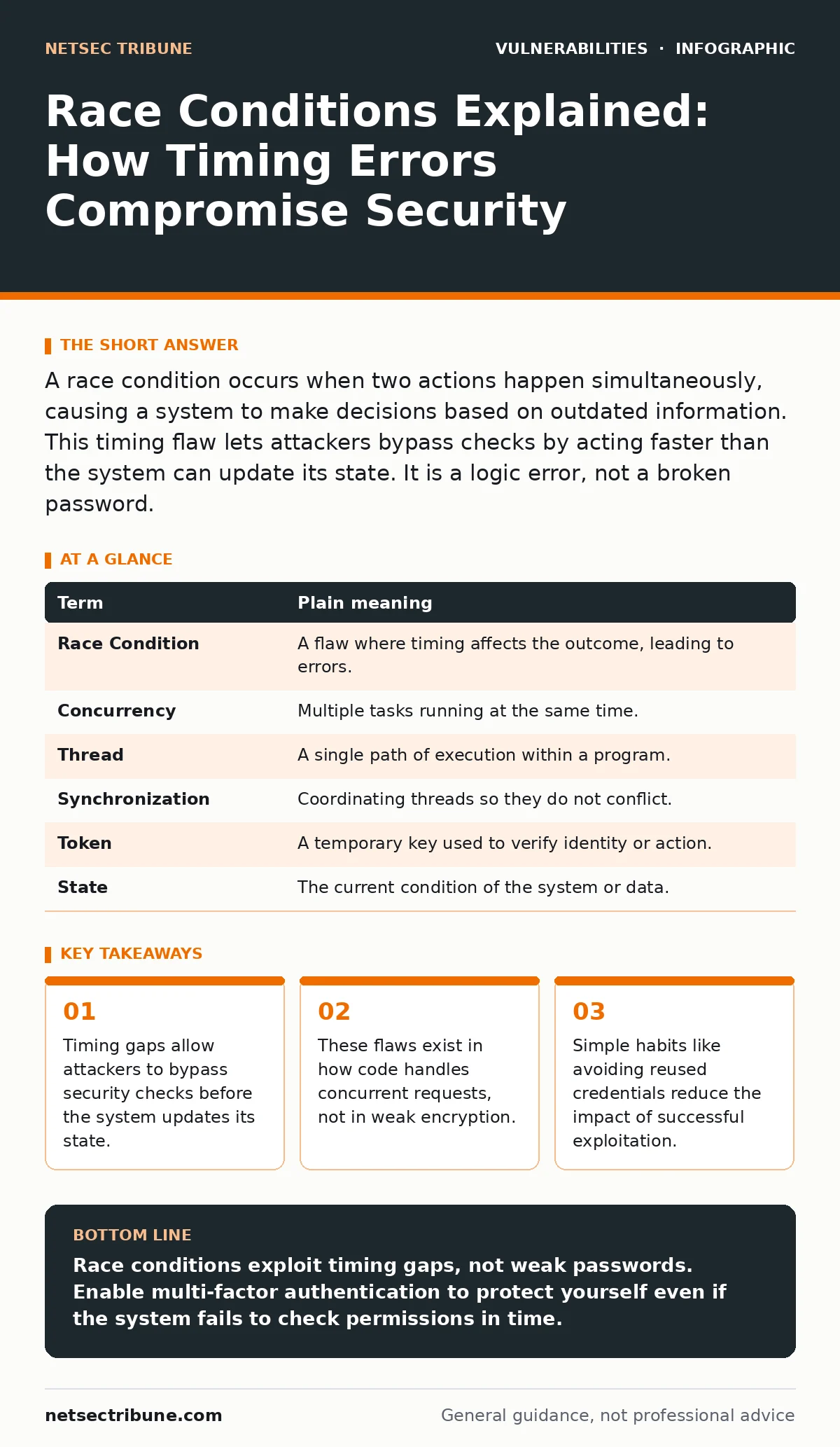
A race condition occurs when two actions happen simultaneously, causing a system to make decisions based on outdated information. This timing flaw lets attackers bypass checks by acting faster than the system can update its state. It is a logic error, not a broken password.
The Checkout Counter Analogy
Imagine a busy grocery store with a single cashier and a strict rule: you must pay before you leave. The cashier checks your total, then rings up the payment. Now, suppose two friends try to buy the same limited-edition item at the exact same moment. The cashier scans the item for Friend A, sees it is in stock, and starts processing. Before the register updates the inventory to "sold," Friend B scans the same item. The register still shows it is available. Both friends pay and walk out with the item. The system failed because the check for availability and the update of the inventory were not locked together.
This is the core of a race condition. In computing, a race condition happens when the behavior of a system depends on the sequence or timing of uncontrollable events. The system "races" to complete tasks, and if the order changes unexpectedly, the result can be wrong. In security, this wrong result often means an attacker gains access they should not have.
How the Glitch Manifests in Code
Software often processes multiple requests at once to remain fast. This is called concurrency. When a program handles two requests that touch the same data, it must coordinate them. If it does not, the second request might read data that the first request has not yet finished changing.
Consider a password reset feature. The system generates a token, sends an email, and then waits for you to use that token. If the code does not lock the token as "used" immediately upon the first successful reset, an attacker who intercepts the token can try to use it at the same millisecond you do. If the system checks "is this token valid?" for both requests before it sets the flag "token is used," both requests succeed. You reset your password, and the attacker resets it too, locking you out.
The Hidden Cost of Speed
Developers often prioritize performance. Checking every action sequentially slows down applications. To keep sites fast, servers allow multiple threads to run. A thread is a single sequence of programmed instructions within a process. When threads run without proper synchronization, they step on each other.
The trade-off is clear: speed versus consistency. A system that checks every step one by one is safe but slow. A system that allows parallel processing is fast but risky if not designed carefully. Many vulnerabilities arise not from malicious code, but from good intentions to improve user experience. The system assumes that two people will not try to do the same conflicting thing at the exact same nanosecond. Attackers know this assumption is false.
What This Means for You
You do not write the code for the services you use. You cannot patch the server. However, you can understand the risk. A race condition does not mean your password is weak. It means the system’s logic has a blind spot in time. If an attacker exploits this, they can change your account state before you realize it.
This is distinct from broken access control, where a system simply fails to check if you are allowed to see a page. In a race condition, the system checks, but it checks stale information. It is also different from zero-day vulnerabilities, which are unknown flaws. Race conditions are a class of known logical errors, though specific instances may be undiscovered.
Simple Safety Habits
You cannot stop a server from racing, but you can limit the damage. If an attacker uses a race condition to take over your account, they need something to work with.
- Use unique passwords. If one account is compromised via a timing flaw, other accounts remain safe. Do not reuse credentials across banking, email, and social media.
- Enable multi-factor authentication. Even if an attacker resets your password by racing the system, they usually cannot race your physical phone or security key. This adds a step that is harder to automate.
- Monitor account activity. Log in regularly and check for changes you did not make. Early detection limits the time an attacker has to abuse the account.
These habits do not fix the bug, but they raise the cost for the attacker. They make the effort required to exploit the flaw not worth the reward.
See also: Compensating Controls: When Standard Fixes Fail
Related Security Concepts
Understanding race conditions helps you see other flaws. For example, path traversal vulnerabilities allow attackers to read files outside the intended folder. While different in mechanism, both rely on the system trusting input without proper validation. Similarly, mass assignment vulnerabilities occur when a system accepts more data than intended, updating fields it should ignore. Both are logic errors where the system does what it is told, rather than what it should do.
Mini Glossary
| Term | Plain meaning |
|---|---|
| Race Condition | A flaw where timing affects the outcome, leading to errors. |
| Concurrency | Multiple tasks running at the same time. |
| Thread | A single path of execution within a program. |
| Synchronization | Coordinating threads so they do not conflict. |
| Token | A temporary key used to verify identity or action. |
| State | The current condition of the system or data. |
Try This Now
- Audit your logins. Check your last five login attempts in your email and banking apps. Look for locations or devices you do not recognize.
- Enable 2FA. Turn on two-factor authentication for your most sensitive accounts. Use an app or hardware key, not just SMS.
- Update your software. Keep your browser and operating system current. Developers often patch race conditions in updates.
Key takeaways
- Timing gaps allow attackers to bypass security checks before the system updates its state.
- These flaws exist in how code handles concurrent requests, not in weak encryption.
- Simple habits like avoiding reused credentials reduce the impact of successful exploitation.
Race conditions exploit timing gaps, not weak passwords. Enable multi-factor authentication to protect yourself even if the system fails to check permissions in time.
Frequently asked questions
Can antivirus software detect race conditions?
No, antivirus scans for known malicious files. Race conditions are logical errors in how code runs, not a file you can delete.
Are race conditions common in mobile apps?
Yes, mobile apps often handle background processes and network requests concurrently, creating opportunities for timing flaws.
Does using a VPN stop race conditions?
No, a VPN hides your location and traffic content. It does not change the timing of requests between your device and the server.
How do developers fix race conditions?
They use locks or mutexes to ensure only one thread can access specific data at a time, preventing conflicts.
How this guide was produced: written by the NetSec Tribune editorial team with AI assistance, checked against the public references listed below, and reviewed when the facts change. See our editorial policy or report an error.