
Security Misconfigurations: Top Questions Answered
Identify why default settings fail, how to automate verification, and where human error bypasses your strongest encryption layers.
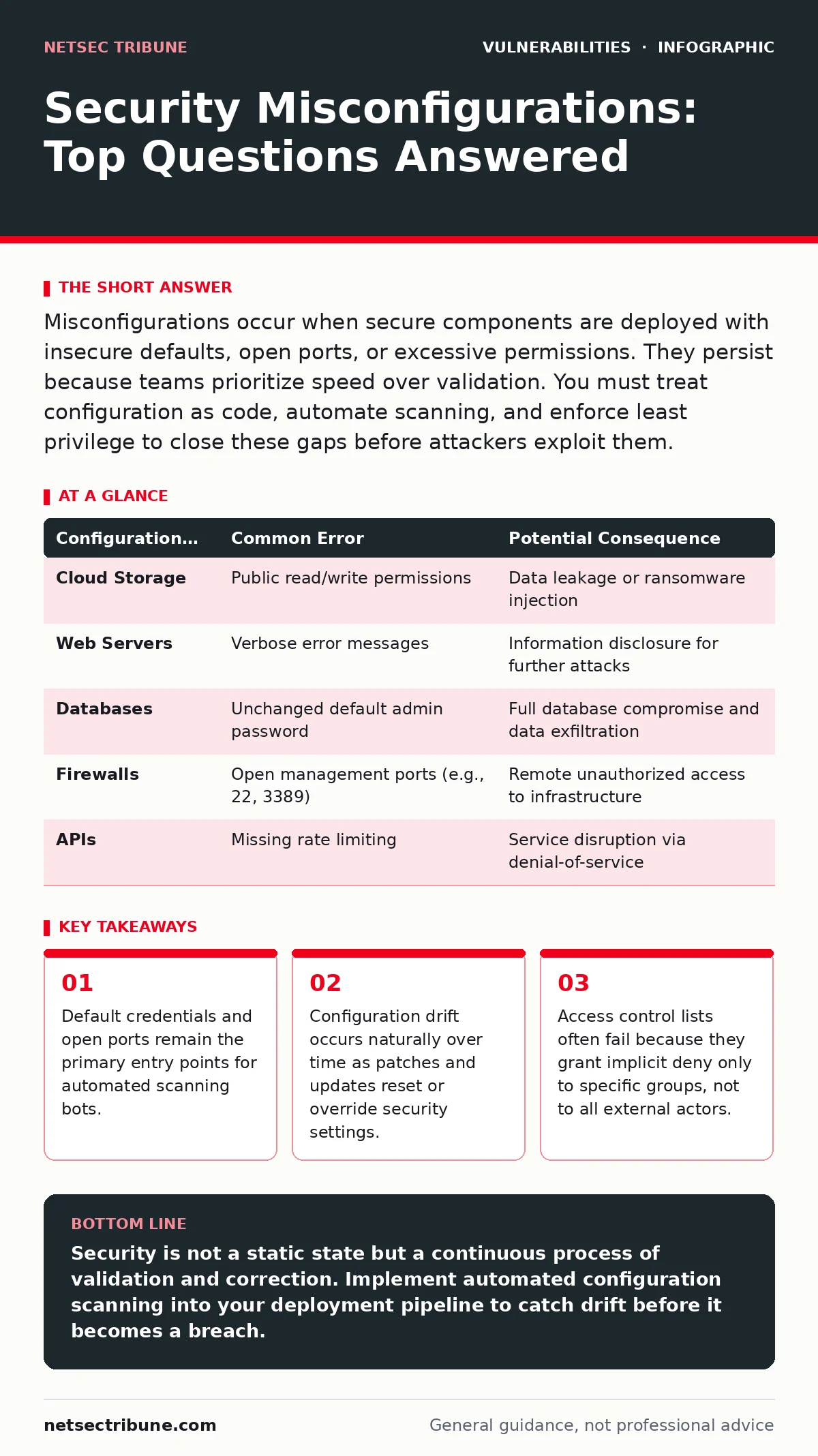
Misconfigurations occur when secure components are deployed with insecure defaults, open ports, or excessive permissions. They persist because teams prioritize speed over validation. You must treat configuration as code, automate scanning, and enforce least privilege to close these gaps before attackers exploit them.
What exactly is a security misconfiguration?
A security misconfiguration is the failure to set up a system, application, or network with the minimum necessary security controls. It is not a flaw in the software code itself, but rather an error in how that software is deployed or maintained. These errors range from leaving default administrative accounts active to exposing database ports to the public internet.
Why do misconfigurations persist even after deployment?
Persistence occurs because configuration management is rarely a one-time event. Systems evolve through patches, updates, and feature additions, each of which can reset or override previous security settings. This phenomenon, known as configuration drift, means that a system secured during launch may become vulnerable months later due to routine maintenance that lacked security validation.
How do default settings create immediate risk?
Manufacturers ship products with default credentials and open interfaces to facilitate easy initial setup. If an administrator deploys the product without changing these defaults, any automated scanner on the internet can identify and exploit the system within minutes. These defaults are public knowledge, often documented in user manuals or reverse-engineered by researchers, making them low-hanging fruit for attackers.
Is encryption alone enough to prevent data exposure?
Encryption protects data in transit and at rest, but it does not control who can access that data. If a storage bucket or database is publicly accessible due to misconfigured firewall rules, an attacker can retrieve the encrypted files. While they may not read the content immediately, the exposure confirms the asset’s existence and location, aiding further targeted attacks. Additionally, if the decryption keys are stored insecurely, encryption provides no practical barrier.
| Configuration Area | Common Error | Potential Consequence |
|---|---|---|
| Cloud Storage | Public read/write permissions | Data leakage or ransomware injection |
| Web Servers | Verbose error messages | Information disclosure for further attacks |
| Databases | Unchanged default admin password | Full database compromise and data exfiltration |
| Firewalls | Open management ports (e.g., 22, 3389) | Remote unauthorized access to infrastructure |
| APIs | Missing rate limiting | Service disruption via denial-of-service |
Why do access control lists often fail?
Access control lists (ACLs) frequently fail because administrators configure them to allow known good traffic rather than denying all unknown traffic by default. This approach assumes that any traffic not explicitly blocked is safe, which is a flawed assumption in a dynamic network environment. A single missing rule or a broad wildcard permission can leave critical services exposed to unauthorized users or automated scanning tools.
See also: Tenant Isolation for Small Business: Practical Cloud Security Steps · Cloud Penetration Testing: Seven Practices for Realistic Assessment
How does configuration drift occur in containerized environments?
Containers are ephemeral, meaning they are created and destroyed frequently. If the base image used to build the container contains misconfigurations or outdated libraries, every instance inherits those vulnerabilities. Furthermore, if the deployment pipeline does not enforce security policies at build time, malicious or insecure configurations can slip into production. This drift is insidious because it replicates the error across hundreds of instances simultaneously.
Can automation fully prevent misconfigurations?
Automation can significantly reduce the frequency of misconfigurations by applying consistent settings across all deployments. However, automation only enforces the rules you program into it. If the baseline configuration template is insecure, automation will scale that insecurity rapidly. Therefore, the security of the automation pipeline itself must be validated just as rigorously as the applications it deploys.
What is the hidden cost of permissive cloud permissions?
Cloud environments often grant broad permissions to service accounts to facilitate development and testing. Over time, these permissions accumulate, creating a large attack surface if one account is compromised. The hidden cost is not just the initial breach, but the lateral movement an attacker can perform across the entire cloud environment using those excessive privileges. Revoking unused permissions is a continuous process, not a one-time fix.
How do you verify that a configuration is secure?
Verification requires continuous scanning and comparison against a known secure baseline. You must use tools that check for compliance with established security frameworks, such as CIS Benchmarks or NIST guidelines. These checks should run automatically during every deployment cycle, blocking releases that deviate from the approved configuration. Manual audits are insufficient due to the scale and speed of modern infrastructure changes.
Why is logging critical for detecting misconfigurations?
Misconfigurations often go unnoticed until they are exploited. Comprehensive logging allows you to detect anomalous access patterns that suggest a configuration error. For example, unexpected traffic to a management port indicates that a firewall rule may have been misapplied. Without detailed logs, you cannot distinguish between normal operational noise and a security breach caused by a configuration flaw.
What is the most common mistake in web server configuration?
The most common mistake is leaving diagnostic features enabled in production environments. Features like server-side includes, directory listing, or verbose error messages provide attackers with detailed information about the server’s software version and directory structure. This information reduces the effort required to find and exploit known vulnerabilities in those specific software versions.
Key takeaways
- Default credentials and open ports remain the primary entry points for automated scanning bots.
- Configuration drift occurs naturally over time as patches and updates reset or override security settings.
- Access control lists often fail because they grant implicit deny only to specific groups, not to all external actors.
Security is not a static state but a continuous process of validation and correction. Implement automated configuration scanning into your deployment pipeline to catch drift before it becomes a breach.
Frequently asked questions
How often should I audit my security configurations?
Audits should be automated and run continuously, ideally at every deployment stage, rather than relying on periodic manual checks.
Are open-source software configurations more vulnerable?
Open-source software is not inherently more vulnerable, but its widespread use makes common misconfigurations highly visible to attackers.
Can a firewall fix a misconfigured application?
A firewall can limit exposure by blocking unauthorized access, but it cannot fix insecure settings within the application itself.
What is the difference between a vulnerability and a misconfiguration?
A vulnerability is a flaw in the code, while a misconfiguration is an error in how the system is set up or deployed.
How this guide was produced: written by the NetSec Tribune editorial team with AI assistance, checked against the public references listed below, and reviewed when the facts change. See our editorial policy or report an error.