
GitHub Actions Injection: Correcting Common Security Myths
Workflow injection risks extend beyond public pull requests into trusted internal code, static analysis gaps, and the complex interaction of environment variable parsing rules.
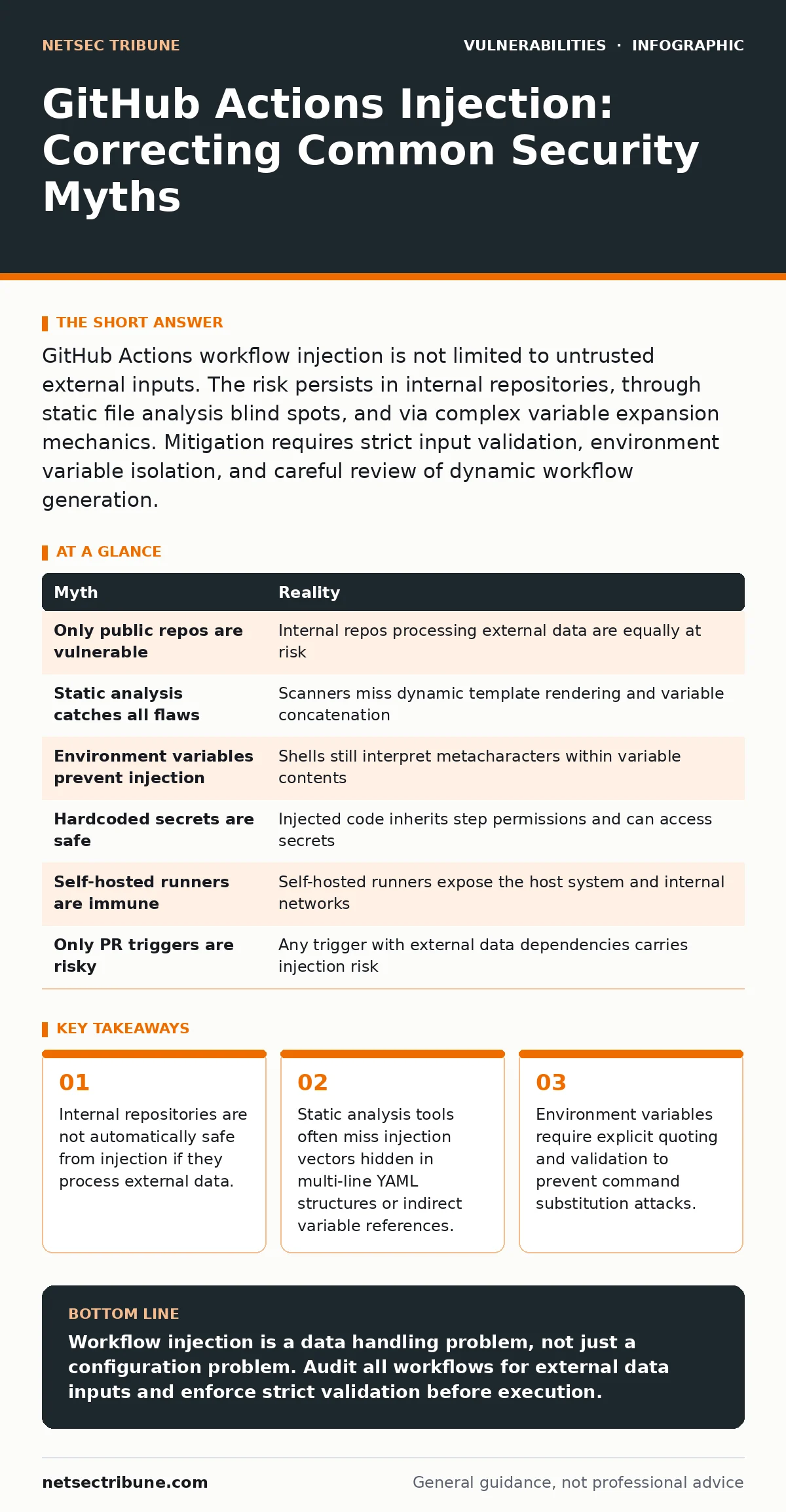
GitHub Actions workflow injection is not limited to untrusted external inputs. The risk persists in internal repositories, through static file analysis blind spots, and via complex variable expansion mechanics. Mitigation requires strict input validation, environment variable isolation, and careful review of dynamic workflow generation.
Myth: Only Public Repositories Are Vulnerable to Injection
Reality: Private and internal repositories face identical injection risks when they process data from external sources. The security boundary is not the repository visibility setting, but the trust model of the input data. A private repository that fetches dependencies, parses issue comments, or processes pull request data from public forks inherits the same attack surface. The code that handles this input must validate and sanitize it regardless of where the code resides.
Imagine an internal team repository that automatically creates release notes from public GitHub issues. If the workflow template injects the issue title directly into a shell command, an attacker with a public account can trigger code execution. The private nature of the repository does not sanitize the external input. Security operations must treat all external data as hostile, even when the processing code lives behind authentication walls. This misconception leads teams to neglect validation in internal tools, assuming their organizational boundaries provide inherent protection.
Myth: Static Analysis Tools Catch All Injection Flaws
Reality: Static analysis scanners often miss workflow injection because YAML is a data format, not a programming language. Traditional static application security testing tools look for known dangerous functions in code files. They struggle with dynamic template rendering where the payload is assembled at runtime from separate variables. The logic that combines user input with the command string may appear benign in isolation. The vulnerability emerges only when the workflow engine interprets the final constructed string.
Consider a workflow that uses a matrix strategy to iterate over test cases. The matrix values might be defined in a separate configuration file. A scanner reviewing the workflow file sees only safe template syntax. A scanner reviewing the configuration file sees only data. Neither tool sees the dangerous concatenation that occurs during execution. This gap requires manual review of data flow paths. Teams relying solely on automated scanning leave significant blind spots in their CI/CD pipeline vulnerabilities. Effective detection requires understanding how the workflow engine parses and executes the final YAML structure.
Myth: Using Environment Variables Prevents Command Injection
Reality: Environment variables do not automatically escape special characters or prevent command substitution. When a workflow step passes an environment variable to a shell command, the shell interprets the contents. If the variable contains shell metacharacters like backticks or dollar signs, the shell executes them. Simply storing user input in an environment variable is insufficient. You must explicitly validate the input or use quoting mechanisms that prevent interpretation. The shell remains the execution context, and it remains vulnerable to injection.
Suppose a workflow sets an environment variable USER_INPUT with a value provided in a pull request body. The workflow then runs echo $USER_INPUT. If the input contains $(whoami), the shell executes the command. The environment variable acted as a carrier, not a shield. This misunderstanding leads developers to believe that moving data into environment variables isolates it from the execution logic. In reality, it often makes the injection vector less visible in the workflow file, complicating detection. Proper mitigation involves validating input before it enters any shell context.
Myth: Hardcoded Secrets Are Safe from Injection Attacks
Reality: Hardcoded secrets in workflow files do not protect against injection if the surrounding logic is vulnerable. An attacker who can inject commands into a workflow step can potentially read environment variables or access secrets that are available to that step. The presence of secrets does not change the execution privileges of the injected code. If the workflow grants the GITHUB_TOKEN or other secrets to the step, the injected code inherits those permissions. The risk is the privilege escalation, not the storage method of the secret.
Imagine a workflow that deploys code using a secret API key. If the deployment step accepts user-controlled input for the deployment target URL, an attacker could redirect the request or execute commands before the deployment. The secret is used, but the attacker controls the context in which it is used. This leads to data exfiltration or unauthorized access. Security teams must limit secret access to only the steps that strictly require them. Principle of least privilege applies to workflow steps as it does to user accounts.
Myth: Self-Hosted Runners Are Immune to Injection
Reality: Self-hosted runners often have broader permissions and network access than cloud-hosted runners, increasing the impact of injection. If a self-hosted runner is compromised via workflow injection, the attacker gains access to the host system. This host may have direct access to internal networks, databases, or other sensitive resources. The attack surface expands from the containerized workflow environment to the underlying infrastructure. The isolation provided by virtualization is weaker when the runner has persistent network connections.
Suppose a self-hosted runner is configured to access an internal artifact repository. An injection attack could exfiltrate build artifacts or modify source code on the host. The damage is not limited to the workflow execution. It extends to the entire host system. Teams using self-hosted runners must implement strict network segmentation and minimal privilege configurations. They should treat the runner host as a high-value target. Compensating controls like read-only file systems and restricted network interfaces become necessary to limit lateral movement.
See also: Bug Bounty Triage Explained: How to Filter Noise From Real Threats
Myth: Pull Request Triggers Are the Only Risk
Reality: Workflow injection risks exist in any trigger that accepts external input, including issue comments, release events, and scheduled runs that fetch external data. Focusing only on pull requests ignores other attack vectors. An attacker can inject code via an issue comment if the workflow parses comment bodies. They can manipulate data fetched during a scheduled run if the external source is compromised. The trigger mechanism is less important than the data source. Any workflow that processes untrusted data as code is vulnerable.
Consider a workflow that runs nightly to sync data from a public API. If the API response is manipulated, the workflow could execute malicious commands. The trigger is time-based, not user-driven, but the input is still external. This broadens the scope of required validation. Security operations must audit all workflows for external data dependencies, not just those triggered by user interaction. This requires a holistic view of data flow across the entire CI/CD pipeline.
| Myth | Reality |
|---|---|
| Only public repos are vulnerable | Internal repos processing external data are equally at risk |
| Static analysis catches all flaws | Scanners miss dynamic template rendering and variable concatenation |
| Environment variables prevent injection | Shells still interpret metacharacters within variable contents |
| Hardcoded secrets are safe | Injected code inherits step permissions and can access secrets |
| Self-hosted runners are immune | Self-hosted runners expose the host system and internal networks |
| Only PR triggers are risky | Any trigger with external data dependencies carries injection risk |
Key takeaways
- Internal repositories are not automatically safe from injection if they process external data.
- Static analysis tools often miss injection vectors hidden in multi-line YAML structures or indirect variable references.
- Environment variables require explicit quoting and validation to prevent command substitution attacks.
- Hardcoded secrets in workflow files do not protect against injection if the surrounding logic is vulnerable.
Workflow injection is a data handling problem, not just a configuration problem. Audit all workflows for external data inputs and enforce strict validation before execution.
Frequently asked questions
Does pinning action versions prevent injection?
Pinning versions prevents supply chain attacks from compromised actions, but it does not stop injection from user-supplied inputs within your own workflow logic.
How do I validate input in GitHub Actions?
Use input validation steps that check for expected patterns and reject inputs containing shell metacharacters before they reach execution steps.
Are matrix strategies safe from injection?
Matrix strategies are not inherently safe if the matrix values are derived from external sources or unvalidated user input.
Can I use a separate workflow for validation?
Yes, running validation in a separate, restricted workflow can limit the blast radius of any potential injection attack.
How this guide was produced: written by the NetSec Tribune editorial team with AI assistance, checked against the public references listed below, and reviewed when the facts change. See our editorial policy or report an error.