Purple Teaming: How to Close Gaps Without Wasting Resources
Purple teaming exposes detection failures faster than red teaming, but it often reveals that your monitoring tools are configured incorrectly rather than missing.
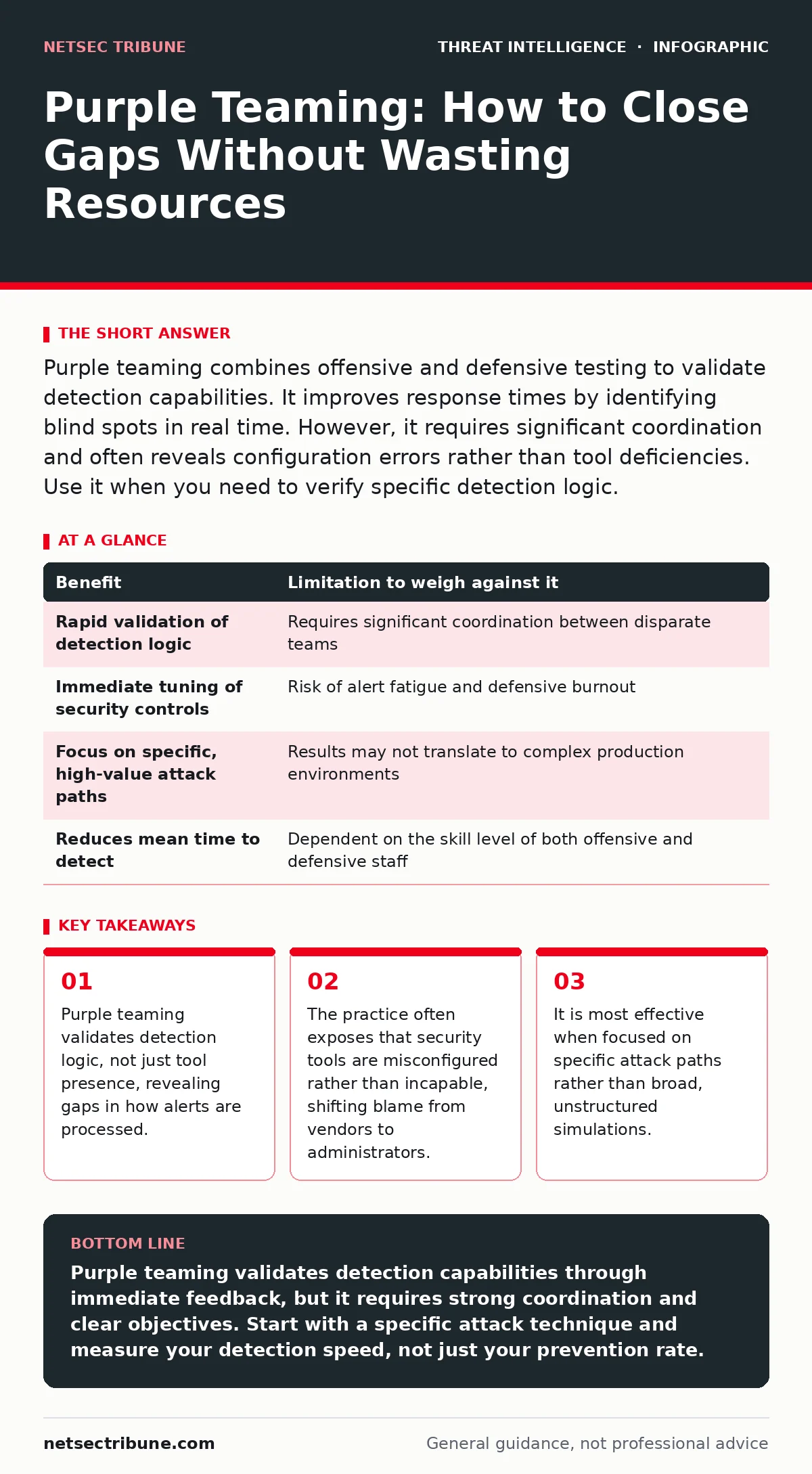
Purple teaming combines offensive and defensive testing to validate detection capabilities. It improves response times by identifying blind spots in real time. However, it requires significant coordination and often reveals configuration errors rather than tool deficiencies. Use it when you need to verify specific detection logic.
Defining the Feedback Loop
Purple teaming is not a third type of team. It is a methodology that bridges the gap between red teaming, which simulates attacks, and blue teaming, which defends against them. Instead of running these exercises in isolation, purple teaming creates a continuous feedback loop. The offensive side attempts a specific technique, and the defensive side immediately verifies if their controls detected it.
This approach shifts the focus from "did we get hacked?" to "did we see it happen?" The goal is to validate the effectiveness of your detection and response capabilities. You are testing the entire chain of events, from initial intrusion to alert generation. This differs significantly from traditional penetration testing, which often stops once access is gained.
The Value of Immediate Validation
The primary benefit of purple teaming is speed. In traditional models, red teams may run for weeks or months before reporting findings. By then, the context is lost, and the defensive team must reconstruct the attack to understand what was missed. Purple teaming provides immediate feedback. When an attack technique is executed, the defensive team knows instantly whether their sensors caught it.
This immediacy allows for rapid iteration. If a detection rule fails, you can adjust the configuration and test again in the same session. This reduces the mean time to detect, which is often more valuable than mean time to respond. You are not just finding vulnerabilities; you are verifying that your monitoring stack actually works as intended.
Imagine you have deployed a new endpoint detection and response solution. A red team might bypass it using a known technique. A purple team would test that specific technique, see the failure, and tune the sensor immediately. This closes the gap while the threat model is still fresh in everyone's mind.
The Cost of Coordination and Context
Purple teaming is resource-intensive. It requires deep collaboration between offensive and defensive personnel. These groups often have different cultures, tools, and priorities. Getting them to work together effectively can be difficult. The offensive team may want to move fast and break things, while the defensive team needs stability and clear documentation.
There is also a risk of scope creep. Without strict boundaries, purple teaming can devolve into a series of unstructured attacks that overwhelm the defensive team. This leads to alert fatigue and burnout. The defensive team may stop trusting their own tools if they are constantly bombarded with simulated incidents that look like real breaches.
Another hidden cost is the dependency on specific environments. If you test in a staging environment that does not mirror production, your results will be misleading. You might find that your detections work in a clean lab but fail in the noisy, complex reality of your actual network.
| Benefit | Limitation to weigh against it |
|---|---|
| Rapid validation of detection logic | Requires significant coordination between disparate teams |
| Immediate tuning of security controls | Risk of alert fatigue and defensive burnout |
| Focus on specific, high-value attack paths | Results may not translate to complex production environments |
| Reduces mean time to detect | Dependent on the skill level of both offensive and defensive staff |
When It Is Worth It
Purple teaming is most valuable when you have a specific hypothesis about your security posture. Suppose you suspect that your organization is vulnerable to LSASS credential theft, a technique where attackers steal passwords from memory. Instead of a broad assessment, you design a purple team exercise specifically around this technique. You test if your Sysmon configuration captures the process creation and memory access events associated with this attack.
It is also worth it when you are implementing new security controls. If you have just deployed a new firewall or intrusion detection system, purple teaming can verify that the rules are working as expected. This is particularly useful for complex environments where standard testing methods may not reveal subtle misconfigurations.
Furthermore, if you rely on threat intelligence feeds to update your blocklists, purple teaming can validate that these feeds are actually effective. You can simulate an attack using known indicators of compromise from these feeds and see if your systems block or alert on them. This ensures that your intelligence is actionable, not just informational.
When It Is Not
Purple teaming is not a substitute for foundational security hygiene. If your organization is still struggling with basic patch management or access controls, purple teaming will only highlight these obvious gaps. It is inefficient to spend resources on advanced detection testing when basic vulnerabilities remain unaddressed. It is better to focus on strategic threat intelligence to understand your risk profile before diving into tactical exercises.
It is also not suitable for organizations that lack the internal expertise to interpret the results. If your defensive team cannot distinguish between a false positive and a true detection, the exercise will not yield useful insights. You need personnel who understand the underlying mechanisms of attacks and defenses. Without this knowledge, the feedback loop breaks down.
Additionally, if you are dealing with sophisticated adversaries using domain generation algorithms, purple teaming may not be the right tool. These algorithms create unpredictable domain names, making it difficult to simulate specific attack paths. In such cases, broader monitoring and packet capture analysis may be more effective than targeted purple teaming exercises.
See also: Secure Email Gateway Checklist for Modern Threat Defense · Sandbox Evasion Myths: What Your Analysis Tools Actually Miss
Integrating With Existing Practices
For purple teaming to be effective, it must be integrated into your existing security operations. This means treating the findings as actionable items, not just report cards. Each failed detection should lead to a specific change in configuration or process. You should track these changes over time to measure improvement.
It is also important to document the results. Create a repository of attack techniques and your organization's detection capabilities for each. This becomes a valuable asset for future exercises and for onboarding new team members. It helps build institutional knowledge about your specific security posture.
Consider how purple teaming fits with your use of initial access brokers. These actors often sell access to organizations, making the initial breach easy. Purple teaming can help you identify if your perimeter defenses are too weak, allowing these brokers to succeed. By focusing on the initial access phase, you can strengthen your first line of defense.
The Human Element
The success of purple teaming depends heavily on the relationship between the offensive and defensive teams. Trust is essential. The defensive team must feel safe admitting when a detection failed, without fear of blame. The offensive team must be willing to explain their techniques in detail, rather than just demonstrating success.
Regular debriefs are necessary to maintain this trust. After each exercise, both teams should discuss what worked, what didn't, and why. This open dialogue helps break down silos and fosters a culture of continuous improvement. It turns security from a adversarial game into a collaborative effort.
Key takeaways
- Purple teaming validates detection logic, not just tool presence, revealing gaps in how alerts are processed.
- The practice often exposes that security tools are misconfigured rather than incapable, shifting blame from vendors to administrators.
- It is most effective when focused on specific attack paths rather than broad, unstructured simulations.
Purple teaming validates detection capabilities through immediate feedback, but it requires strong coordination and clear objectives. Start with a specific attack technique and measure your detection speed, not just your prevention rate.
Frequently asked questions
How often should we conduct purple teaming exercises?
Frequency depends on your change velocity. If you frequently update security tools or infrastructure, quarterly exercises are reasonable. For stable environments, semi-annual may suffice.
Do we need dedicated purple team personnel?
No. It is often more effective to have existing red and blue team members collaborate. This builds cross-functional skills and ensures that insights are shared directly.
Can purple teaming replace penetration testing?
No. Penetration testing assesses vulnerability and exploitability. Purple teaming assesses detection and response. They serve different purposes and should be complementary.
What is the difference between purple teaming and red teaming?
Red teaming simulates an adversary to test overall security posture. Purple teaming focuses on specific techniques to validate detection and response capabilities in a collaborative manner.
How this guide was produced: written by the NetSec Tribune editorial team with AI assistance, checked against the public references listed below, and reviewed when the facts change. See our editorial policy or report an error.