
Strategic Threat Intelligence: 8 Questions That Bridge Data and Decisions
Strategic intelligence converts raw telemetry into resource allocation decisions, revealing that most teams waste budget on data they cannot act upon.
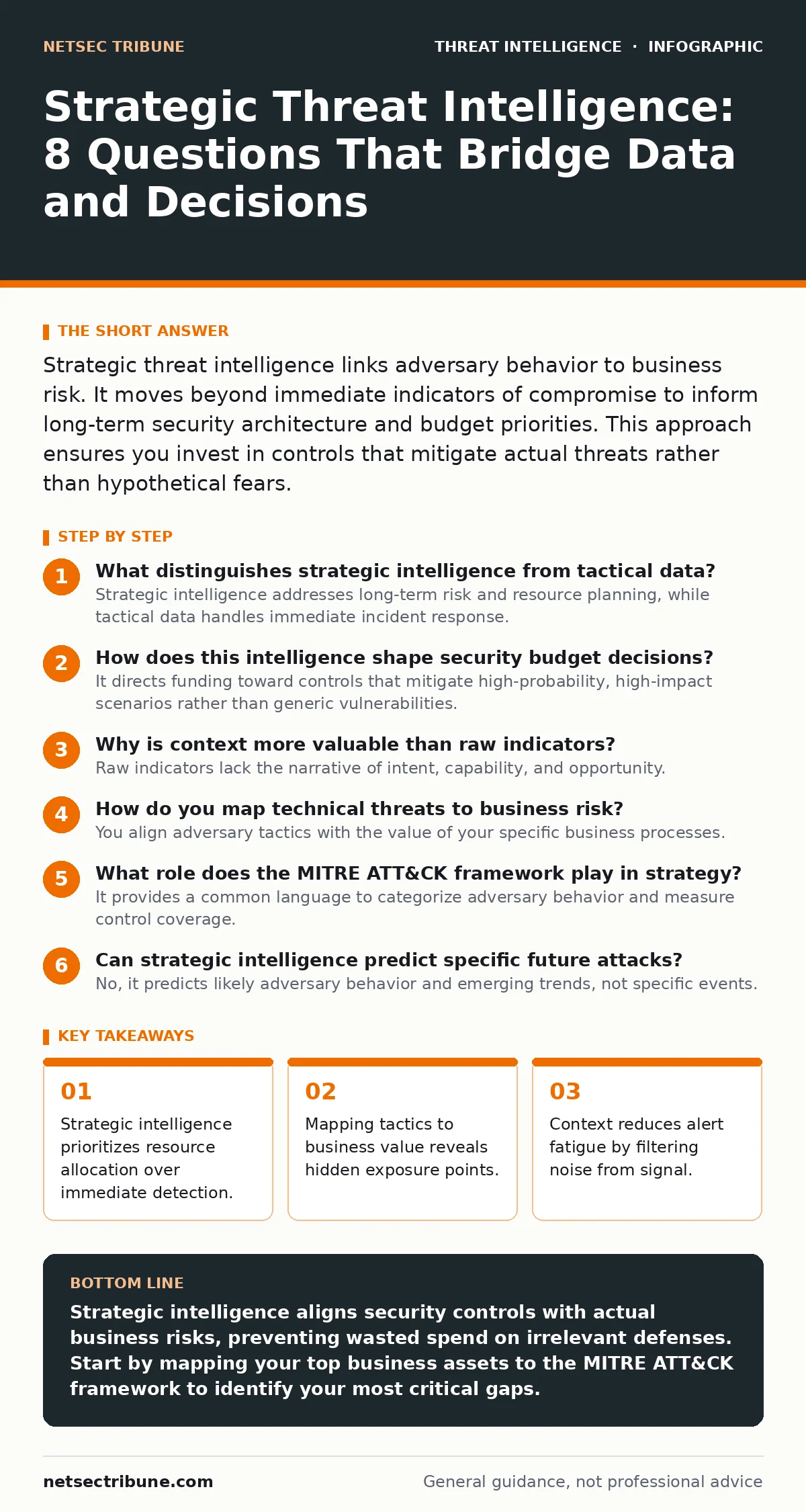
Strategic threat intelligence links adversary behavior to business risk. It moves beyond immediate indicators of compromise to inform long-term security architecture and budget priorities. This approach ensures you invest in controls that mitigate actual threats rather than hypothetical fears.
What distinguishes strategic intelligence from tactical data?
Strategic intelligence addresses long-term risk and resource planning, while tactical data handles immediate incident response. Tactical feeds provide specific indicators of compromise that you block today. Strategic analysis explains why certain adversary groups target your sector and how their methods evolve over years.
You cannot manage risk with short-term data alone. Imagine a firewall rule that blocks a specific IP address. That is tactical. Understanding that a nation-state actor shifts to living-off-the-land techniques requires strategic foresight to adjust your monitoring architecture.
How does this intelligence shape security budget decisions?
It directs funding toward controls that mitigate high-probability, high-impact scenarios rather than generic vulnerabilities. Most organizations purchase tools based on feature lists, not threat relevance. Strategic analysis identifies which attack vectors actually reach your critical assets.
This prevents wasted expenditure on unused security features. For example, if your primary risk involves insider data exfiltration, investing heavily in perimeter intrusion detection yields diminishing returns. You instead prioritize data loss prevention and access logging.
Why is context more valuable than raw indicators?
Raw indicators lack the narrative of intent, capability, and opportunity. An IP address or file hash tells you what was seen, not why it matters. Context explains the adversary’s goal and the conditions that allowed the breach.
Without context, you treat symptoms rather than the disease. A single malicious domain might appear in ten different attacks. Understanding that these attacks share a specific social engineering hook allows you to train users on that exact tactic, rather than just blocking the domain.
How do you map technical threats to business risk?
You align adversary tactics with the value of your specific business processes. Not all assets hold equal value to an attacker. Strategic intelligence helps you identify which data sets or systems are most attractive to your likely adversaries.
This mapping reveals gaps in your defense that technical audits miss. Suppose your financial records are heavily protected, but your customer support logs contain enough data for identity theft. Strategic analysis highlights this secondary target, prompting you to secure those logs with equal rigor.
What role does the MITRE ATT&CK framework play in strategy?
It provides a common language to categorize adversary behavior and measure control coverage. The MITRE ATT&CK framework breaks down attacks into tactics and techniques. You use this structure to see which phases of an attack your current tools detect or miss.
This visibility exposes blind spots in your security posture. If you detect initial access but miss lateral movement, you know your internal network monitoring is weak. You can then prioritize tools that improve visibility into host-based activities, such as Sysmon, to catch that movement.
See also: Lateral Movement in Cybersecurity: Definition and Detection
Can strategic intelligence predict specific future attacks?
No, it predicts likely adversary behavior and emerging trends, not specific events. Predicting exact targets or times is impossible due to the dynamic nature of human adversaries. Strategic intelligence identifies shifts in methodology, such as a move from ransomware to data extortion.
This allows you to prepare for classes of attacks rather than specific incidents. You might notice adversaries increasingly abusing legitimate cloud management tools. In response, you tighten access controls on those tools, reducing the surface area for that specific class of attack.
How do you validate the quality of intelligence sources?
You assess sources based on their methodology, transparency, and historical accuracy. Many commercial feeds aggregate data without verifying its relevance or origin. Strategic analysis requires trusted sources that explain their collection and analysis processes.
Poor quality data leads to false assumptions and wasted effort. If a source consistently flags benign traffic as malicious, you lose trust in your entire pipeline. You should cross-reference findings with multiple independent sources to ensure reliability before acting on strategic insights.
What is the hidden cost of ignoring strategic analysis?
You accumulate technical debt in your security architecture. Without strategic direction, you add layers of security that do not address core risks. This creates complexity that slows incident response and increases operational costs.
Imagine adding a new endpoint detection tool that overlaps with your existing solution. You now have two tools generating alerts for the same events. Your team spends time correlating data instead of investigating real threats. This inefficiency grows as you add more disconnected tools.
| Intelligence Type | Primary Focus | Time Horizon | Typical Output |
|---|---|---|---|
| Tactical | Immediate indicators | Hours to Days | IP blocks, hash bans |
| Operational | Adversary TTPs | Weeks to Months | Campaign profiles, IOCs |
| Strategic | Business risk & trends | Months to Years | Resource plans, policy updates |
Strategic intelligence transforms security from a reactive cost center to a proactive business enabler. It ensures your team focuses on what truly matters. By understanding the broader context of threats, you make smarter decisions about technology and personnel.
How does purple teaming support strategic goals?
Purple teaming validates whether your strategic assumptions hold up against realistic attacks. It bridges the gap between red team exercises and blue team monitoring. You use these exercises to test if your controls detect the specific tactics identified in your strategic analysis.
This feedback loop refines your intelligence priorities. If a purple team exercise shows that pass-the-hash attacks bypass your current logging, you know your strategic plan underestimated credential theft risks. You then adjust your monitoring and access controls to address this specific gap.
What is the first step in building a strategic program?
Define your organization’s specific threat model and business objectives. Generic frameworks do not account for your unique industry, geography, or technology stack. You must identify who wants to hurt you and why.
This clarity guides every subsequent decision. It determines which data sources you subscribe to and which metrics you track. Without this foundation, your intelligence efforts remain scattered and ineffective.
Key takeaways
- Strategic intelligence prioritizes resource allocation over immediate detection.
- Mapping tactics to business value reveals hidden exposure points.
- Context reduces alert fatigue by filtering noise from signal.
Strategic intelligence aligns security controls with actual business risks, preventing wasted spend on irrelevant defenses. Start by mapping your top business assets to the MITRE ATT&CK framework to identify your most critical gaps.
Frequently asked questions
How often should strategic threat intelligence be updated?
Review strategic assessments quarterly or after significant business changes. Adversary tactics evolve slowly, but business risk profiles can shift rapidly due to mergers, new products, or regulatory changes.
Can small organizations benefit from strategic intelligence?
Yes, even small teams can apply strategic thinking by focusing on their most critical assets. You do need expensive tools; you need a clear understanding of your specific risks and a disciplined approach to mitigation.
How does strategic intelligence differ from threat hunting?
Threat hunting is an operational activity that searches for hidden threats. Strategic intelligence provides the hypotheses and context for those hunts, ensuring hunters look for relevant indicators rather than random noise.
What metrics measure the success of strategic intelligence?
Track the reduction in high-severity incidents related to targeted attack vectors. Also, measure the alignment of security spending with identified business risks. Success is seen in improved resilience and efficient resource use.
How this guide was produced: written by the NetSec Tribune editorial team with AI assistance, checked against the public references listed below, and reviewed when the facts change. See our editorial policy or report an error.