
Domain Generation Algorithm Response: Containment and Recovery Steps
Static domain blocking fails against domain generation algorithms, requiring defenders to deploy sinkhole infrastructure and monitor algorithmic patterns instead.
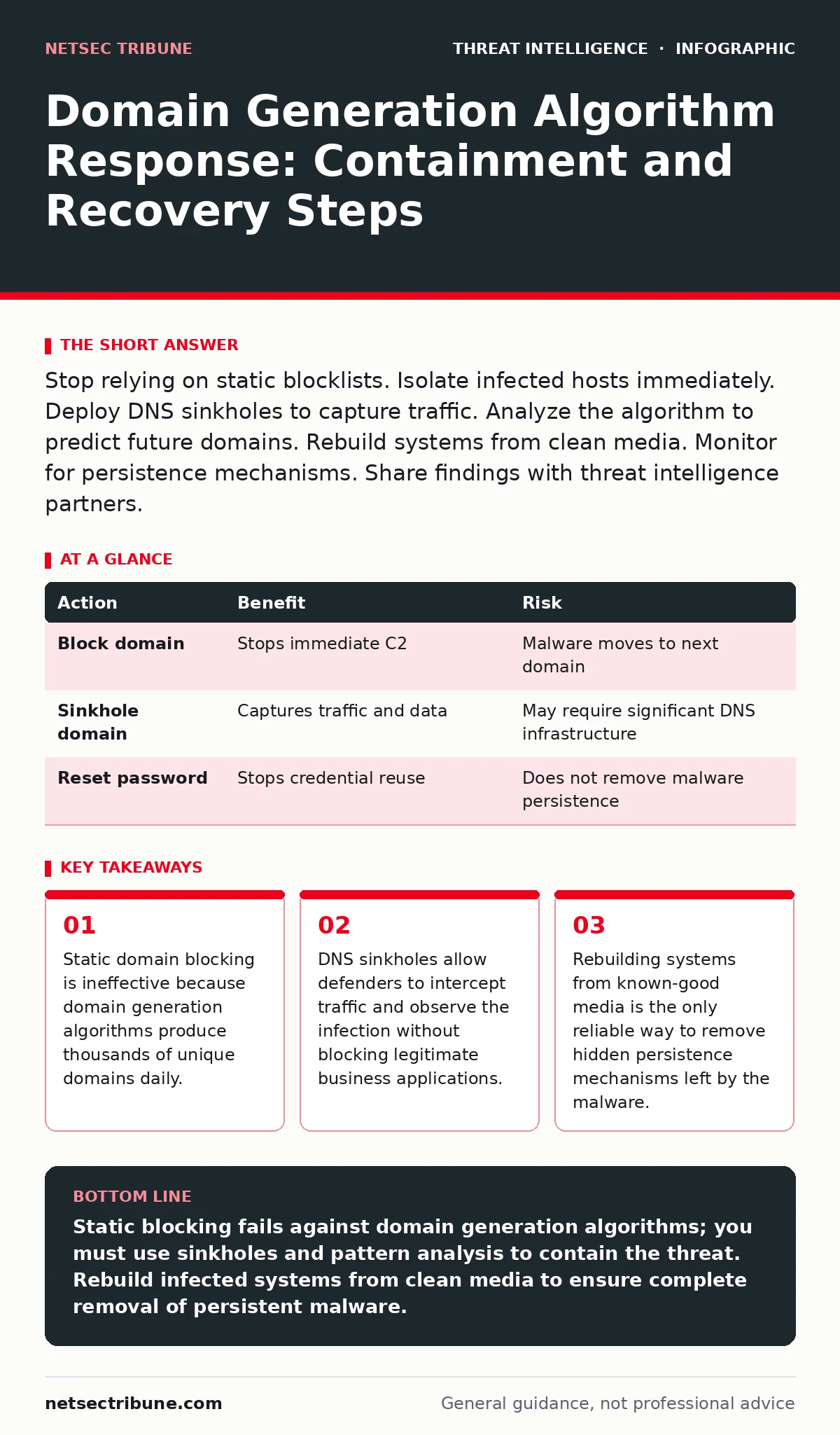
Stop relying on static blocklists. Isolate infected hosts immediately. Deploy DNS sinkholes to capture traffic. Analyze the algorithm to predict future domains. Rebuild systems from clean media. Monitor for persistence mechanisms. Share findings with threat intelligence partners.
The Mechanics of Algorithmic Evasion
Domain generation algorithms, often abbreviated as DGA, allow malware to generate a large number of pseudo-random domain names. The malware attempts to resolve each name, usually only one of which is registered by the attacker. This creates a moving target for defenders. Traditional blocklists fail because they cannot anticipate the next domain in the sequence.
You are not fighting a single malicious domain; you are fighting a mathematical function. The attacker registers a subset of these domains to establish command and control channels. If you block the current domain, the malware simply moves to the next one in the sequence. This makes manual intervention slow and often futile. The speed of domain generation far exceeds the speed of human analysis.
First Hour
The immediate goal is to stop the data exfiltration and command channel. Do not attempt to clean the infected system in place. Assume the malware has already harvested credentials or installed additional payloads. Your priority is network isolation.
- Identify the infected hosts using DNS query logs. Look for queries to non-existent domains, which indicate failed DGA resolutions.
- Isolate the affected systems from the network immediately. Disable network interfaces or move them to a quarantine VLAN.
- Capture packet data from the affected segments. This data is critical for reconstructing the communication pattern.
- Preserve memory dumps from the hosts if possible. Volatile memory may contain the algorithm’s seed value.
- Disable compromised user accounts associated with the infection.
First Day
Once the immediate bleed is stopped, you must understand the scope and the pattern. The malware may have spread laterally before detection. You need to determine if this is an isolated incident or a broader compromise.
- Analyze the DNS logs for high volumes of NXDOMAIN responses. A sudden spike in failed lookups is a strong indicator of DGA activity.
- Correlate the timestamps of the failed queries with the successful ones. The successful queries reveal which domains the attacker currently controls.
- Review firewall logs for outbound connections to those successful domains. This confirms the command and control channel was active.
- Check for signs of lateral movement. Look for unusual remote procedure calls or pass-the-hash attacks originating from the infected host.
- Begin the process of rebuilding the affected systems. Do not attempt to disinfect them. The malware may have modified system files in ways that are difficult to detect.
Imagine you find a single workstation generating thousands of DNS queries. It appears to be talking to random, unregistered domains. This is the signature behavior of a DGA. The workstation is likely beaconing home. If you ignore the NXDOMAIN responses, you will miss the majority of the traffic. The successful connections are the tip of the iceberg.
Implementing DNS Sinkholes
Blocking individual domains is a losing battle. Instead, you should deploy a DNS sinkhole. A sinkhole is a DNS server that responds to queries for malicious domains with an address you control. This allows you to intercept the traffic without disrupting the malware’s operation. The malware believes it has connected to the attacker. In reality, it is talking to your server. This gives you visibility into the communication. You can analyze the data being sent and received. This helps you understand what the malware is doing. It also prevents the attacker from receiving the stolen data.
| Action | Benefit | Risk |
|---|---|---|
| Block domain | Stops immediate C2 | Malware moves to next domain |
| Sinkhole domain | Captures traffic and data | May require significant DNS infrastructure |
| Reset password | Stops credential reuse | Does not remove malware persistence |
You must ensure your DNS infrastructure can handle the volume of queries. DGA malware generates queries at a high frequency. Your sinkhole must be resilient enough to absorb this load. If your DNS server crashes, you lose visibility. You may also need to update your security information and event management systems to alert on sinkhole hits. This helps you identify other infected hosts that are still active.
Recovery and Rebuilding
Recovery involves restoring the affected systems to a known good state. You cannot trust the operating system on an infected host. The malware may have installed rootkits or modified boot sectors. These modifications can survive a standard malware scan. The only safe path is to wipe the drive and reinstall the operating system from clean media.
- Backup only user data from the infected system. Do not backup executable files or system configurations.
- Scan the user data for malware before restoring it. Use multiple scanning engines if possible.
- Reinstall the operating system from verified media.
- Apply all security patches and updates immediately.
- Restore user data to the clean system.
- Monitor the system for any signs of re-infection.
This process is time-consuming and disruptive. However, it is the only way to ensure complete removal. Shortcuts may leave remnants that allow the attacker to regain access. You must balance the urgency of recovery with the need for thoroughness. Rushing the rebuild can lead to a repeat infection.
See also: Data Breach Response: Containment, Recovery and Prevention Steps · Difference Between Cloud Logging and Monitoring: Operational Reality
Preventing Recurrence
To stop a repeat infection, you must address the initial access vector. DGA malware often enters through phishing emails or vulnerable services. You need to strengthen your email filtering and patch management processes. Additionally, you should implement application whitelisting. This prevents unauthorized executables from running on your systems. If the malware cannot execute, it cannot generate domains.
You should also enhance your monitoring capabilities. Use Sysmon to log process creations and network connections. This provides detailed visibility into system activity. You can use this data to detect the early signs of DGA activity. Regular purple teaming exercises can help you test your detection rules. These exercises simulate real-world attacks to identify gaps in your defenses.
Sharing Intelligence
Threat intelligence is a collaborative effort. Sharing your findings with the broader security community helps others defend against the same threat. You can share indicators of compromise, such as the algorithm’s seed value or the structure of the domains. This helps other organizations update their blocklists and detection rules. However, you must ensure you are not sharing sensitive internal data. Anonymize your findings before sharing them.
Strategic threat intelligence provides context for these findings. It helps you understand the attacker’s motives and capabilities. This information informs your long-term security strategy. You can adjust your defenses to better counter the specific tactics used by the attacker. This proactive approach reduces the risk of future incidents.
Key takeaways
- Static domain blocking is ineffective because domain generation algorithms produce thousands of unique domains daily.
- DNS sinkholes allow defenders to intercept traffic and observe the infection without blocking legitimate business applications.
- Rebuilding systems from known-good media is the only reliable way to remove hidden persistence mechanisms left by the malware.
Static blocking fails against domain generation algorithms; you must use sinkholes and pattern analysis to contain the threat. Rebuild infected systems from clean media to ensure complete removal of persistent malware.
Frequently asked questions
How do I distinguish DGA traffic from normal DNS noise?
Look for a high volume of NXDOMAIN responses from a single host. Normal traffic rarely generates thousands of failed lookups in a short period.
Can I clean an infected system without rebuilding it?
No. DGA malware often installs persistence mechanisms that are difficult to detect. Rebuilding from clean media is the only reliable method.
What is a DNS sinkhole and how do I implement it?
A DNS sinkhole redirects queries for malicious domains to a controlled server. You implement it by configuring your DNS infrastructure to respond to specific domains with an internal address.
How can I predict future domains generated by the algorithm?
You must reverse-engineer the algorithm to find the seed value. Once you have the seed, you can simulate the algorithm to predict future domains.
How this guide was produced: written by the NetSec Tribune editorial team with AI assistance, checked against the public references listed below, and reviewed when the facts change. See our editorial policy or report an error.