MITRE ATT&CK Framework FAQ: Mapping Tactics and Techniques
The framework separates adversary intent from specific tools, allowing you to detect new malware using existing behavioral logic.
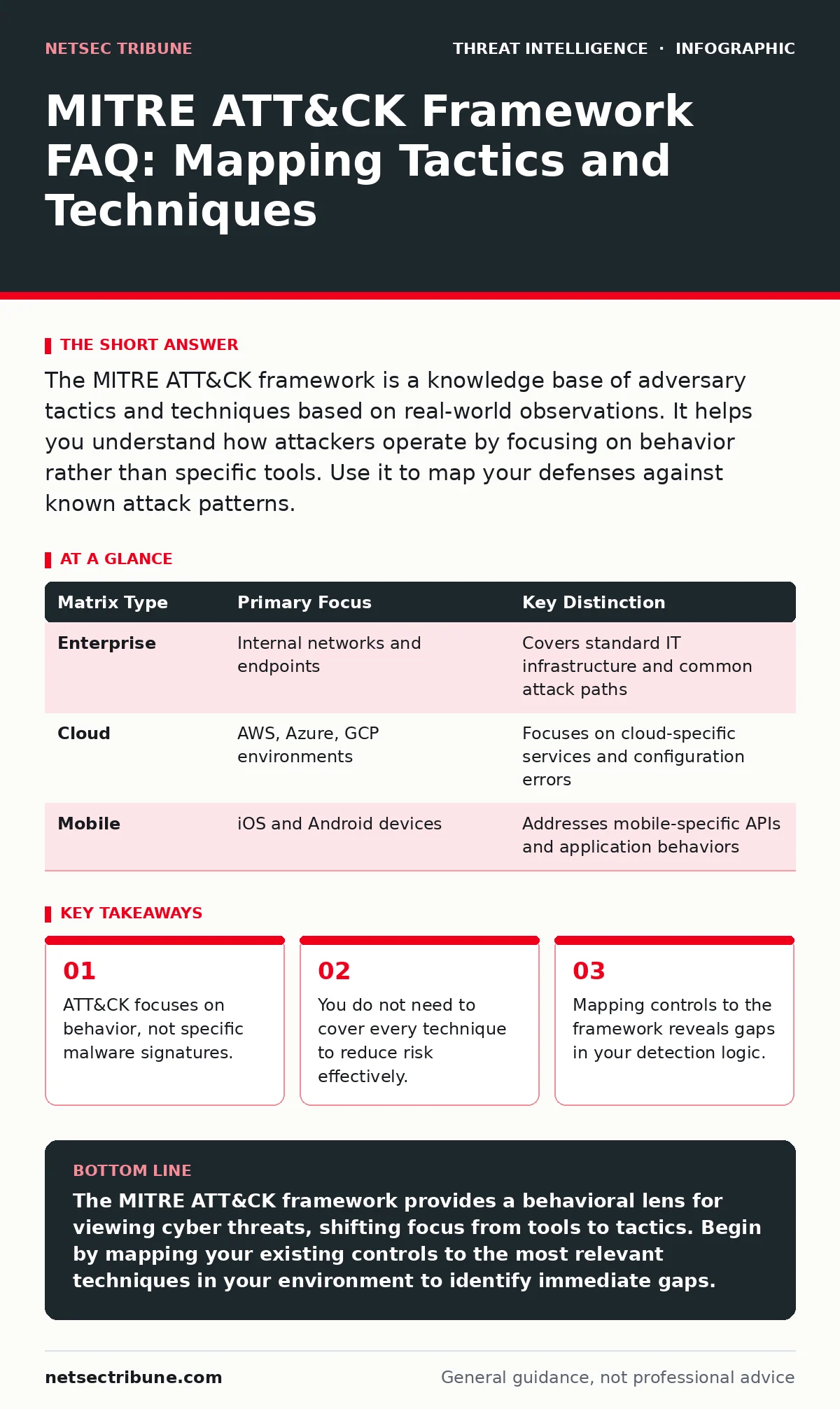
The MITRE ATT&CK framework is a knowledge base of adversary tactics and techniques based on real-world observations. It helps you understand how attackers operate by focusing on behavior rather than specific tools. Use it to map your defenses against known attack patterns.
What is the MITRE ATT&CK framework?
The MITRE ATT&CK framework is a structured knowledge base of adversary tactics and techniques derived from real-world observations of cyber intrusions. It categorizes attacker behavior into tactics, which represent the "why" or goal, and techniques, which represent the "how" or method. This structure allows defenders to understand the logic behind an attack regardless of the specific tools used.
How does ATT&CK differ from indicators of compromise?
Indicators of compromise are specific artifacts, such as file hashes or IP addresses, that signal a breach has occurred. ATT&CK describes the behaviors that produce those artifacts, such as the method used to exfiltrate data. Relying solely on indicators is reactive, while using ATT&CK allows you to anticipate actions before specific files are created. This distinction is critical when analyzing threat intelligence feeds for actionable context.
Why use tactics versus techniques?
Tactics describe the adversary's operational goal, such as establishing persistence or escalating privileges. Techniques describe the specific methods used to achieve that goal, such as creating a scheduled task. This hierarchy helps you prioritize defenses by understanding the broader objective rather than just blocking a single tool. It allows you to group related techniques under a common strategic intent.
Is ATT&CK only for large enterprises?
The framework is scalable and useful for organizations of any size that want to understand their security posture. Smaller teams can focus on the most common techniques relevant to their industry and environment. You do not need to implement controls for every entry to benefit from the structure. The value lies in identifying which techniques are likely to target your specific assets.
How do I map my security controls to ATT&CK?
Start by listing your existing detection and prevention mechanisms, then identify which ATT&CK techniques they address. Look for gaps where an adversary could execute a technique without triggering an alert or blocking mechanism. This process often reveals that many controls are duplicated or that critical areas are entirely uncovered. It is often helpful to review your approach to strategic threat intelligence to align these mappings with business risk.
See also: Fix IOC Enrichment Errors: 6 Common Misunderstandings · Hybrid Warfare in Cyberspace: Correcting 6 Common Intelligence Errors
What is the difference between ATT&CK and kill chain?
The Cyber Kill Chain focuses on the stages of an attack from reconnaissance to actions on objectives. ATT&CK provides a more granular view of post-compromise behavior, detailing many more techniques than the kill chain. While the kill chain is useful for high-level planning, ATT&CK offers the depth needed for tactical detection engineering. Many teams use both models to bridge strategic goals with technical implementation.
Can I use ATT&CK for purple teaming?
Purple teaming involves collaboration between red and blue teams to improve security effectiveness. ATT&CK serves as a common language for these teams to define test scenarios and measure detection capabilities. By targeting specific techniques, teams can validate whether their monitors catch the intended behavior. This structured approach prevents tests from becoming random chaos and ensures measurable outcomes.
Does ATT&CK cover cloud and mobile environments?
Yes, the framework includes matrices for cloud environments and mobile devices, in addition to the standard enterprise matrix. Each matrix contains tactics and techniques specific to those platforms, reflecting the unique capabilities and constraints of each environment. You should select the matrix that matches your primary infrastructure to ensure relevant coverage. Ignoring platform-specific matrices leaves significant blind spots in modern hybrid environments.
| Matrix Type | Primary Focus | Key Distinction |
|---|---|---|
| Enterprise | Internal networks and endpoints | Covers standard IT infrastructure and common attack paths |
| Cloud | AWS, Azure, GCP environments | Focuses on cloud-specific services and configuration errors |
| Mobile | iOS and Android devices | Addresses mobile-specific APIs and application behaviors |
How do I handle the volume of techniques?
You cannot and should not attempt to detect every technique in the framework. Prioritize techniques based on the likelihood of use by adversaries targeting your sector and the impact of successful execution. Focus on high-impact areas like credential access and lateral movement first. This targeted approach prevents alert fatigue and ensures your team focuses on meaningful detections.
What is the relationship between ATT&CK and MITRE D3FEND?
MITRE D3FEND is a counter-adversary knowledge base that maps defensive actions to ATT&CK techniques. It describes how specific controls and detections can mitigate or detect adversary behavior. While ATT&CK describes the attack, D3FEND describes the defense, providing a direct link between threat and control. This pairing helps engineers design detections with specific defensive outcomes in mind.
How does ATT&CK help with incident response?
During an incident, ATT&CK helps you contextualize the adversary's actions and predict their next moves. By identifying the techniques used, you can search for other instances of those behaviors across your environment. This improves the speed and accuracy of your investigation and remediation efforts. It also helps you understand if the adversary has achieved their tactical goals, such as LSASS credential theft.
Is ATT&CK static or dynamic?
The framework is continuously updated as new adversary behaviors are observed and validated. New techniques are added, and existing ones are refined to reflect changes in the threat environment. You should regularly review updates to ensure your detection logic remains relevant. Static defenses become obsolete quickly, while a dynamic understanding of attacker behavior remains valuable.
How do I integrate ATT&CK into my daily workflow?
Integrate the framework into your detection engineering, threat hunting, and incident response processes. Use it to tag alerts, document investigations, and define test cases for your security tools. This creates a consistent language across your security operations and improves collaboration. Over time, this integration leads to more efficient and effective security practices.
Key takeaways
- ATT&CK focuses on behavior, not specific malware signatures.
- You do not need to cover every technique to reduce risk effectively.
- Mapping controls to the framework reveals gaps in your detection logic.
The MITRE ATT&CK framework provides a behavioral lens for viewing cyber threats, shifting focus from tools to tactics. Begin by mapping your existing controls to the most relevant techniques in your environment to identify immediate gaps.
Frequently asked questions
Does ATT&CK include defensive controls?
No, ATT&CK focuses solely on adversary behavior. Defensive controls are mapped separately, often using frameworks like MITRE D3FEND or CIS Controls.
Can I use ATT&CK for compliance reporting?
While ATT&CK is not a compliance framework, it can help demonstrate that you have addressed specific technical risks required by standards like NIST or ISO.
How often is ATT&CK updated?
The framework is updated regularly with new techniques and refinements based on observed adversary activity. Check the official documentation for release notes.
Is ATT&CK free to use?
Yes, the MITRE ATT&CK framework is freely available for use by individuals and organizations.
How this guide was produced: written by the NetSec Tribune editorial team with AI assistance, checked against the public references listed below, and reviewed when the facts change. See our editorial policy or report an error.