Pass-the-Hash Attack Explained: How Credential Theft Bypasses Logins
Attackers reuse captured password hashes to access systems without ever knowing the actual password or triggering standard authentication alerts.
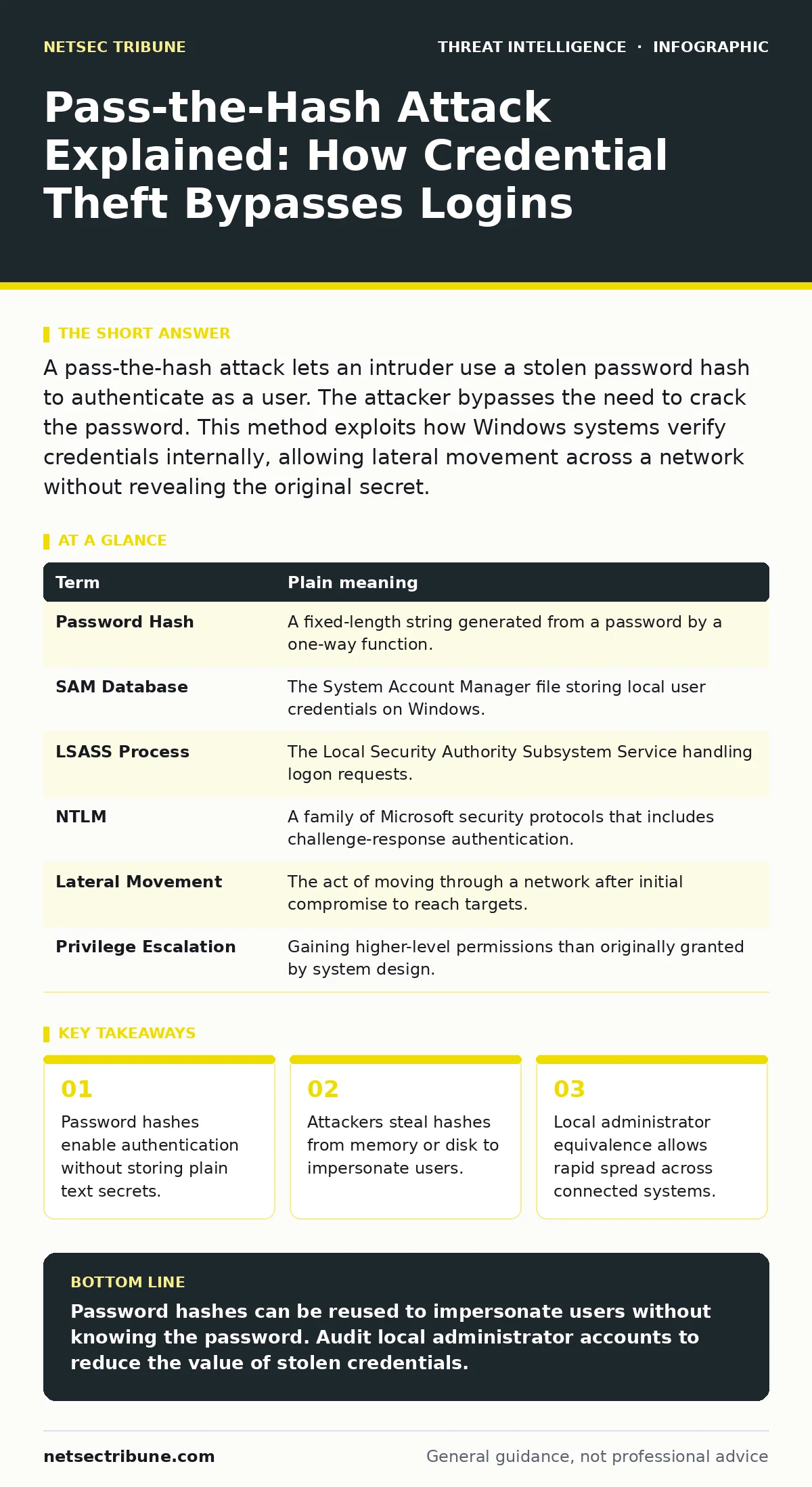
A pass-the-hash attack lets an intruder use a stolen password hash to authenticate as a user. The attacker bypasses the need to crack the password. This method exploits how Windows systems verify credentials internally, allowing lateral movement across a network without revealing the original secret.
Pass the hash attack explained
A pass-the-hash attack occurs when an adversary captures a password hash and uses it to authenticate as that user. You do not need to know the actual password to gain access. The system verifies the hash against the stored value. If they match, access is granted. This bypasses the login screen entirely. The attacker operates with the privileges of the compromised account. This technique relies on the fact that systems store passwords as irreversible hashes. These hashes act as digital fingerprints for the original password.
Imagine a hotel where guests check in with a unique key card. The front desk does not see your name. It only scans the card’s magnetic strip. If the strip matches the database, the door opens. Now suppose a thief steals a guest’s key card. The thief does not know the guest’s name or room number. The thief simply walks up to the elevator, swipes the stolen card, and enters. The building grants access because the card is valid. The system never asks for the guest’s identity. It only checks if the card is legitimate.
Key terms for credential theft
Understanding the mechanics requires defining the components involved in this specific threat vector. The following table clarifies the technical language used in security operations.
| Term | Plain meaning |
|---|---|
| Password Hash | A fixed-length string generated from a password by a one-way function. |
| SAM Database | The System Account Manager file storing local user credentials on Windows. |
| LSASS Process | The Local Security Authority Subsystem Service handling logon requests. |
| NTLM | A family of Microsoft security protocols that includes challenge-response authentication. |
| Lateral Movement | The act of moving through a network after initial compromise to reach targets. |
| Privilege Escalation | Gaining higher-level permissions than originally granted by system design. |
How the theft happens
The attacker must first obtain the hash. This usually happens after an initial foothold is gained. The process often involves dumping the LSASS memory. This process holds the credentials for currently logged-in users. Tools designed for this purpose can extract these hashes in seconds. The attacker does not need to crack the hash. Cracking is slow and often fails against complex passwords. Using the hash directly is instantaneous. The attacker copies the hash value from the compromised machine. This value is then used in a new authentication request on a different machine.
The mechanics of impersonation
When the attacker attempts to log in remotely, the target system sends a challenge. The attacker responds with the stolen hash. The target system compares this hash to its own stored copy. If the hashes match, the target assumes the user is legitimate. The system creates a session for the attacker. This session inherits the permissions of the original account. If the stolen hash belongs to an administrator, the attacker gains full control. This works because the protocol trusts the hash as proof of identity. The actual password remains unknown to both parties.
This method fails if the target system uses different password policies or hash algorithms. It also fails if mutual authentication is required. However, in many internal networks, this trust is implicit. This implicit trust is the core vulnerability. It allows an attacker to move from one machine to another without new credentials. This pattern aligns with the lateral movement techniques detailed in the MITRE ATT&CK framework. Understanding this flow helps defenders spot anomalous authentication attempts.
Everyday analogy extension
Returning to the hotel analogy, the thief now has a key card for Room 101. The thief goes to the hotel office. The office computer is linked to the same key card system. The thief swipes the card again. The computer grants access to the guest list. The thief can now print new key cards for other rooms. The thief does not need to know who lives in Room 202. The thief only needs the valid card data. The system trusts the card format. It does not verify if the person holding the card is the registered guest. This lack of secondary verification allows the theft to scale.
See also: Lateral Movement in Cybersecurity: Definition and Detection
Why cracking is unnecessary
Many defenders focus on password strength. Strong passwords make cracking difficult. They do not stop pass-the-hash attacks. The attacker never tries to crack the password. The attacker uses the hash directly. This means a 50-character random password is as vulnerable as a simple one. If the hash is stolen, the password complexity is irrelevant. The defense must shift from password strength to access control. You must limit who can access the LSASS process. You must restrict administrative privileges. Reducing the number of local administrators limits the value of stolen hashes.
First practical step
You can start mitigating this risk by auditing local administrator accounts. Check every server and workstation in your environment. Identify which accounts have local admin rights. Remove unnecessary accounts. Standard users should not have administrative privileges. This reduces the number of high-value hashes available for theft. If an attacker steals a standard user hash, they cannot easily move to servers. This containment strategy limits the blast radius. It forces the attacker to work harder to escalate privileges.
Try this now:
- Generate a list of all local administrator accounts on your domain controllers.
- Identify accounts that do not require administrative access for daily tasks.
- Remove those accounts from the local administrators group immediately.
Detection and monitoring
Detecting this attack requires monitoring for unusual authentication patterns. Look for logins using cached credentials or hashes. Check for connections from unusual source IPs to high-value targets. Tools like Sysmon can log process creation and network connections. These logs help identify when LSASS is accessed by non-system processes. Correlate these events with your threat intelligence feeds. This context helps distinguish between legitimate admin work and malicious activity. You are looking for the wrong person accessing the right process.
Limitations of the technique
Pass-the-hash does not work across all environments. It is primarily a Windows technology. Linux systems use different authentication methods. They typically rely on SSH keys or PAM modules. This attack also fails if network segmentation is strict. If the compromised machine cannot talk to the target, the hash is useless. Virtualization adds another layer of complexity. Hyper-V isolation can prevent direct memory access. Understanding these boundaries helps you design your defense. You cannot protect against everything, but you can block the easiest paths.
Related techniques like AS-REP roasting exploit different weaknesses in the same authentication stack. Understanding the broader attack surface is necessary. You must defend against multiple vectors simultaneously. Credential theft is a persistent problem. Your defense must be layered. Access control, monitoring, and segmentation all play a part. No single tool stops this attack. You must combine several strategies to reduce risk.
Key takeaways
- Password hashes enable authentication without storing plain text secrets.
- Attackers steal hashes from memory or disk to impersonate users.
- Local administrator equivalence allows rapid spread across connected systems.
Password hashes can be reused to impersonate users without knowing the password. Audit local administrator accounts to reduce the value of stolen credentials.
Frequently asked questions
Can you perform a pass-the-hash attack over the internet?
No, this technique typically requires local network access or direct memory access to the target system.
Does changing the password stop an active pass-the-hash attack?
Changing the password invalidates the old hash, but the attacker may have already moved laterally before the change.
Are Linux systems vulnerable to pass-the-hash attacks?
Linux systems use different authentication mechanisms, so this specific Windows technique does not apply directly.
How does domain generation algorithms relate to credential theft?
Domain generation algorithms are used by malware to find command servers, not for stealing credentials directly.
How this guide was produced: written by the NetSec Tribune editorial team with AI assistance, checked against the public references listed below, and reviewed when the facts change. See our editorial policy or report an error.