
Pass-the-Hash Attacks: Risks and Protection for Small Businesses
Credential theft in small networks often bypasses login screens entirely by stealing stored authentication tokens rather than guessing passwords.
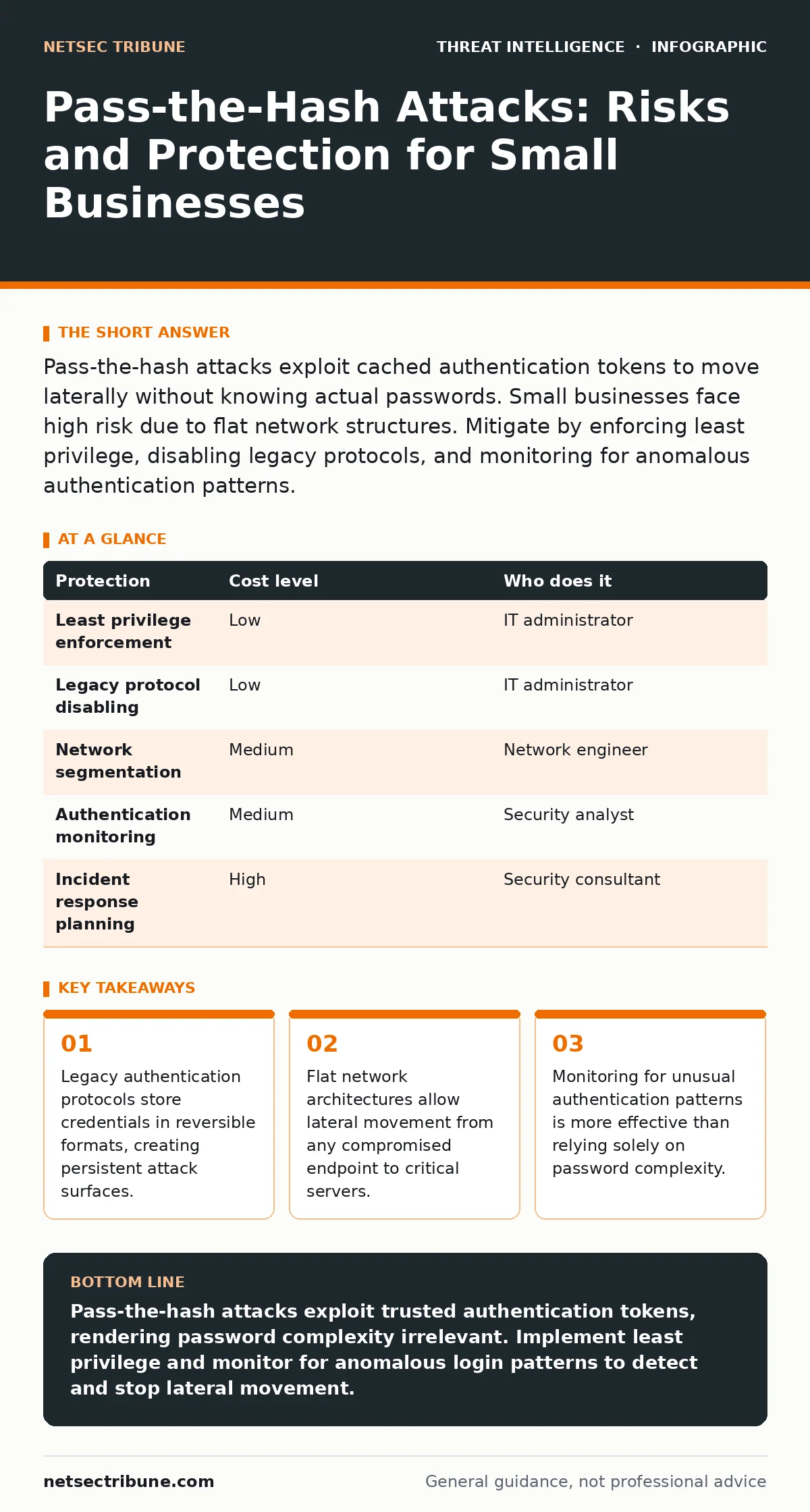
Pass-the-hash attacks exploit cached authentication tokens to move laterally without knowing actual passwords. Small businesses face high risk due to flat network structures. Mitigate by enforcing least privilege, disabling legacy protocols, and monitoring for anomalous authentication patterns.
The Mechanics of Credential Reuse
Pass-the-hash attacks exploit how operating systems handle authentication. When a user logs in, the system hashes the password. A hash is a fixed-length string derived from the password using a mathematical algorithm. This hash is stored locally and sent to the domain controller for verification. The system does not send the raw password.
In a pass-the-hash attack, an adversary steals this hash value from memory or storage. They do not need to reverse the hash to get the password. Instead, they present the stolen hash to the authentication service as if they were the legitimate user. The system accepts the hash as valid proof of identity. This bypasses traditional password-based defenses.
The vulnerability lies in the trust placed in the hash itself. If the hash is valid, the system grants access. This means that even complex, unique passwords offer no protection if the underlying authentication mechanism allows hash replay. The attack succeeds because the system cannot distinguish between a legitimate login attempt and a replayed credential.
Why Small Organizations Are Exposed
Small organizations often operate with flat network architectures. In such environments, most users have administrative privileges or access to shared resources without strict segmentation. There is no clear boundary between a standard user workstation and a critical server. This lack of segmentation allows an attacker to move laterally from any compromised endpoint to any other system.
Administrative accounts in small teams are frequently shared or used for daily tasks. When a user with high privileges performs routine work, their authentication tokens are cached on their device. If that device is compromised, the attacker gains immediate access to the entire network. Large organizations mitigate this with privileged access management, but small teams often lack the tools or expertise to implement such controls.
Another factor is the reliance on legacy protocols. Older versions of authentication protocols, such as NTLM, store hashes in formats that are easier to extract and replay. While modern protocols like Kerberos offer better security, they are not always the default or are misconfigured. Small IT teams may not audit these settings regularly, leaving the door open for exploitation.
The Hidden Cost of Flat Networks
A common misconception is that strong passwords prevent credential theft. They do not. Pass-the-hash attacks ignore the password entirely. They target the token that proves the password was correct. This means that investing heavily in password complexity policies yields diminishing returns against this specific threat.
The real cost is the speed of lateral movement. In a flat network, an attacker can reach critical assets in minutes. There are no network zones to traverse, no firewalls to bypass, and no multi-factor authentication prompts to trigger. The attack is silent. It does not generate failed login attempts. It looks like normal activity. This makes detection difficult without specialized monitoring tools.
Low-Cost Protections for Limited Budgets
Implementing protection does not require expensive hardware or complex infrastructure. The most effective defense is principle of least privilege. Ensure that standard users do not have administrative rights. Create separate accounts for administrative tasks. This limits the value of any stolen token. If a standard user’s hash is stolen, the attacker cannot access administrative resources.
Disable legacy authentication protocols where possible. Modern operating systems support Kerberos, which does not transmit hashes in the same way. Configure group policies to enforce Kerberos authentication. This reduces the attack surface by removing the older, weaker mechanisms. This change is often free if the operating system already supports it.
Segment the network logically. Use virtual local area networks to separate critical servers from user workstations. Even without new hardware, you can configure existing switches to restrict traffic flow. This slows down lateral movement. An attacker who steals a hash from a workstation cannot easily reach the server VLAN. This buys time for detection and response.
Monitoring for Anomalous Behavior
Detection relies on observing patterns rather than blocking specific threats. Normal authentication follows predictable patterns. Users log in from specific devices, at specific times, and to specific resources. A pass-the-hash attack often breaks these patterns. An attacker may log in from multiple devices simultaneously or access resources outside their normal scope.
Use built-in logging tools to monitor authentication events. Look for successful logins that originate from unexpected sources. Pay attention to service account usage. Service accounts often have high privileges and are targeted for lateral movement. If a service account logs in from a user workstation, it is likely an attack.
See also: Lateral Movement in Cybersecurity: Definition and Detection
What to Ask an IT Provider
When engaging an IT provider, focus on their ability to detect and respond to credential theft. Ask about their monitoring capabilities. Do they track authentication events? How do they distinguish between normal and suspicious activity? A provider that only manages patches and antivirus is not equipped to handle this threat.
Ask about their incident response plan. What steps do they take when a credential compromise is suspected? Do they have a process for isolating affected systems? Do they preserve logs for forensic analysis? A clear plan indicates experience with advanced threats.
Review their configuration management practices. Do they enforce least privilege? Do they disable legacy protocols? Do they segment the network? These are basic controls that prevent many attacks. If the provider cannot explain these measures, they may not be providing adequate security.
| Protection | Cost level | Who does it |
|---|---|---|
| Least privilege enforcement | Low | IT administrator |
| Legacy protocol disabling | Low | IT administrator |
| Network segmentation | Medium | Network engineer |
| Authentication monitoring | Medium | Security analyst |
| Incident response planning | High | Security consultant |
Questions for Your Provider
- How do you monitor for lateral movement within our network?
- What steps do you take to disable legacy authentication protocols?
- Do you enforce separation between standard user and administrative accounts?
- How do you detect the use of service accounts from unexpected locations?
- What is your process for investigating suspicious authentication events?
Integrating Broader Security Practices
Addressing pass-the-hash attacks is part of a larger security strategy. You should align your defenses with established frameworks. The MITRE ATT&CK framework provides a taxonomy of tactics and techniques used by adversaries. Understanding this framework helps you map your controls to specific threats.
Consider implementing Sysmon, a system monitor tool that logs detailed system activity. It captures process creation, network connections, and authentication events. This data is invaluable for detecting lateral movement. While it requires configuration, the insights it provides are critical for visibility.
Do not ignore indicators of compromise. These are forensic artifacts left behind by an attacker. While pass-the-hash leaves few traces, other activities associated with the initial compromise may leave indicators. Regularly scanning for these signs helps identify compromised systems before they are used for lateral movement.
For deeper analysis, consider packet capture analysis. This involves recording network traffic to identify suspicious patterns. While resource-intensive, it can reveal authentication attempts that bypass normal logging. This is particularly useful for detecting attacks that evade standard monitoring tools.
Key takeaways
- Legacy authentication protocols store credentials in reversible formats, creating persistent attack surfaces.
- Flat network architectures allow lateral movement from any compromised endpoint to critical servers.
- Monitoring for unusual authentication patterns is more effective than relying solely on password complexity.
Pass-the-hash attacks exploit trusted authentication tokens, rendering password complexity irrelevant. Implement least privilege and monitor for anomalous login patterns to detect and stop lateral movement.
Frequently asked questions
Does multi-factor authentication stop pass-the-hash attacks?
Standard multi-factor authentication does not stop pass-the-hash if the second factor is not required for token replay. Some implementations require re-authentication for sensitive actions, which can mitigate the risk.
Can I detect a pass-the-hash attack with antivirus?
Traditional antivirus software is unlikely to detect pass-the-hash attacks as they use legitimate system processes and credentials. Specialized endpoint detection and response tools are needed.
Is Kerberos immune to pass-the-hash attacks?
Kerberos is more resistant than NTLM, but it is not immune. Attackers can still perform pass-the-ticket attacks, which exploit Kerberos tickets rather than hashes.
How often should I rotate service account passwords?
Regular rotation is good practice, but it does not prevent pass-the-hash if the token is already stolen. Focus on monitoring service account usage and restricting their scope.
How this guide was produced: written by the NetSec Tribune editorial team with AI assistance, checked against the public references listed below, and reviewed when the facts change. See our editorial policy or report an error.