What Are Botnet Attacks: Mechanics, Impact and Defenses
Botnets hide in plain sight by using legitimate device connections to mask malicious traffic from standard network monitoring tools.
Botnet attacks involve malware that infects devices, turning them into remotely controlled nodes. An attacker commands these devices to launch coordinated assaults, such as flooding servers with traffic or stealing data. Understanding the command structure helps you detect anomalies before they cause outages.
Understanding the Botnet Mechanism
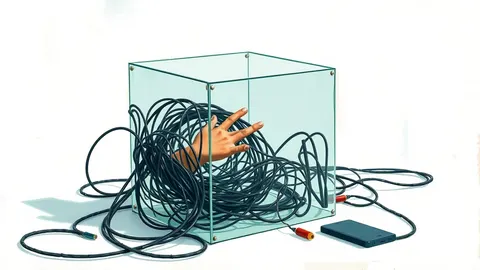
Imagine a library where every book can suddenly stand up and shout the same sentence at once. The books did not choose to shout. A hidden librarian told them to do it. This is how botnet attacks function. The term botnet combines robot and network. It refers to a collection of internet-connected devices that have been infected with malware. The malware allows a remote attacker, known as the botmaster, to control the devices simultaneously. The infected devices are called bots. They perform tasks without the user’s knowledge.
The infection usually starts with a vulnerability in software or a weak configuration. Once inside, the malware establishes a persistent connection to a command and control server. This server sends instructions to the bots. The instructions might tell the bots to send spam emails, mine cryptocurrency, or launch a distributed denial of service attack. The botmaster never needs to control the devices directly. The malware handles the communication. This indirect control makes tracing the attacker difficult. The traffic looks like normal user activity.
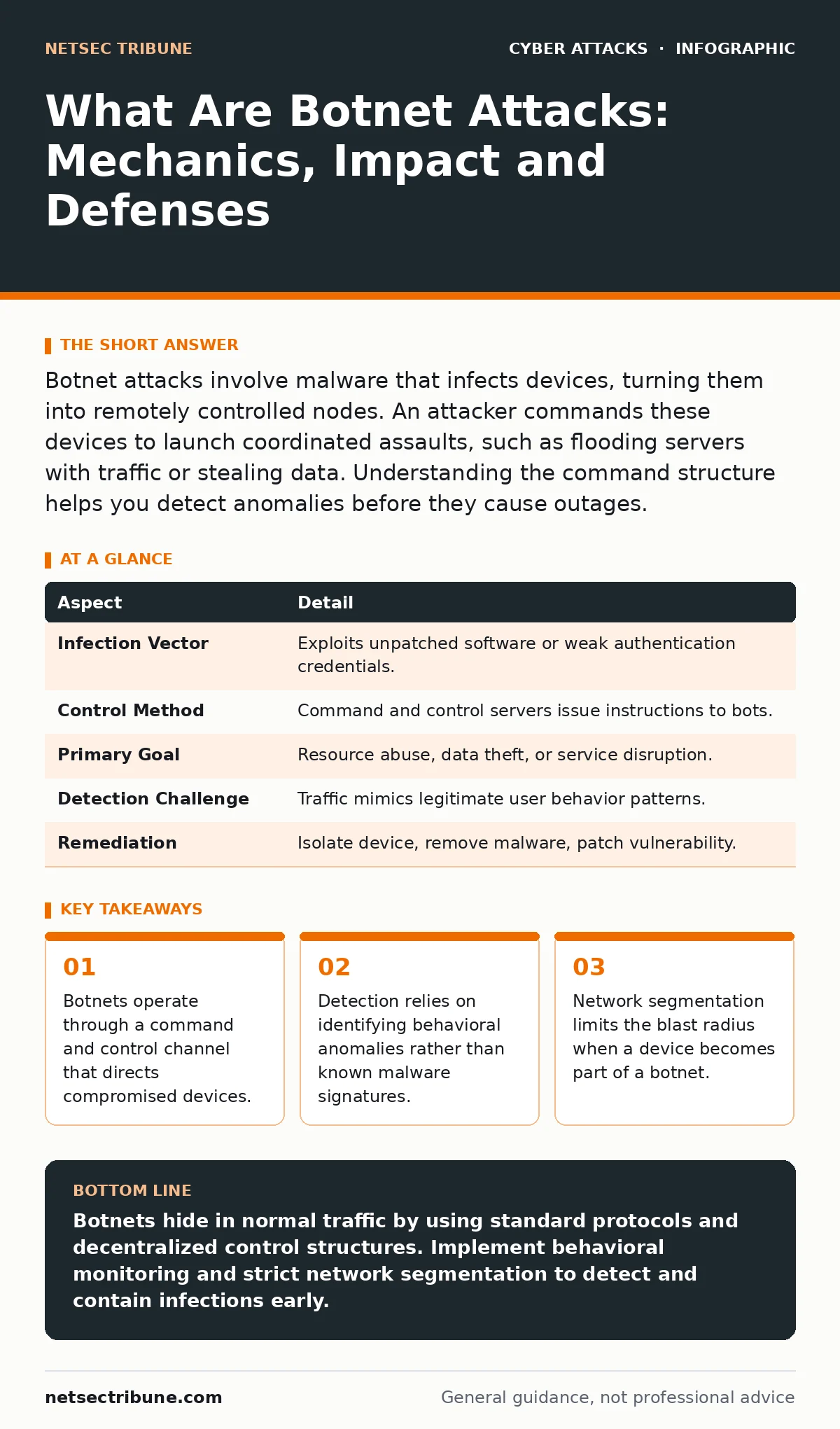
| Aspect | Detail |
|---|---|
| Infection Vector | Exploits unpatched software or weak authentication credentials. |
| Control Method | Command and control servers issue instructions to bots. |
| Primary Goal | Resource abuse, data theft, or service disruption. |
| Detection Challenge | Traffic mimics legitimate user behavior patterns. |
| Remediation | Isolate device, remove malware, patch vulnerability. |
How Command and Control Works
The architecture of a botnet defines its resilience. Early botnets used a centralized model. All bots connected to a single server. If security teams shut down that server, the botnet died. Modern botnets use decentralized structures. They often employ peer-to-peer networking. In this model, each bot can act as a server for other bots. If one node is removed, the network survives. This resilience is why botnet attacks are persistent threats.
The communication between the bot and the controller is often encrypted. This prevents network defenders from reading the commands. The bot might use standard protocols like HTTP or DNS to blend in. This technique is known as domain generation algorithms. The malware generates a new domain name for the controller at regular intervals. If security blocks one domain, the bot finds the next one. This constant shifting makes static blocking ineffective. You must monitor for behavioral patterns, not just specific addresses.
Who Gets Targeted and Why
Botnet attacks do not discriminate based on organization size. They target any device that is connected to the internet and has a security weakness. Home users often provide the bulk of the bots. Their devices are usually less secured. Small businesses are frequent victims of the attacks launched by these bots. Large organizations suffer the most from the impact. The motive varies. Some botnets are rented out on underground markets. Attackers use them for quick profit. Others are built for long-term espionage.
The impact extends beyond direct victims. When a botnet launches a denial of service attack, it floods a target with traffic. This traffic comes from thousands of innocent devices. The target server crashes under the load. Legitimate users cannot access the service. This creates a cascade effect. If the target is a DNS provider, websites across the internet may become unreachable. The collateral damage is significant. The attack disrupts trust in the underlying infrastructure. You must consider the blast radius of any connected device.
What People Usually Get Wrong
Many teams assume that firewalls stop botnet communication. This is incorrect. Firewalls filter traffic based on ports and IP addresses. Botnets often use allowed ports like port 80 or 443. The traffic looks like web browsing. A standard firewall allows it. You need application-level filtering to see the content. Without inspecting the payload, you are blind to the command and control channel.
Another misconception is that antivirus software provides complete protection. Traditional antivirus relies on signatures. It looks for known patterns of malware. If the botnet code is new or polymorphic, the signature does not match. The antivirus misses it. Behavioral detection is more effective. It watches for actions, not code. If a device starts making unusual network connections, behavioral tools flag it. You must combine multiple layers of defense. No single tool catches everything.
Detection and Analysis
Detecting a botnet requires looking for outliers. Normal devices have predictable behavior. A web server responds to requests. A printer accepts print jobs. If a printer starts sending email, something is wrong. You must establish a baseline for each device type. Then monitor for deviations. High volumes of outbound traffic from an internal device are a red flag. Connections to unknown external IPs are another.
Log analysis is critical. You must correlate logs from different sources. Network logs show connections. Endpoint logs show process execution. If a process starts and immediately connects to a new IP, that is suspicious. Time synchronization helps. You need to align timestamps across all logs. Without this, you cannot reconstruct the attack timeline. Automated tools can help, but human analysis catches the nuances. The pattern might be subtle. It might look like a glitch. Trust but verify.
See also: Domain Generation Algorithms: Debunking Common Misconceptions · Sandbox Evasion Myths: What Your Analysis Tools Actually Miss
Mitigation and Response
When you suspect a botnet infection, immediate isolation is key. Disconnect the device from the network. Do not power it off. The memory contains evidence. Powering it off destroys that evidence. Capture a memory dump if possible. Then analyze the disk image. Identify the malware and the vulnerability it exploited. Patch that vulnerability. If you do not patch it, the device will be reinfected.
Reset all credentials that were stored on the device. The malware may have captured them. Change passwords for any accounts that the device accessed. Review access logs for those accounts. Look for unauthorized changes. This step prevents session hijacking. The attacker might have used the stolen credentials to move laterally. You must assume the compromise is wider than the single device. Conduct a full sweep.
Long-Term Prevention Strategies
Prevention starts with configuration hygiene. Disable unnecessary services. Every open port is a potential entry point. Use network segmentation. Isolate critical systems from general user traffic. If a user device gets infected, it cannot reach the core servers. This limits the damage. Implement least privilege principles. Users should only have access to what they need. This reduces the value of compromised credentials.
Regular updates are non-negotiable. Patch operating systems and applications promptly. Many botnets exploit known vulnerabilities that have patches available. The delay between patch release and exploitation is the window of risk. Close that window. Consider using passkeys instead of passwords for authentication. Passkeys are resistant to phishing and credential theft. This adds a layer of security that botnets cannot easily bypass. Combine these measures for a defense in depth.
What Are Botnet Attacks: A Summary
Botnet attacks leverage the collective power of many compromised devices. They are persistent because they adapt and hide. They are dangerous because they can scale quickly. Understanding the mechanics helps you defend against them. You must look beyond surface-level indicators. Monitor behavior, not just signatures. Isolate, analyze, and patch. Repeat. Security is a process, not a product. Stay alert to the changing tactics. The botmasters are always evolving. You must evolve too.
Key takeaways
- Botnets operate through a command and control channel that directs compromised devices.
- Detection relies on identifying behavioral anomalies rather than known malware signatures.
- Network segmentation limits the blast radius when a device becomes part of a botnet.
Botnets hide in normal traffic by using standard protocols and decentralized control structures. Implement behavioral monitoring and strict network segmentation to detect and contain infections early.
Frequently asked questions
Can a smartphone be part of a botnet?
Yes, if it runs unpatched software or installs apps with malware. Mobile devices are increasingly targeted for their processing power and network access.
How do I know if my server is under a botnet attack?
Look for sudden spikes in traffic volume or failed login attempts. Check logs for connections from many different IP addresses in a short time.
Does HTTPS stop botnet communication?
No, HTTPS encrypts the content. Botnets use HTTPS to hide commands from network inspectors. You must use endpoint detection to see what the malware does.
What is the difference between a worm and a botnet?
A worm is self-replicating malware that spreads automatically. A botnet is a network of infected devices controlled by an attacker. A worm can create a botnet.
How this guide was produced: written by the NetSec Tribune editorial team with AI assistance, checked against the public references listed below, and reviewed when the facts change. See our editorial policy or report an error.