Botnets: How Command and Control Networks Operate and Persist
A botnet remains active because it uses decentralized communication channels that bypass traditional perimeter defenses and survive device resets.
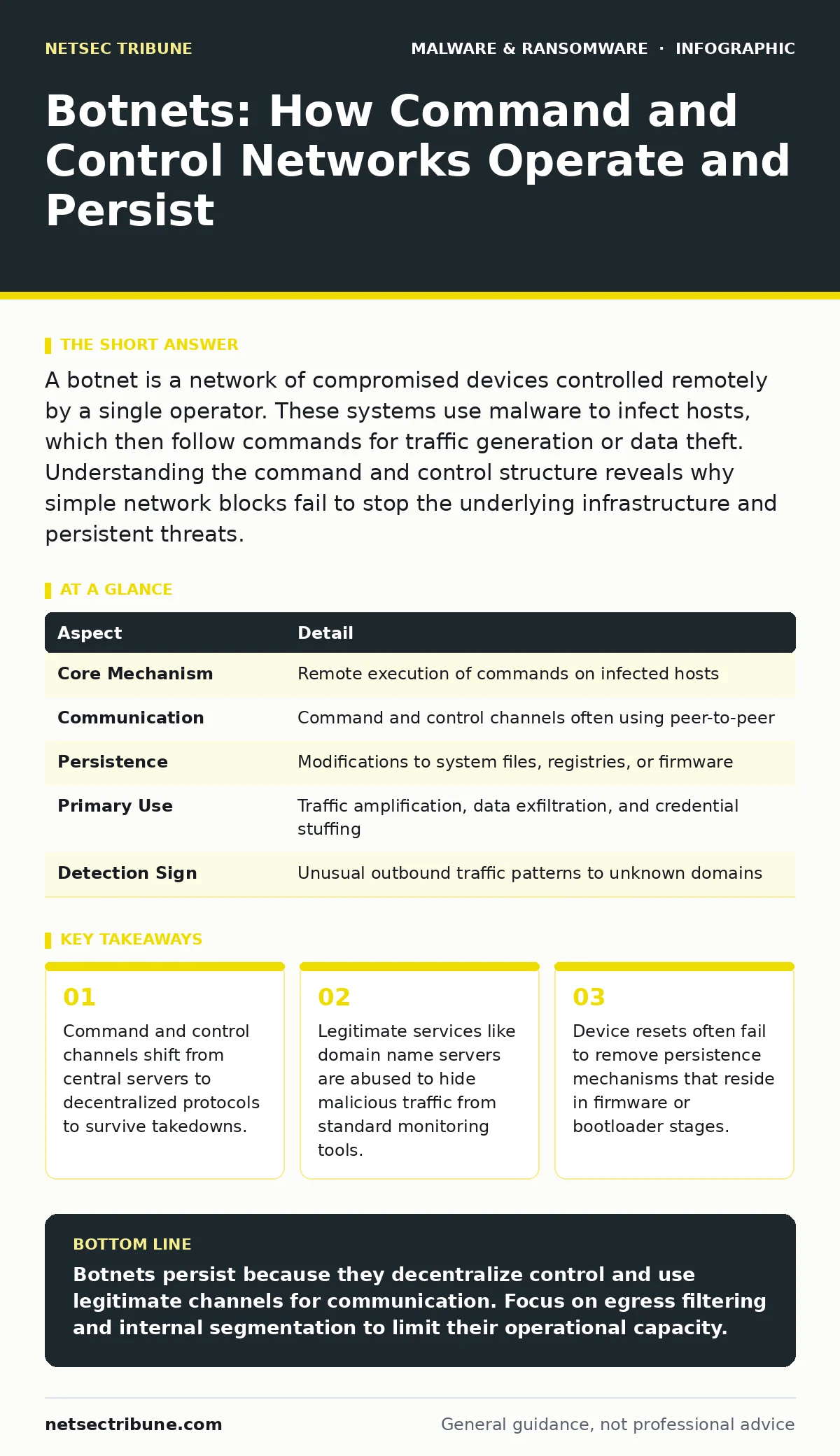
A botnet is a network of compromised devices controlled remotely by a single operator. These systems use malware to infect hosts, which then follow commands for traffic generation or data theft. Understanding the command and control structure reveals why simple network blocks fail to stop the underlying infrastructure and persistent threats.
The Anatomy of a Distributed Threat
Imagine a theater where every audience member receives identical cue cards. When the director signals, thousands of people act in unison without direct contact. A botnet operates on this same principle of distributed coordination. The term combines "robot" and "network" to describe a collection of internet-connected devices infected with malware. Each device, known as a bot, executes commands received from a central operator. This structure allows attackers to scale their impact without exposing their own identity.
The defining feature of a botnet is the command and control channel. This is the communication link between the attacker and the infected devices. Early models relied on simple chat rooms, but modern implementations use more sophisticated methods. The operator sends instructions, and the bots execute them simultaneously. This synchronization creates massive volume, whether for sending spam, generating search queries, or launching denial of service attacks. The distributed nature means no single point of failure exists for the attacker.
| Aspect | Detail |
|---|---|
| Core Mechanism | Remote execution of commands on infected hosts |
| Communication | Command and control channels often using peer-to-peer |
| Persistence | Modifications to system files, registries, or firmware |
| Primary Use | Traffic amplification, data exfiltration, and credential stuffing |
| Detection Sign | Unusual outbound traffic patterns to unknown domains |
How Infection and Control Establishes
The lifecycle begins with initial compromise. Attackers exploit vulnerabilities in web servers, email clients, or unpatched operating systems. Once inside, the malware installs a loader. This loader is responsible for maintaining the connection to the command and control server. It often includes a kill switch to deactivate the bot if the system is being examined. This prevents analysis and helps the botnet remain hidden.
Control is maintained through periodic check-ins. The bot sends a heartbeat signal to confirm it is online. The server then responds with tasks. Modern botnets use domain generation algorithms to create thousands of potential command domains. This makes blacklisting ineffective because the attacker can switch to a new domain instantly. The bot tries to connect to each generated domain until one resolves. This resilience is why traditional firewall rules often fail to block the entire network.
Common Forms and Operational Modes
Botnets adapt their behavior based on the resources available. Resource-heavy tasks require powerful servers, while low-resource tasks can run on inexpensive internet of things devices. The form of the botnet dictates the type of attack it can perform. Understanding these forms helps in identifying the specific risks to your infrastructure.
Peer-to-peer botnets distribute the command logic across all infected nodes. There is no central server to take down. Each bot acts as both a client and a server for its neighbors. This architecture is highly resistant to disruption but harder to build and maintain. Client-server botnets are simpler but vulnerable to server seizures. Hybrid models combine both approaches to balance resilience and control.
Some botnets focus on financial gain through fraud. They generate fake clicks on advertisements or submit fraudulent warranty claims. Others are rented out as a service. Attackers lease control of the bots to third parties for specific campaigns. This commercialization lowers the barrier to entry for cybercrime. The infrastructure is ready-made and requires no technical skill to deploy.
What People Usually Get Wrong
Many defenders assume that a botnet is primarily a tool for denial of service attacks. This view is outdated. Modern botnets are multifunctional platforms. They can steal credentials, mine cryptocurrency, or serve as proxies for further attacks. The initial payload is often just a gateway to more dangerous malware.
Another misconception is that removing the malware from a device stops the threat. Persistence mechanisms often survive standard cleanup. The malware may rewrite boot sectors or modify firmware. Even after a factory reset, the device can reconnect to the botnet if the firmware remains compromised. This is particularly true for network appliances and smart home devices that lack secure update mechanisms.
The Hidden Cost of Decentralization
Decentralized botnets introduce a hidden cost for defenders: increased noise. When a botnet uses peer-to-peer communication, every infected device talks to several others. This creates a web of legitimate-looking traffic. Distinguishing malicious coordination from normal peer interactions is difficult. Standard intrusion detection systems look for known signatures. They struggle with encrypted or polymorphic traffic that changes its appearance.
The use of legitimate services exacerbates this issue. Attackers route command traffic through domain name system queries or cloud storage services. This traffic looks identical to normal user activity. Filtering it requires deep packet inspection, which raises privacy and performance concerns. The trade-off is between visibility and efficiency. High-fidelity monitoring slows down network throughput and increases storage costs.
See also: Remote Access Trojan Warning Signs and Immediate Response Steps · Software Restriction Policies: 6 Common Misunderstandings
Reducing Risk Through Architecture
Defending against botnets requires shifting from perimeter defense to internal segmentation. Assume that some devices will be compromised. Design your network to limit the damage. Isolate critical systems from general user networks. Use micro-segmentation to control lateral movement. This prevents a single infected device from accessing sensitive data or other systems.
Implement strict egress filtering. Monitor outbound traffic for unusual patterns. Block connections to known malicious ports and protocols. Allow only necessary outbound connections. This limits the ability of a bot to communicate with its controller. Regularly audit installed software and remove unused services. Reducing the attack surface lowers the chance of initial infection.
Beyond Basic Defense Mechanisms
Standard antivirus solutions are insufficient against modern botnets. The malware often uses techniques similar to those seen in sandbox evasion. It checks for virtual machines and delays execution until it confirms a real environment. Static analysis fails because the code changes upon each run. Behavioral monitoring is more effective. It looks for unusual actions, such as a process trying to modify system files or establish unexpected network connections.
Consider the role of software restriction policies. These policies define which applications can run on your systems. By default, block all applications except those explicitly allowed. This prevents unauthorized malware from executing even if it reaches the device. It requires careful maintenance to ensure legitimate tools are not blocked, but the security gain is significant.
Related threats often overlap with botnet infrastructure. Malicious mobile apps can serve as bot components, using mobile networks for command and control. Similarly, trojanized software may contain hidden botnet loaders. Understanding these vectors helps in creating a holistic defense strategy. The goal is not to catch every piece of malware, but to prevent them from organizing and acting in concert.
Key takeaways
- Command and control channels shift from central servers to decentralized protocols to survive takedowns.
- Legitimate services like domain name servers are abused to hide malicious traffic from standard monitoring tools.
- Device resets often fail to remove persistence mechanisms that reside in firmware or bootloader stages.
Botnets persist because they decentralize control and use legitimate channels for communication. Focus on egress filtering and internal segmentation to limit their operational capacity.
Frequently asked questions
Can a personal computer be part of a botnet without showing signs?
Yes. Modern malware minimizes resource usage to avoid detection. It may only activate during specific windows or when commanded, leaving system performance largely unaffected.
Does using a firewall stop a botnet infection?
A firewall can block some communication but does not stop initial infection. If the malware uses outbound connections on allowed ports, the firewall will permit the traffic. Egress filtering is required for effective protection.
How do attackers maintain control if a server is seized?
They use peer-to-peer architectures or domain generation algorithms. The control logic is distributed among the bots, or new command domains are generated dynamically, making server seizures ineffective.
Is it possible to remove a botnet from firmware?
It is difficult. Firmware updates are required to remove such persistence. If the manufacturer does not provide secure updates, the device may need to be physically replaced to ensure complete removal.
How this guide was produced: written by the NetSec Tribune editorial team with AI assistance, checked against the public references listed below, and reviewed when the facts change. See our editorial policy or report an error.