
Domain Generation Algorithms: Debunking Common Misconceptions
Domain generation algorithms do not create random noise; they produce deterministic strings that allow defenders to predict and sinkhole malicious infrastructure before execution.
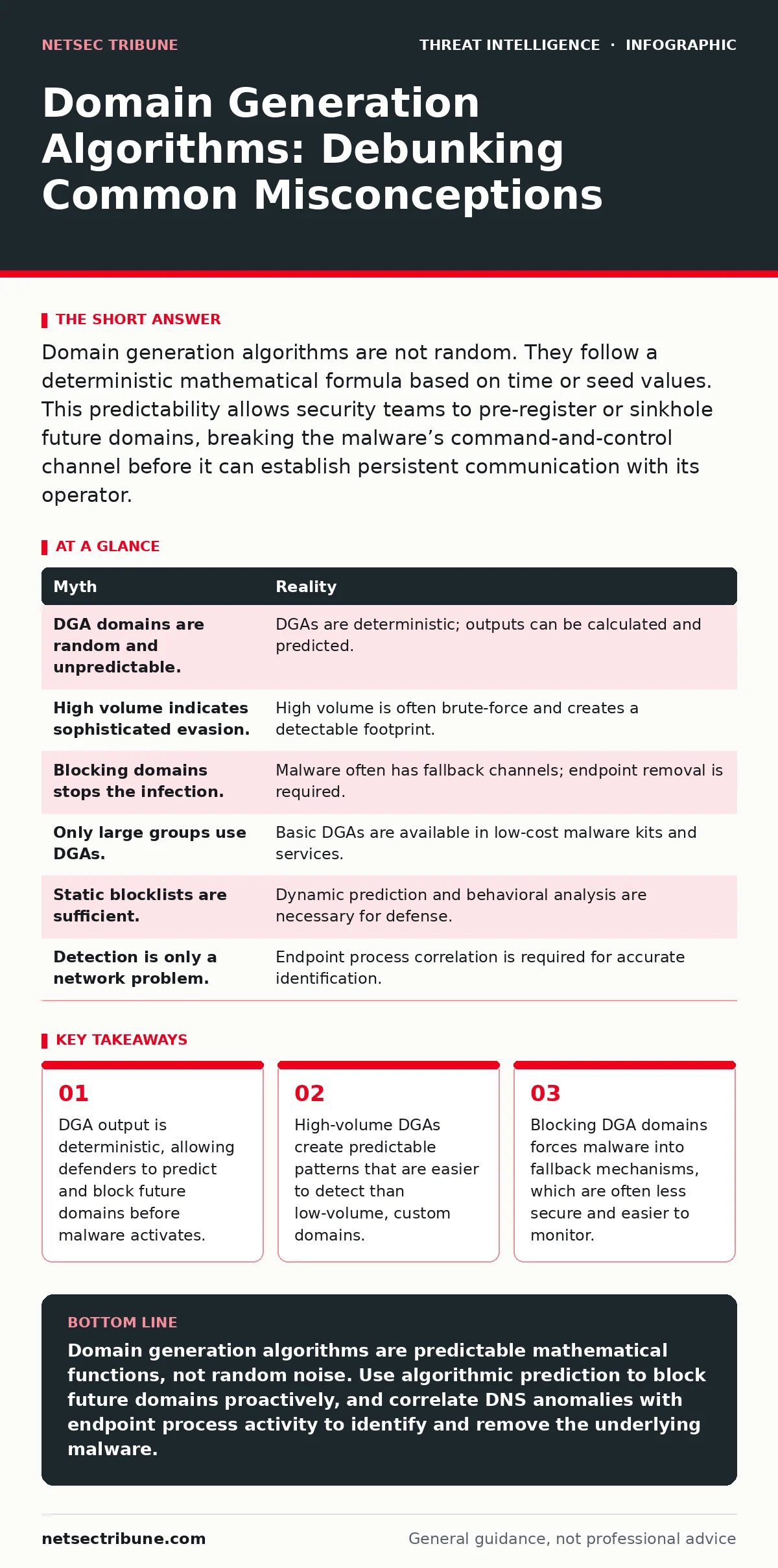
Domain generation algorithms are not random. They follow a deterministic mathematical formula based on time or seed values. This predictability allows security teams to pre-register or sinkhole future domains, breaking the malware’s command-and-control channel before it can establish persistent communication with its operator.
Myth: DGA domains are completely random and unpredictable
Reality: Domain generation algorithms rely on deterministic mathematical functions. They use inputs such as the current date, a static seed value, or a combination of both to generate a specific string of characters. This means the same input always produces the same output. You can calculate the exact domain name a malware instance will attempt to contact tomorrow if you know the algorithm and the seed.
Randomness implies no pattern, but DGAs are engineered for consistency across thousands of infected hosts. The malware does not guess; it calculates. This determinism is the primary weakness of the technique. It allows defenders to run the same algorithm locally and generate lists of potential future domains. By registering or sinkholing these predicted domains in advance, you deny the malware its communication channel.
This approach shifts the advantage from the attacker, who relies on obscurity, to the defender, who relies on prediction. It turns a reactive blocklist into a proactive defense. The attacker cannot change the algorithm on deployed malware without pushing an update, which itself requires a working command-and-control channel.
Myth: High volume of domains indicates sophisticated evasion
Reality: Generating thousands of domains daily is often a sign of brute-force simplicity, not sophistication. Many basic DGAs simply cycle through permutations to ensure at least one domain remains unregistered and available. This high volume creates a noisy footprint. It increases the likelihood of hitting registered trademarks or reserved namespaces, which draws immediate attention from domain registrars and security researchers.
Sophisticated attackers often prefer low-volume, high-entropy domains that mimic legitimate typing patterns. These domains are harder to distinguish from human-typed typosquatting or legitimate dynamic DNS entries. The sheer volume of a DGA is a double-edged sword. It ensures availability but sacrifices stealth. Defenders can detect these bursts by monitoring registration velocity and entropy spikes in real-time.
Myth: Blocking known DGA domains stops the infection permanently
Reality: Modern malware families incorporate fallback mechanisms for when their primary DGA channel fails. If the malware cannot resolve the predicted domain, it may switch to a secondary DGA with a different seed or algorithm. It might also fall back to hard-coded backup domains or use peer-to-peer communication to find other infected hosts. Blocking the primary channel disrupts the attacker but does not necessarily remove the malware from your network.
This resilience means that domain blocking is a containment strategy, not a cure. The malware remains on the endpoint, waiting for a working channel to re-establish contact. You must combine domain prediction with endpoint detection and response. Monitor for the malware’s behavior, such as attempts to contact multiple domains in rapid succession or unusual DNS query patterns.
The attacker’s goal is persistence, not just communication. Disrupting one channel forces them to use less efficient methods, which are often easier to detect. This trade-off benefits the defender. It increases the attacker’s operational cost and reduces their ability to exfiltrate data silently.
Myth: DGAs are only used by large, organized cybercriminal groups
Reality: The barrier to entry for implementing a basic DGA is low. Open-source malware kits and commercially available malware-as-a-service platforms often include DGA functionality by default. Small-scale actors and script kiddies can deploy these tools without understanding the underlying mathematics. The complexity lies in avoiding detection, not in creating the algorithm.
This democratization of DGA technology means you will encounter them in various threat contexts. It is not limited to advanced persistent threats. Even low-sophistication campaigns use DGAs to ensure they have a reliable command-and-control channel. The assumption that only state-sponsored actors use DGAs leads to complacency. You must treat any unexpected DNS activity with suspicion, regardless of the suspected actor’s profile.
Myth: Static blocklists are sufficient for DGA defense
Reality: Static blocklists are inherently reactive. They only contain domains that have already been observed and reported. By the time a DGA domain appears on a blocklist, the malware may have already executed its payload. DGAs generate new domains every day, often every hour. A static list cannot keep pace with this volume.
Effective defense requires dynamic, algorithmic prediction. You must integrate threat intelligence feeds that provide DGA seeds or algorithms, not just domain names. This allows your security systems to generate and block future domains proactively. Combine this with behavioral monitoring for DNS queries. Look for high entropy in domain names and unusual query frequencies.
See also: Fix IOC Enrichment Errors: 6 Common Misunderstandings · Hybrid Warfare in Cyberspace: Correcting 6 Common Intelligence Errors
Myth: DGA detection is purely a network-level problem
Reality: While DNS traffic is the visible symptom, the root cause is on the endpoint. The malware must execute the algorithm locally to generate the domain name. Endpoint detection and response solutions can identify the process responsible for the DNS queries. Correlating network DNS logs with endpoint process trees provides a complete picture.
This correlation helps distinguish between a compromised host generating DGA traffic and a legitimate application making high-volume DNS requests. It also aids in incident response. Identifying the malicious process allows you to terminate the infection and isolate the host. Relying solely on network indicators leaves you blind to the initial execution and persistence mechanisms.
| Myth | Reality |
|---|---|
| DGA domains are random and unpredictable. | DGAs are deterministic; outputs can be calculated and predicted. |
| High volume indicates sophisticated evasion. | High volume is often brute-force and creates a detectable footprint. |
| Blocking domains stops the infection. | Malware often has fallback channels; endpoint removal is required. |
| Only large groups use DGAs. | Basic DGAs are available in low-cost malware kits and services. |
| Static blocklists are sufficient. | Dynamic prediction and behavioral analysis are necessary for defense. |
| Detection is only a network problem. | Endpoint process correlation is required for accurate identification. |
Key takeaways
- DGA output is deterministic, allowing defenders to predict and block future domains before malware activates.
- High-volume DGAs create predictable patterns that are easier to detect than low-volume, custom domains.
- Blocking DGA domains forces malware into fallback mechanisms, which are often less secure and easier to monitor.
- Defenders must monitor for domain registration velocity and entropy spikes, not just known malicious lists.
Domain generation algorithms are predictable mathematical functions, not random noise. Use algorithmic prediction to block future domains proactively, and correlate DNS anomalies with endpoint process activity to identify and remove the underlying malware.
Frequently asked questions
How do I identify if a domain was generated by a DGA?
Look for high entropy in the domain name, lack of meaningful words, and unusual registration patterns such as bulk registration of similar structures.
Can DGAs be used for legitimate purposes?
Yes, some legitimate services use dynamic naming for load balancing or privacy, but they typically follow recognizable patterns and use known registrars.
What is the best way to block DGA traffic?
Combine algorithmic prediction to block future domains with behavioral analysis to detect ongoing DNS anomalies and endpoint monitoring to identify the malicious process.
Do DGAs work with HTTPS?
Yes, DGAs can generate domains for HTTPS connections, making the traffic encrypted and harder to inspect. This makes prediction and endpoint detection even more critical.
How this guide was produced: written by the NetSec Tribune editorial team with AI assistance, checked against the public references listed below, and reviewed when the facts change. See our editorial policy or report an error.