
Tabletop Exercise Mistakes: 7 Errors That Break Your Incident Response
Most tabletop exercises fail because participants rehearse perfect scenarios instead of practicing the messy, incomplete decisions required during a real crisis.
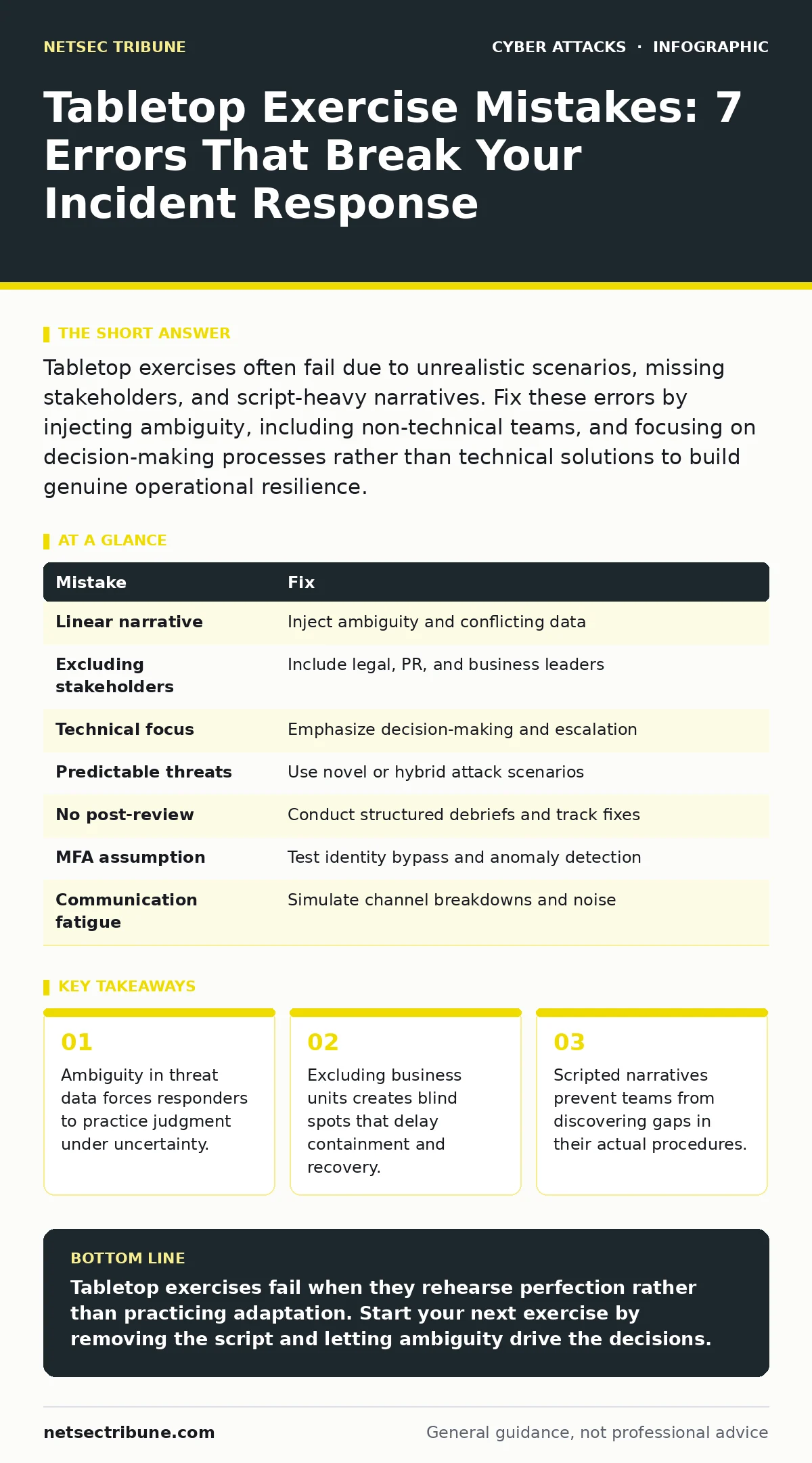
Tabletop exercises often fail due to unrealistic scenarios, missing stakeholders, and script-heavy narratives. Fix these errors by injecting ambiguity, including non-technical teams, and focusing on decision-making processes rather than technical solutions to build genuine operational resilience.
Mistake 1: Designing a Perfectly Linear Narrative
Many exercise designers construct a timeline where every event follows logically from the previous one. This approach assumes that attackers behave predictably and that intelligence is always accurate. In reality, threat actors pivot unexpectedly, and initial indicators are often misleading.
Why it hurts: Teams rehearse a single path to resolution. When the actual incident deviates from the script, responders freeze because they have not practiced handling divergence. This lack of flexibility leads to delayed containment when facing complex threats like API abuse or lateral movement.
The fix: Inject deliberate ambiguity into the scenario. Provide conflicting intelligence reports or incomplete data logs. Force participants to make containment decisions without full visibility. This trains the muscle memory required for real-world judgment.
Mistake 2: Excluding Non-Technical Stakeholders
Tabletop exercises often invite only the security operations center staff and IT engineers. This creates an echo chamber where technical solutions are discussed in isolation. However, incident response is as much about business continuity as it is about technical mitigation.
Why it hurts: Decisions made in isolation ignore legal, public relations, and regulatory implications. A technical fix might violate data privacy laws or cause significant revenue loss. Without these voices, the response plan remains theoretical and disconnected from business reality.
The fix: Invite legal counsel, communications teams, and business unit leaders. Give them specific decision points, such as when to notify customers or when to shut down a service. This ensures the response plan accounts for reputational and financial risks.
Mistake 3: Focusing on Technical Solutions Over Process
Participants often spend the majority of the exercise discussing specific firewall rules or patch deployment strategies. While technical details matter, the primary goal of a tabletop exercise is to validate the decision-making process and communication flows.
Why it hurts: Teams miss opportunities to identify gaps in escalation paths or role definitions. They may assume a tool exists or a vendor will act, only to find out later that the contract does not cover the specific scenario. This focus on tools obscures procedural failures.
The fix: Shift the conversation to "who decides" and "who notifies." If a technical discussion arises, steer it back to the process. Ask how the team verifies the efficacy of a control, rather than just configuring it.
Mistake 4: Using Known, Predictable Threats
Designers frequently choose common threats like basic phishing or ransomware because the playbook is well-established. This comfort zone leads to complacency. Teams already know how to respond to these standard attacks, so the exercise becomes a confirmation bias exercise.
Why it hurts: It fails to stress-test the organization against novel or hybrid attacks. For example, an attack combining session hijacking with social engineering requires different coordination than a standard malware outbreak. Predictable scenarios do not reveal hidden dependencies or blind spots.
The fix: Select scenarios that are plausible but unfamiliar. Consider supply chain compromises, insider threats with legitimate access, or infrastructure failures that mimic attacks. This forces teams to adapt existing playbooks rather than reciting them.
Mistake 5: Skipping the Post-Exercise Review
The exercise ends when the scenario concludes, and participants disperse. Without a structured debrief, the lessons learned evaporate. The value of a tabletop exercise lies not in the simulation itself, but in the analysis of what went wrong.
Why it hurts: Errors are repeated in subsequent incidents. Teams may feel they "passed" the exercise because they contained the threat, ignoring the friction points that slowed them down. This false sense of security leaves gaps unaddressed.
The fix: Hold a mandatory debrief session within two days of the exercise. Document every decision, delay, and confusion point. Assign owners to fix each identified gap. Track these items to closure before the next exercise.
See also: Data Breach Response: Containment, Recovery and Prevention Steps · Difference Between Cloud Logging and Monitoring: Operational Reality
Mistake 6: Assuming Multi-Factor Authentication Stops Everything
Exercises often assume that multi-factor authentication prevents account takeover, so they skip testing identity-based attacks. This assumption is dangerous because MFA can be bypassed through fatigue attacks, token theft, or certificate abuse.
Why it hurts: Teams neglect identity monitoring and anomaly detection. When an attacker bypasses MFA, the response is slow because the team believed the control was absolute. This oversight is particularly risky in environments with high privilege access.
The fix: Include scenarios where MFA is bypassed or compromised. Test the detection of impossible travel or unusual login patterns. Ensure the response plan includes steps for resetting credentials and revoking tokens, not just blocking IPs.
Mistake 7: Ignoring Communication Fatigue
Exercises often assume that communication channels remain clear and that messages are always read. In a real crisis, alert fatigue sets in quickly. Critical messages are buried in noise, and stakeholders ignore updates due to frequency.
Why it hurts: Vital instructions are missed, leading to uncoordinated actions. Teams may duplicate efforts or contradict each other because they are not listening to the same channel. This chaos extends the dwell time of the threat.
The fix: Simulate communication breakdowns. Have key participants go offline or receive delayed messages. Test alternative communication methods, such as out-of-band channels. This prepares the team to maintain coordination under stress.
| Mistake | Fix |
|---|---|
| Linear narrative | Inject ambiguity and conflicting data |
| Excluding stakeholders | Include legal, PR, and business leaders |
| Technical focus | Emphasize decision-making and escalation |
| Predictable threats | Use novel or hybrid attack scenarios |
| No post-review | Conduct structured debriefs and track fixes |
| MFA assumption | Test identity bypass and anomaly detection |
| Communication fatigue | Simulate channel breakdowns and noise |
Key takeaways
- Ambiguity in threat data forces responders to practice judgment under uncertainty.
- Excluding business units creates blind spots that delay containment and recovery.
- Scripted narratives prevent teams from discovering gaps in their actual procedures.
Tabletop exercises fail when they rehearse perfection rather than practicing adaptation. Start your next exercise by removing the script and letting ambiguity drive the decisions.
Frequently asked questions
How long should a tabletop exercise last?
Aim for two to four hours. Longer sessions cause fatigue and reduce the quality of decision-making, while shorter sessions may not allow enough time to explore complex scenarios.
Can remote teams participate effectively?
Yes, but you must adapt the format. Use collaborative digital tools for mapping decisions and ensure all participants have stable connectivity. Test these tools before the exercise begins.
How do you measure success in a tabletop exercise?
Success is not about containing the threat quickly. It is about identifying gaps in process, communication, and decision-making. Track the number of actionable findings and the speed of closure for these items.
Should you include attackers in the exercise?
No, tabletop exercises are for defenders. Including attackers can create conflict and distract from the defensive objectives. Focus on the perspective of the response team.
How this guide was produced: written by the NetSec Tribune editorial team with AI assistance, checked against the public references listed below, and reviewed when the facts change. See our editorial policy or report an error.