
Bot Protection Explained: How to Stop Automated Abuse
Most bot protection fails because it treats all automation as hostile, blocking legitimate tools while malicious scripts slip through behavioral gaps.
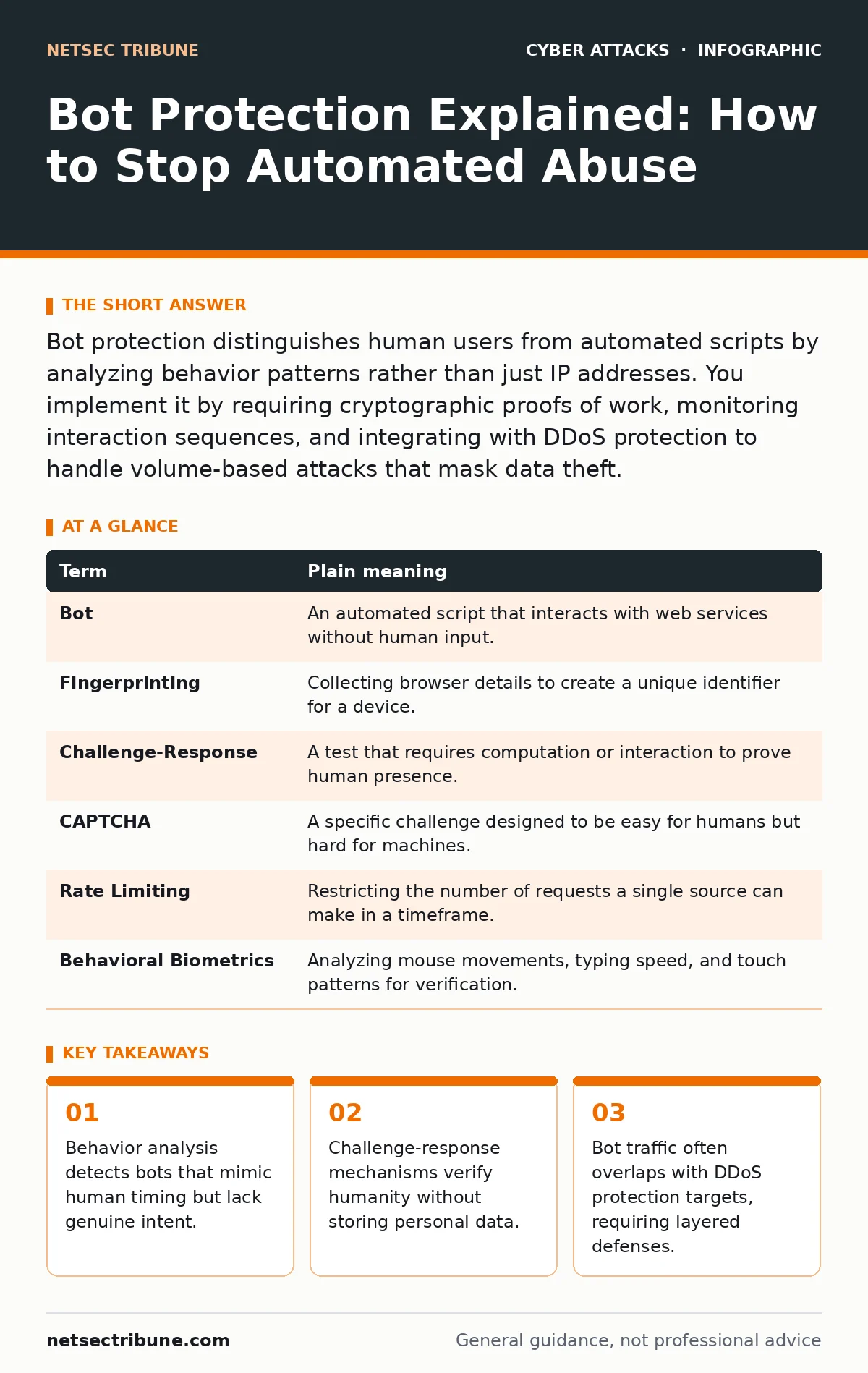
Bot protection distinguishes human users from automated scripts by analyzing behavior patterns rather than just IP addresses. You implement it by requiring cryptographic proofs of work, monitoring interaction sequences, and integrating with DDoS protection to handle volume-based attacks that mask data theft.
The Airport Security Analogy
Imagine an airport where every passenger must pass through security. Humans walk at varying speeds, glance around, and sometimes fumble with their bags. Robots move at constant speeds, ignore their surroundings, and process items with mechanical precision. Security does not ban all fast walkers. It identifies the pattern. Bot protection works the same way. It does not block all automated requests. It blocks requests that lack the chaotic, inefficient, and intentional markers of human behavior.
Defining the Threat Surface
You must distinguish between good bots and bad bots. Search engines, monitoring tools, and legitimate integrations are good. They follow rules and identify themselves. Bad bots scrape pricing, steal credentials, or book inventory for resale. They hide their identity. The core challenge is that bad bots increasingly mimic good ones. They use residential IP addresses. They rotate user agents. They solve simple puzzles. The defense shifts from identity verification to behavioral verification.
| Term | Plain meaning |
|---|---|
| Bot | An automated script that interacts with web services without human input. |
| Fingerprinting | Collecting browser details to create a unique identifier for a device. |
| Challenge-Response | A test that requires computation or interaction to prove human presence. |
| CAPTCHA | A specific challenge designed to be easy for humans but hard for machines. |
| Rate Limiting | Restricting the number of requests a single source can make in a timeframe. |
| Behavioral Biometrics | Analyzing mouse movements, typing speed, and touch patterns for verification. |
The Hidden Cost of Friction
Every verification step adds latency. You are trading user experience for security. If the check is too heavy, legitimate users leave. If it is too light, bots pass through. This is the central trade-off. Many organizations choose the light path to preserve revenue. They accept some bot traffic as the cost of doing business. This is a strategic decision, not a technical failure. You must define your acceptable loss rate before you configure your tools.
Beyond Simple Checks
Traditional methods like cookie checks or IP blocklists are obsolete. Bots clear cookies. They use proxy networks to rotate IPs. You need layered detection. Start with JavaScript challenges. These require a browser engine to execute code. Many simple bots cannot do this. Next, add behavioral analysis. Track how the mouse moves. Track how quickly forms are filled. Humans hesitate. They correct typos. They scroll. Bots jump. They submit. This data builds a risk score.
Consider how API abuse often bypasses these frontend checks. APIs have no mouse movements. They have no scroll events. You must apply different logic to API endpoints. Use strict rate limiting and require strong authentication. For deeper identity assurance, look into passkeys, which remove passwords entirely and reduce the value of stolen credentials.
Integrating with Network Defenses
Bot traffic often serves a larger purpose. It might be scouting for vulnerabilities. It might be preparing for a credential stuffing attack. It might be part of a distributed denial of service. This is why bot protection must talk to your DDoS protection systems. When traffic volume spikes, the bot filter tightens. It assumes more traffic is malicious. This correlation prevents resource exhaustion.
Imagine a scenario where attackers use a slow-and-low approach. They send requests just below the rate limit. They mimic human pacing. This is harder to detect. You need historical baselines. You need to know what normal traffic looks like for your specific application. Without baselines, you are guessing.
See also: What Is Input Validation: How to Stop Bad Data From Breaking Systems · Should I Use Captcha On My Site? The Security Trade-Offs
Practical Implementation Steps
You cannot fix this with a single tool. You need a process. Start by cataloging your endpoints. Identify which ones are high value. Product pages are high value. Login pages are high value. About us pages are low value. Protect the high value ones first. Use multi-factor authentication on login pages to stop credential stuffing even if bots pass the initial filter.
- Identify critical endpoints that host valuable data or transactions.
- Implement JavaScript challenges on those endpoints to filter simple scripts.
- Enable behavioral analysis to flag anomalous interaction patterns for review.
Monitoring and Adjustment
Bot tactics evolve. Your defenses must too. Review your logs weekly. Look for new patterns. Look for spikes in specific error codes. Look for unusual geographic distributions. If you see a surge in traffic from a region you do not serve, investigate. It might be a new botnet. It might be a legitimate marketing campaign. Distinguish between the two.
Also consider that session hijacking attacks often follow successful bot logins. If a bot bypasses your initial checks and logs in, it can steal the session token. Ensure your session management is secure. Use short expiration times. Bind sessions to device fingerprints where possible. This limits the damage of a successful bypass.
Key takeaways
- Behavior analysis detects bots that mimic human timing but lack genuine intent.
- Challenge-response mechanisms verify humanity without storing personal data.
- Bot traffic often overlaps with DDoS protection targets, requiring layered defenses.
Frequently asked questions
Does bot protection stop all automated attacks?
No bot protection stops every attack. It raises the cost and complexity for attackers. It reduces the volume of successful automated abuse. It does not eliminate the threat entirely.
How do I avoid blocking legitimate users?
Use behavioral analysis rather than static rules. Allow users to prove humanity through challenges only when risk scores are high. Monitor conversion rates and adjust thresholds regularly to minimize false positives.
Is CAPTCHA still effective for bot protection?
Traditional image-based CAPTCHAs are less effective than they were. Bots can solve them using AI. Modern systems use invisible challenges or behavioral biometrics that do not disrupt the user experience while still verifying human intent.
What is the first step to implementing bot protection?
The first step is identifying your high-value endpoints. You cannot protect everything equally. Focus your resources on login pages, checkout processes, and search functions where bot abuse causes the most financial or operational harm. BOTTOM LINE: Bot protection is a balancing act between security and user experience. Start by protecting high-value endpoints with behavioral analysis and adjust based on real-world conversion data.
How this guide was produced: written by the NetSec Tribune editorial team with AI assistance, checked against the public references listed below, and reviewed when the facts change. See our editorial policy or report an error.