
DDoS Protection Explained: How Traffic Shaping Stops Floods
Distributed denial-of-service attacks succeed by exploiting network capacity limits, not by breaking encryption or stealing credentials, making traffic management the primary defense.
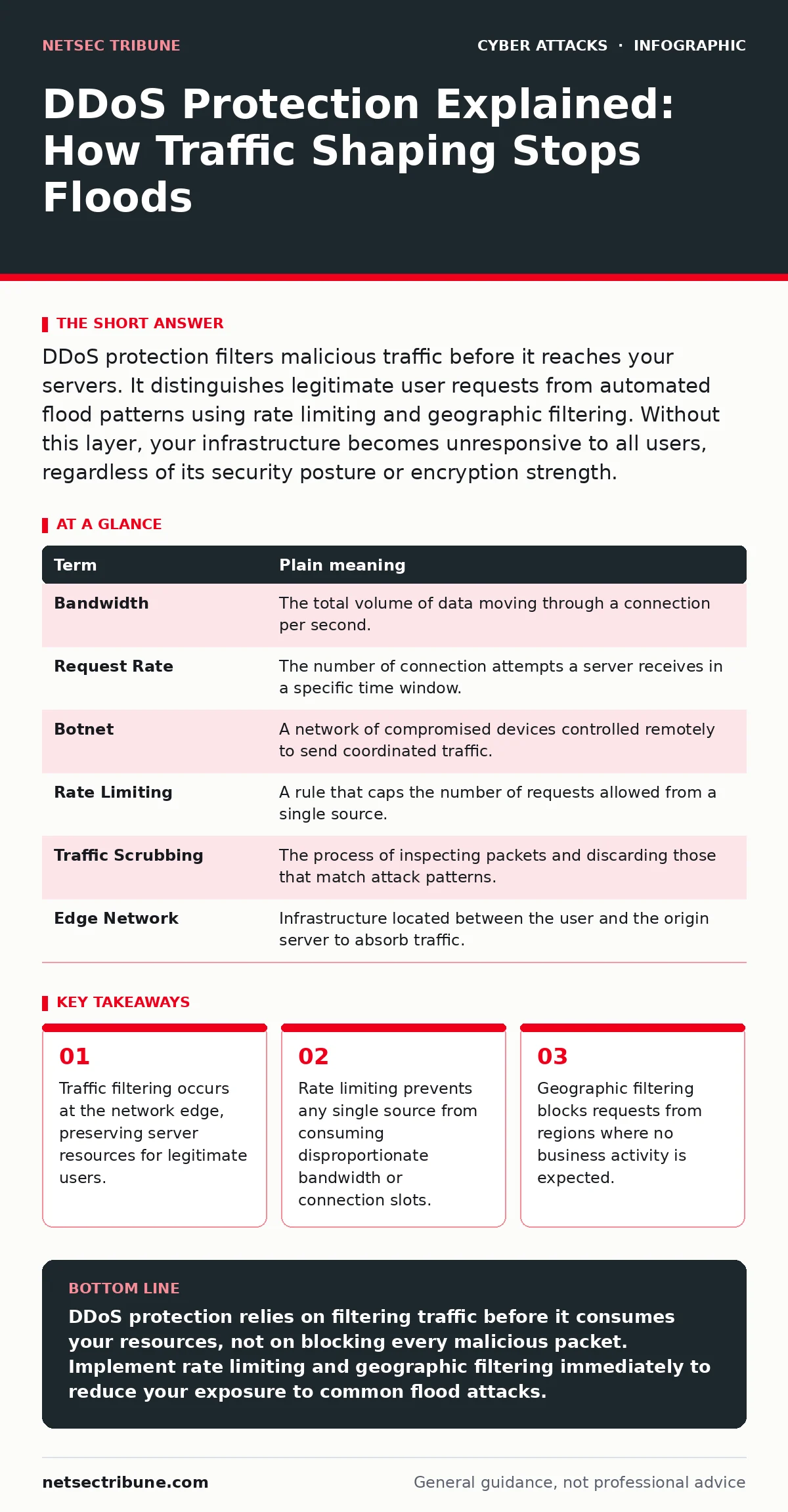
DDoS protection filters malicious traffic before it reaches your servers. It distinguishes legitimate user requests from automated flood patterns using rate limiting and geographic filtering. Without this layer, your infrastructure becomes unresponsive to all users, regardless of its security posture or encryption strength.
The Highway Toll Booth Analogy
Imagine a highway toll booth that processes one car every 2 seconds. Under normal conditions, traffic flows smoothly. Now suppose a coordinated group sends 500 fake cars to that single booth simultaneously. The booth does not break. The mechanism works perfectly. It simply cannot process 500 cars in the time it takes to handle one. The result is a total standstill for every legitimate driver waiting behind the flood. This is the core mechanism of a distributed denial-of-service attack. The attacker does not need to hack the toll booth. They only need to overwhelm its processing capacity.
Defining the Attack Vector
A distributed denial-of-service (DDoS) attack floods a target with more requests than it can handle. The "distributed" aspect means the traffic originates from thousands of compromised devices, often called a botnet. This makes the source difficult to block because it appears to come from many different locations. The goal is availability loss, not data theft. Your services become unreachable to real users. This differs from intrusion attempts where an attacker seeks entry. Here, the attacker seeks to clog the entryway.
Key Terms for Traffic Analysis
Understanding the mechanics requires precise vocabulary. These terms define how traffic is measured and filtered.
| Term | Plain meaning |
|---|---|
| Bandwidth | The total volume of data moving through a connection per second. |
| Request Rate | The number of connection attempts a server receives in a specific time window. |
| Botnet | A network of compromised devices controlled remotely to send coordinated traffic. |
| Rate Limiting | A rule that caps the number of requests allowed from a single source. |
| Traffic Scrubbing | The process of inspecting packets and discarding those that match attack patterns. |
| Edge Network | Infrastructure located between the user and the origin server to absorb traffic. |
The Hidden Cost of Volume Attacks
Most teams focus on application-layer attacks, such as those exploiting logic flaws. However, volume attacks are simpler and harder to mitigate without specialized infrastructure. If your internet connection has a capacity of 1 gigabit per second, an attack sending 10 gigabits per second will saturate your link. Your firewall cannot filter traffic it cannot see. The traffic never reaches your filters; it fills the pipe leading to them. This is why on-premise defenses alone are insufficient against large-scale volume attacks. You must offload the filtering to a location with higher capacity.
Implementing Traffic Shaping
Traffic shaping is the primary defense mechanism. It involves setting rules that prioritize legitimate traffic and drop suspicious patterns. One effective method is rate limiting. You configure your network to accept only a certain number of requests per second from any single IP address. If a source exceeds this limit, subsequent requests are dropped. This prevents a single compromised device from consuming all available resources. It also protects against slow-and-low attacks, which send traffic just below the detection threshold to avoid triggering alarms.
See also: Lateral Movement in Cybersecurity: Definition and Detection · How to Prevent ARP Spoofing: Static Mapping and Port Security
Geographic Filtering as a First Line
If your business operates only in North America, requests from other continents are likely malicious or erroneous. Geographic filtering allows you to block traffic from regions where you have no customers. This reduces the noise your security tools must process. It is a blunt instrument but highly effective for reducing the attack surface. You must balance this with the need to serve global users if your business model requires it. For local services, blocking non-local traffic is a high-impact, low-cost measure.
Try This Now: 3 Steps
- [ ] Audit your current bandwidth capacity and compare it to your peak legitimate traffic. Know your baseline so you can detect anomalies.
- [ ] Implement rate limiting on your web server or load balancer. Set thresholds slightly above your normal peak to avoid blocking real users during busy periods.
- [ ] Enable geographic filtering for regions where you do not conduct business. Review this list quarterly to ensure it matches your current customer base.
Integrating with Broader Security
DDoS protection is a layer of defense, not a complete solution. It keeps services online but does not prevent other threats. For example, an attacker might use a low-volume DDoS to distract your team while performing session hijacking on a vulnerable endpoint. Or they might use the chaos to mask insider threats that exfiltrate data. You must monitor for lateral movement even when the network appears stable. Understanding the blast radius of a service outage helps you prioritize which systems need the highest level of protection.
The Role of External Mitigation
For large-scale attacks, you need external mitigation. This involves routing your traffic through a third-party network that has the capacity to absorb massive floods. These networks use traffic scrubbing to remove malicious packets before sending clean traffic to your origin server. This is similar to having a massive reservoir that holds back a flood until the water level drops to a manageable flow. You cannot build this capacity in-house without significant investment. Using an edge network provider ensures you have access to infrastructure orders of magnitude larger than your own.
Key takeaways
- Traffic filtering occurs at the network edge, preserving server resources for legitimate users.
- Rate limiting prevents any single source from consuming disproportionate bandwidth or connection slots.
- Geographic filtering blocks requests from regions where no business activity is expected.
DDoS protection relies on filtering traffic before it consumes your resources, not on blocking every malicious packet. Implement rate limiting and geographic filtering immediately to reduce your exposure to common flood attacks.
Frequently asked questions
How do I know if I am under a DDoS attack?
Look for a sudden, sustained increase in traffic volume from diverse IP addresses that causes service slowdowns or outages for legitimate users.
Can a firewall stop a DDoS attack?
A standard firewall can filter known bad IPs but cannot handle volume attacks that exceed your connection capacity. It will become a bottleneck.
Is DDoS protection the same as a firewall?
No. Firewalls filter based on rules and signatures. DDoS protection focuses on traffic volume, rate, and behavior to maintain availability during floods.
Do I need DDoS protection if I am a small business?
Yes. Small businesses are frequent targets because they often lack robust defenses. An attack can cripple operations quickly without requiring sophisticated tools.
How this guide was produced: written by the NetSec Tribune editorial team with AI assistance, checked against the public references listed below, and reviewed when the facts change. See our editorial policy or report an error.