API Abuse Explained: How Broken Rules Steal Your Data
Most API breaches happen not because hackers break in, but because the system fails to check if they are allowed to be there.
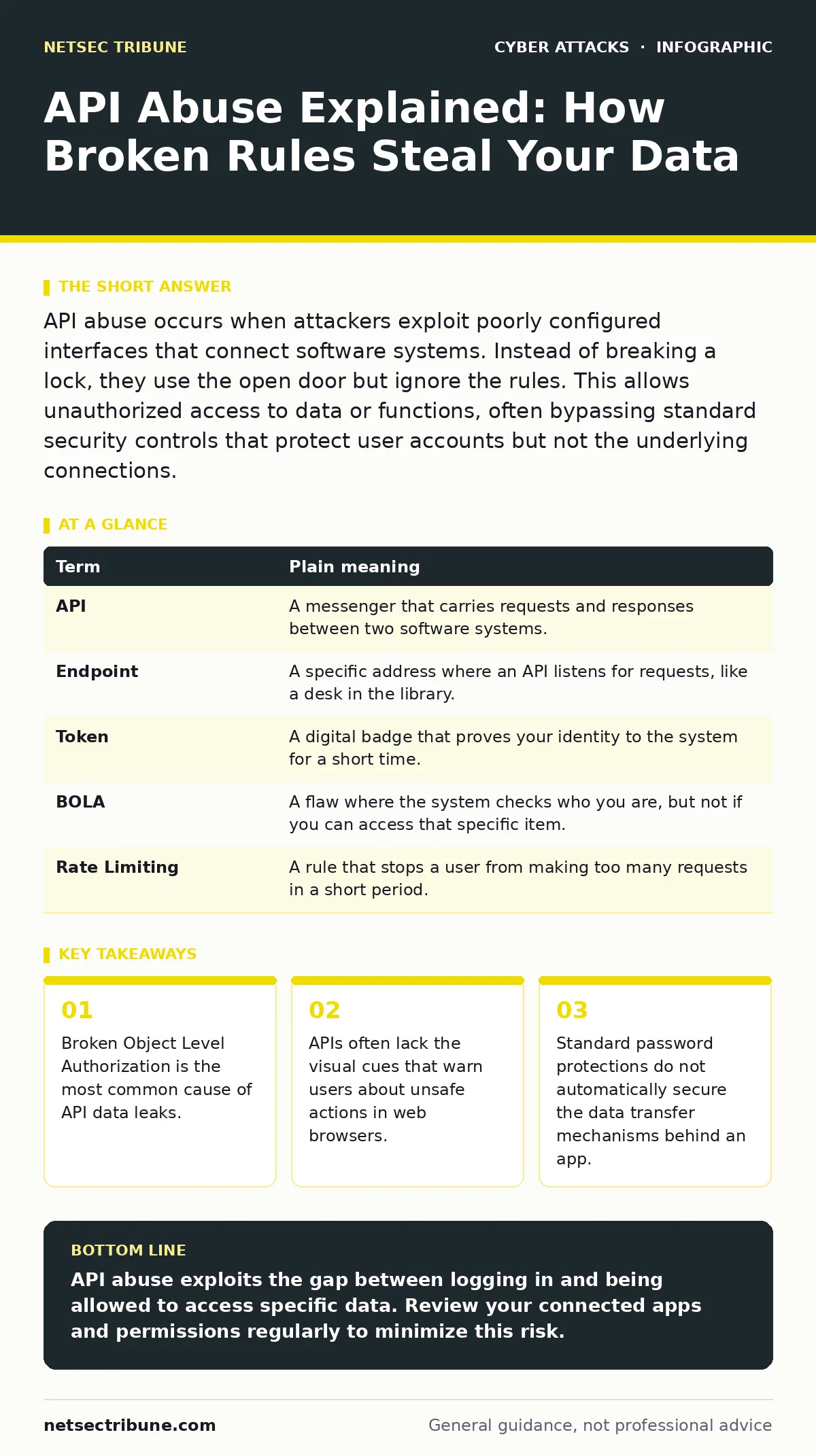
API abuse occurs when attackers exploit poorly configured interfaces that connect software systems. Instead of breaking a lock, they use the open door but ignore the rules. This allows unauthorized access to data or functions, often bypassing standard security controls that protect user accounts but not the underlying connections.
The Library Card Analogy
Imagine a library that uses a digital card system. The card gets you into the building, but it does not tell you which books you may read. The librarian’s computer system, or API, is supposed to check your clearance before handing over a restricted file. If the system has a flaw, it hands you any book you ask for, regardless of your membership level. You did not break the lock on the door. You simply asked for a book the system failed to deny. This is the core of API abuse.
What Is an API?
An Application Programming Interface, or API, is a set of rules that allows different software programs to talk to each other. When you check the weather on your phone, an app sends a request to a weather service via an API. The service returns the data in a structured format. Most of these interactions happen in the background, invisible to you. Because they are hidden, they often receive less scrutiny than the visible parts of a website or application.
| Term | Plain meaning |
|---|---|
| API | A messenger that carries requests and responses between two software systems. |
| Endpoint | A specific address where an API listens for requests, like a desk in the library. |
| Token | A digital badge that proves your identity to the system for a short time. |
| BOLA | A flaw where the system checks who you are, but not if you can access that specific item. |
| Rate Limiting | A rule that stops a user from making too many requests in a short period. |
The Hidden Cost of Convenience
APIs are designed for speed and automation. They strip away the friction of manual data entry. This convenience creates a blind spot. Developers often assume that because a user logged in, they can access any data the API exposes. This assumption is dangerous. It ignores the difference between being authenticated and being authorized. Authentication confirms who you are. Authorization confirms what you are allowed to do. Many systems get the first part right and the second part wrong.
How Ordinary Users Are Affected
You might think API abuse only affects large corporations. It affects anyone who uses apps that store personal data. Suppose a fitness app shares your location history with a partner service. If the API between them is misconfigured, an attacker could request the location data of any user, not just yours. You did not share this data. The system gave it away because it did not verify the requestor’s rights. This leads to data leaks that feel like magic to the victim.
The Missing Guardrails
Traditional web applications have many layers of defense. They have firewalls, intrusion detection systems, and user interface constraints. APIs often bypass these layers. They are meant to be consumed by machines, not humans. This means they do not have the same visual warnings or confirmation dialogs. An attacker can script thousands of requests per second. If the API does not have rate limiting, it will process them all. This can lead to data exhaustion or service disruption, similar to DDoS attacks, but targeted at specific data points.
Simple Safety Habits
You cannot fix the API code yourself, but you can reduce your exposure. First, review the permissions you grant to third-party apps. Many services allow you to see which apps have access to your account. Remove access for apps you no longer use. Second, enable multi-factor authentication on any account that supports it. This adds a layer of security that makes it harder for attackers to steal the tokens needed to abuse the API.
Third, be wary of links in messages that ask you to log in or grant permissions. These are often forms of social engineering. They try to trick you into authorizing a malicious app. If you click the link and log in, you may be handing over a valid token to an attacker. This is a form of clone phishing that targets your trust in familiar interfaces.
- Audit connected apps in your account settings monthly.
- Enable multi-factor authentication on all critical accounts.
- Verify the URL before granting any new permissions.
The Long-Term Risk
API abuse is not a one-time event. It is a structural weakness. As more services connect, the number of APIs grows. Each new connection is a potential entry point. Security teams must treat APIs as first-class citizens in their defense strategy. This means testing them regularly, not just assuming they are safe because they are internal. For users, it means understanding that privacy is not just about passwords. It is about controlling who can talk to your data.
Key takeaways
- Broken Object Level Authorization is the most common cause of API data leaks.
- APIs often lack the visual cues that warn users about unsafe actions in web browsers.
- Standard password protections do not automatically secure the data transfer mechanisms behind an app.
API abuse exploits the gap between logging in and being allowed to access specific data. Review your connected apps and permissions regularly to minimize this risk.
Frequently asked questions
Can a virus infect my device through an API?
No, API abuse typically steals data or performs unauthorized actions, but it does not usually install malware on your device directly.
Do I need to change my passwords if an API is abused?
Yes, if you suspect your account was compromised, change your password immediately to invalidate existing access tokens.
How this guide was produced: written by the NetSec Tribune editorial team with AI assistance, checked against the public references listed below, and reviewed when the facts change. See our editorial policy or report an error.