Data Breach Response: Containment, Recovery and Prevention Steps
Rapid network isolation prevents lateral movement, but preserving forensic evidence requires leaving compromised systems powered on during the initial containment phase.
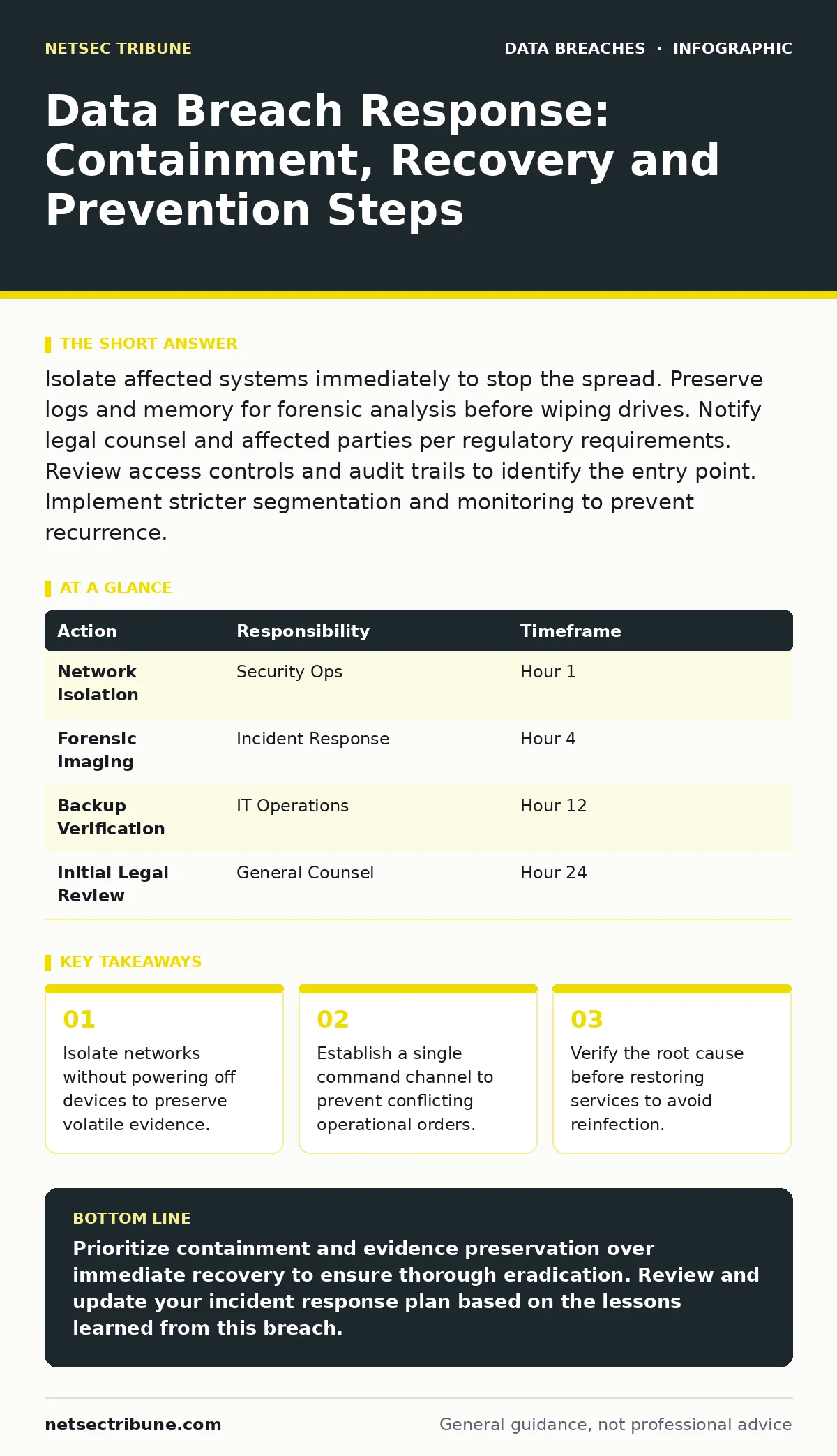
Isolate affected systems immediately to stop the spread. Preserve logs and memory for forensic analysis before wiping drives. Notify legal counsel and affected parties per regulatory requirements. Review access controls and audit trails to identify the entry point. Implement stricter segmentation and monitoring to prevent recurrence.
First hour
The first hour determines whether a data breach becomes a localized incident or a systemic collapse. Your primary objective is containment, not investigation. You must stop the bleeding before you understand the wound. Speed matters more than precision in this phase. Hesitation allows the threat actor to move laterally through your environment.
- Identify the scope of the affected systems and users.
- Isolate compromised segments from the main network.
- Disable compromised user accounts and API keys.
- Preserve system memory and logs for forensic analysis.
- Activate the incident response team and command structure.
- Document every action taken with timestamps.
You must separate the infected zone from the healthy zone. Use network segmentation to cut off communication paths. Disable specific switch ports or firewall rules rather than pulling cables, which can damage hardware or destroy physical evidence. If you suspect ransomware, disconnecting from the internet stops remote commands but may not stop local encryption if the malware is already running in memory.
First day
Once the immediate spread is halted, you shift to assessment and stabilization. You need to understand what data was accessed and how. This requires a calm, methodical approach. Panic leads to missed details. Your incident response plan should already define who has authority to make decisions. If it does not, appoint a lead investigator now.
You must validate the integrity of your backups. Attackers often exfiltrate or encrypt backup files before hitting production systems. Verify that your backups are offline or immutable. If your backups are compromised, you cannot recover safely. Check for signs of data exfiltration by reviewing outbound traffic logs for unusual volumes or destinations.
| Action | Responsibility | Timeframe |
|---|---|---|
| Network Isolation | Security Ops | Hour 1 |
| Forensic Imaging | Incident Response | Hour 4 |
| Backup Verification | IT Operations | Hour 12 |
| Initial Legal Review | General Counsel | Hour 24 |
You should review audit logging configurations. Many organizations collect logs but do not centralize them. Without centralized logging, you cannot correlate events across different systems. Ensure that log retention policies are active and that the logs themselves have not been tampered with. Attackers often delete logs to cover their tracks.
First week
The first week focuses on eradication and recovery. You must remove the threat actor’s presence entirely. This includes deleting malicious files, closing backdoors and resetting credentials. Simply restoring from backup is insufficient if the root cause remains unaddressed. The attacker may still have valid access tokens or unpatched vulnerabilities.
You must change all passwords and API keys associated with the compromised systems. This includes service accounts and shared credentials. Reuse of credentials across environments allows attackers to pivot. Implement role-based access control to ensure that users only have the minimum permissions necessary for their tasks. This limits the blast radius of future compromises.
Communication is critical during this phase. Transparency builds trust, but you must coordinate messages with legal counsel. Inconsistent messaging can lead to liability and reputational damage. Provide clear guidance on what users should do, such as monitoring for identity theft protection or changing passwords on other sites.
Containment strategies
Containment is not just about cutting networks. It involves limiting the attacker’s ability to escalate privileges. You must review user permissions and revoke excessive access. Attackers often exploit service accounts with high privileges to move laterally. Disabling these accounts temporarily can buy you time.
You should also consider application-level containment. Disable specific APIs or web services that are being exploited. This is more granular than network isolation and reduces business impact. However, it requires a deep understanding of your application architecture. If you do not know which service is compromised, you may need to take the entire application offline.
Recovery procedures
Recovery must be methodical. You cannot rush back online. Each system must be verified as clean before reconnection. This includes scanning for malware, verifying file integrity and checking for unauthorized changes. You must also verify that the vulnerability that allowed the initial breach has been patched.
You should test your recovery process in a staging environment first. This ensures that your backups are usable and that your configurations are correct. If you skip this step, you risk restoring corrupted data or reintroducing vulnerabilities. A staged recovery allows you to catch issues before they affect production users.
See also: Decoding Ransom Notes: Evidence Handling and Negotiation Realities · What Are Botnet Attacks: Mechanics, Impact and Defenses
Notification and legal
You must determine who needs to be notified. This includes regulators, customers, employees and potentially law enforcement. The timeline for notification varies by jurisdiction and the type of data breached. Personal data breaches often have strict deadlines. Missing these deadlines can result in significant fines.
Legal counsel must review all notifications. They will ensure that you are not admitting liability unnecessarily. You should also consider notifying partners and suppliers if their data was involved. Transparency with partners can help maintain business relationships. However, you must balance transparency with the need to protect sensitive information.
Prevention of recurrence
Preventing a repeat breach requires understanding the root cause. Was it a phishing email? An unpatched vulnerability? Misconfigured cloud storage? You must address the specific weakness that was exploited. Generic improvements like "better security training" are insufficient without targeted action.
Implement email encryption for sensitive communications. This reduces the risk of data interception during transit. However, it does not protect against phishing or endpoint compromise. You must also review your data masking practices to ensure that sensitive data is not visible in non-production environments. This limits the value of data if a breach occurs.
You should also review your printed document leaks procedures. Physical security is often overlooked. Sensitive documents left in printers or copiers can be accessed by unauthorized personnel. Implement secure print release and auto-shredding for sensitive documents. This closes a physical gap in your security posture.
Key takeaways
- Isolate networks without powering off devices to preserve volatile evidence.
- Establish a single command channel to prevent conflicting operational orders.
- Verify the root cause before restoring services to avoid reinfection.
Prioritize containment and evidence preservation over immediate recovery to ensure thorough eradication. Review and update your incident response plan based on the lessons learned from this breach.
Frequently asked questions
How do I know if my backups are clean after a data breach?
Verify backup integrity by comparing file hashes against known good values. Check backup logs for unauthorized access or modifications. Ensure backups are stored offline or in immutable storage to prevent tampering.
What is the difference between containment and eradication?
Containment stops the spread of the threat, while eradication removes the threat actor’s presence. Containment is immediate and broad, while eradication is targeted and thorough. You must contain before you can eradicate effectively.
Do I need to notify customers if no personal data was exposed?
It depends on your contractual obligations and local regulations. Even if personal data was not exposed, business data breaches may require notification. Consult legal counsel to determine your specific obligations.
How long should I keep forensic logs after a breach?
Retain forensic logs for the duration of any legal proceedings or investigations. Typically, this is several years. Ensure logs are stored securely and are not accessible to unauthorized personnel.
How this guide was produced: written by the NetSec Tribune editorial team with AI assistance, checked against the public references listed below, and reviewed when the facts change. See our editorial policy or report an error.