
Decoding Ransom Notes: Evidence Handling and Negotiation Realities
Ransom notes are cryptographic receipts that prove encryption occurred, but they rarely contain the decryption key or reliable contact information for recovery.
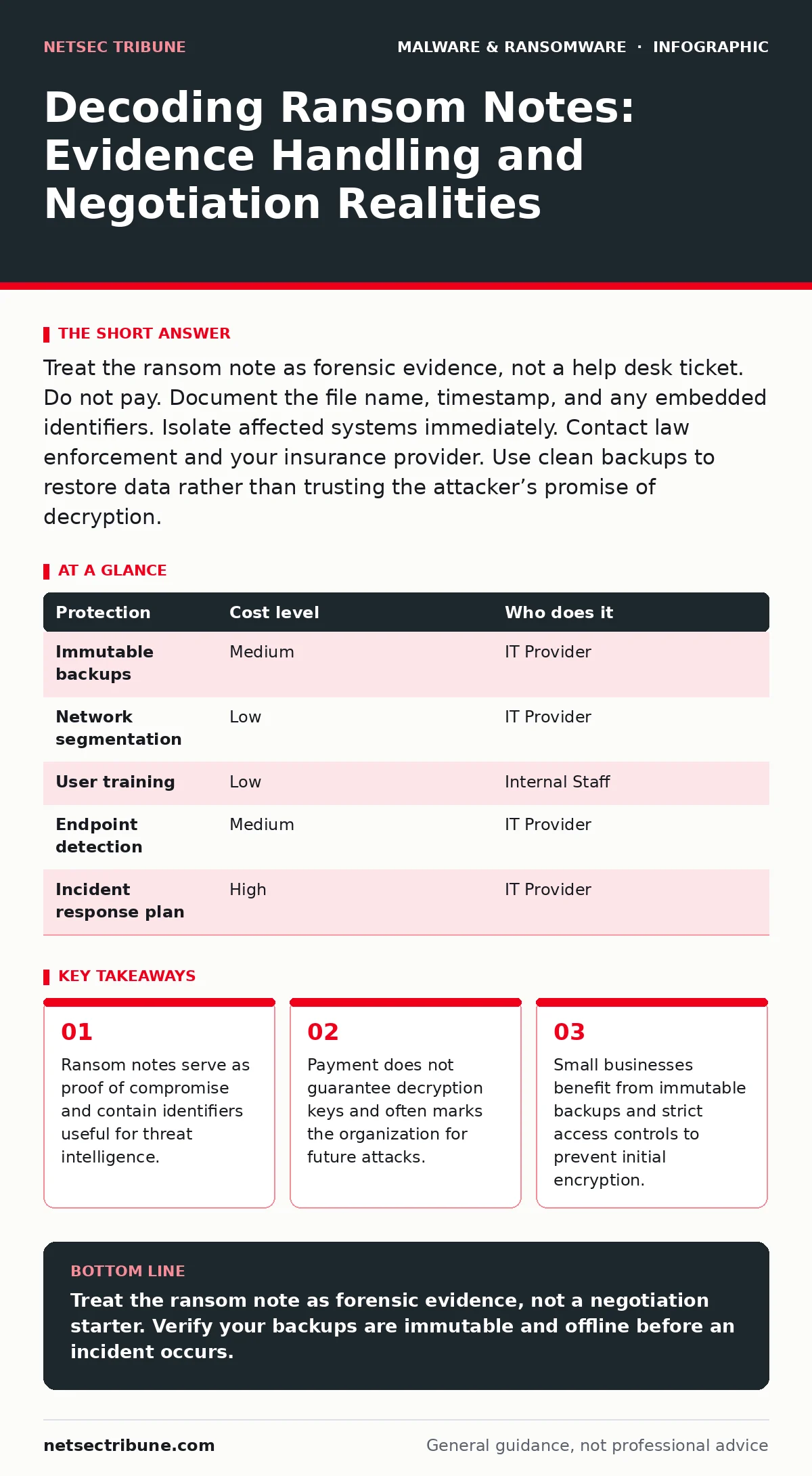
Treat the ransom note as forensic evidence, not a help desk ticket. Do not pay. Document the file name, timestamp, and any embedded identifiers. Isolate affected systems immediately. Contact law enforcement and your insurance provider. Use clean backups to restore data rather than trusting the attacker’s promise of decryption.
The Anatomy of a Ransom Note
A ransom note is a file created by malware to instruct the victim on how to pay for decryption. These files often appear in multiple locations to ensure visibility. The content typically includes a unique victim ID, payment instructions, and a threat to delete data if payment is not received. The note itself is not the malware. It is a symptom. The malware has already executed its payload. The note is the receipt.
The structure of these notes varies by threat actor but follows a consistent pattern. They aim to create urgency. They use countdown timers to induce panic. They provide contact methods that are often dead ends. The primary goal is to bypass rational decision-making. The secondary goal is to generate a unique identifier that links the victim to the attack campaign. This identifier allows threat intelligence teams to track the group and sometimes find decryption tools online.
Small organizations are frequent targets because they often lack layered defenses. They may have backups, but those backups are frequently connected to the network. If the backup system is online, the ransomware encrypts it too. The ransom note then appears on the backup drive. This leaves the organization with no clean copy of their data. The note becomes a barrier to business continuity.
Why Small Scale Is High Risk
Small businesses operate with fewer staff and less redundancy. This makes the impact of a ransom note more severe. A large corporation can absorb the cost of downtime. A small business cannot. The ransom note represents the end of operations. Every hour without data is lost revenue and lost trust.
The risk is not just financial. It is operational. The ransom note disrupts workflow. It prevents employees from accessing emails, documents, and customer records. The psychological impact is significant. Staff may feel personally responsible for the breach. This leads to rushed decisions. Rushed decisions lead to mistakes. Paying the ransom is a common mistake driven by fear. It is rarely the right choice.
Small organizations often lack dedicated security staff. They rely on IT providers. These providers may not have experience with ransomware incidents. The ransom note becomes a test of the provider’s competence. If the provider suggests paying, the organization is in trouble. A competent provider will focus on containment and recovery.
The scale of the attack is often tailored to the target. Attackers use automated tools to identify vulnerable systems. They do not need to be sophisticated. They need to be persistent. The ransom note is the final step in an automated process. It requires no human interaction from the attacker. This makes it scalable and dangerous.
Immediate Actions Upon Discovery
The first step is isolation. Disconnect the affected systems from the network. This stops the malware from spreading. Do not shut down the systems yet. The memory may contain evidence. Shutting down erases volatile data. Pulling the network cable is sufficient. It stops the communication while preserving the state.
Document everything. Take screenshots of the ransom note. Record the file name, size, and location. Note the time of discovery. This information is critical for forensic analysis. It helps determine the scope of the infection. It also helps law enforcement track the attack. Do not delete the note. It is evidence.
Notify your insurance provider. Most cyber insurance policies require prompt notification. Delaying this may void coverage. Contact your IT provider. They need to assess the damage. They should have an incident response plan. If they do not, this is a critical gap. The ransom note is the trigger for that plan.
Do not attempt to decrypt the files yourself. There is no simple key. The encryption is strong. Attempting to break it will likely fail. It may also damage the data further. Leave the encrypted files alone. Focus on containment. Focus on recovery. The ransom note is a distraction. Do not let it dictate your actions.
The Economics of Ransom
Payment is not a solution. It is a gamble. There is no guarantee the attacker will provide the decryption key. Many attackers take the money and disappear. Others provide a broken key. The risk is high. The reward is uncertain.
Paying marks your organization as a target. Attackers keep records. They know who pays. They will return. The cost of future attacks will be higher. The ransom note is not a one-time event. It is the beginning of a relationship with criminals.
The cost of recovery is often lower than the ransom. Restoring from backups takes time. It requires labor. It disrupts business. But it is predictable. Paying is unpredictable. The ransom amount may increase. The negotiation may drag on. The uncertainty is costly.
Small businesses often believe they cannot afford the downtime. They believe payment is faster. This is a misconception. The process of payment is complex. It involves cryptocurrency. It involves secure communication. It takes time. The downtime is similar whether you pay or restore. The difference is the risk.
What to Ask Your IT Provider
Your IT provider is your first line of defense. They should have a plan for ransomware. If they do not, you need a new provider. The ransom note is a test of their preparedness. Ask specific questions. Do not accept vague answers.
- Do you have an incident response plan specifically for ransomware?
- How are backups isolated from the primary network?
- What is the recovery time objective for critical systems?
- Do you monitor for suspicious file changes?
- Can you restore data from an immutable backup?
These questions reveal the depth of their security posture. If they cannot answer them, they are not ready. The ransom note will expose their weaknesses. You need a partner who can guide you through the crisis.
| Protection | Cost level | Who does it |
|---|---|---|
| Immutable backups | Medium | IT Provider |
| Network segmentation | Low | IT Provider |
| User training | Low | Internal Staff |
| Endpoint detection | Medium | IT Provider |
| Incident response plan | High | IT Provider |
The table shows the balance of cost and responsibility. Backups are the most critical. They must be immutable. This means they cannot be changed or deleted. Even by an administrator. This prevents ransomware from encrypting them.
See also: Difference Between Cloud Logging and Monitoring: Operational Reality · What Are Botnet Attacks: Mechanics, Impact and Defenses
Long-Term Prevention Strategies
Prevention is cheaper than recovery. Implement software restriction policies. These limit what programs can run. They stop malware from executing. They are effective against ransomware. They require maintenance. You must update the allow lists. This is a trade-off. Convenience for security.
Use multi-factor authentication. This stops attackers from accessing systems remotely. Many ransomware attacks start with stolen credentials. If the attacker cannot log in, they cannot encrypt. This is a basic control. It is often missing in small businesses.
Regularly test your backups. A backup that has not been tested is not a backup. You do not know if it works until you try. Restore a file every month. Verify it is correct. This ensures you can recover when the ransom note appears.
Consider sandbox evasion techniques used by attackers. They test for security software. If they detect it, they may not execute. This means you need advanced detection. Basic antivirus is not enough. You need behavioral analysis. This looks for suspicious actions, not just known signatures.
Forensic Value of the Note
The ransom note is not just a demand. It is data. The unique ID can be used to search for decryption tools. Security researchers often publish tools for specific variants. The ID links the attack to a known family. This can save you from paying.
The file format can reveal the malware type. Some notes are HTML. Some are text. Some are images. The format helps identify the tool. The language can indicate the origin. This is minor, but it helps.
The contact methods are often dead ends. They use Tor or encrypted chat. They are hard to track. But the attempt to contact them is logged. Law enforcement can use this. Do not contact them yourself. You risk further compromise.
The ransom note is a clue. Use it wisely. Do not ignore it. Do not panic. Analyze it. Isolate it. Report it. This is the professional response. It protects your business. It helps the community.
Key takeaways
- Ransom notes serve as proof of compromise and contain identifiers useful for threat intelligence.
- Payment does not guarantee decryption keys and often marks the organization for future attacks.
- Small businesses benefit from immutable backups and strict access controls to prevent initial encryption.
Treat the ransom note as forensic evidence, not a negotiation starter. Verify your backups are immutable and offline before an incident occurs.
Frequently asked questions
Should I delete the ransom note immediately?
No. The note contains unique identifiers that help security researchers and law enforcement track the attack. Deleting it removes critical evidence needed for potential decryption tools or legal action. Keep it isolated and documented.
Can I negotiate the ransom amount?
Negotiation is risky and often futile. Attackers use automated scripts and may not respond. Engaging with them confirms you are a viable target and may lead to higher demands. It is safer to rely on backups and recovery plans.
How do I know if my backups are safe?
Ensure your backups are immutable and air-gapped. Immutable backups cannot be altered or deleted, even by administrators. Air-gapped backups are physically disconnected from the network. Regularly test restoration procedures to verify integrity.
Is paying the ransom ever justified?
Paying is rarely justified. It does not guarantee decryption and marks your organization for future attacks. The cost of recovery is often lower and more predictable. Legal and ethical concerns also weigh heavily against payment.
How this guide was produced: written by the NetSec Tribune editorial team with AI assistance, checked against the public references listed below, and reviewed when the facts change. See our editorial policy or report an error.