
CIA Triad Security: How Confidentiality, Integrity and Availability Protect Data
Most security programs fail because they optimize for confidentiality while ignoring the hidden costs of enforcing data integrity and system availability.
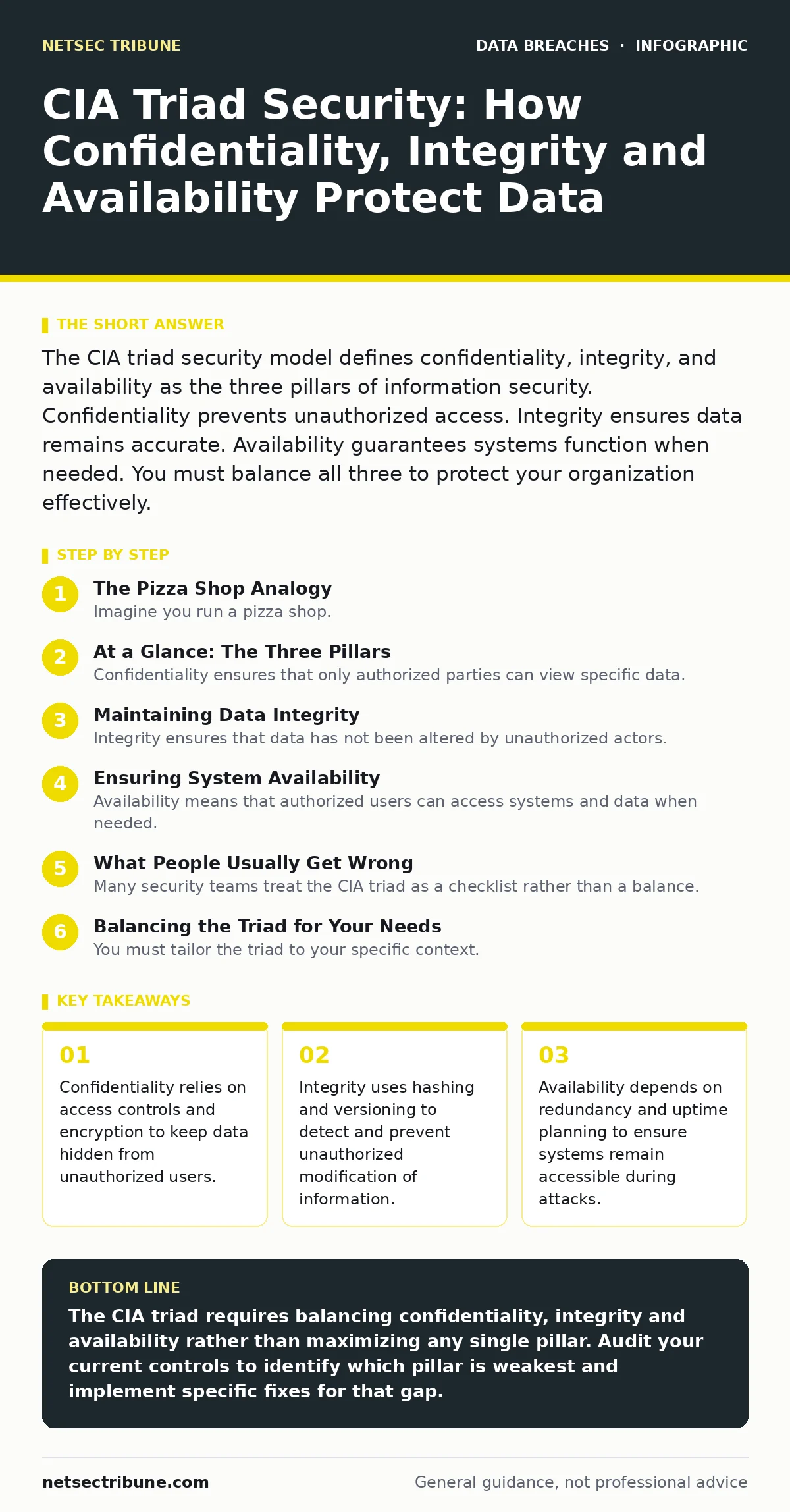
The CIA triad security model defines confidentiality, integrity, and availability as the three pillars of information security. Confidentiality prevents unauthorized access. Integrity ensures data remains accurate. Availability guarantees systems function when needed. You must balance all three to protect your organization effectively.
The Pizza Shop Analogy
Imagine you run a pizza shop. You have a secret pepperoni recipe that competitors cannot see. This represents confidentiality. You ensure the recipe is not altered by mistake or sabotage. This represents integrity. You keep the ovens running so customers can order pizza at any time. This represents availability.
If you lock the recipe in a vault but forget the key, you have confidentiality but lose availability. If anyone can change the recipe, you lose integrity. The CIA triad security framework applies this logic to digital systems. It forces you to consider how these three goals conflict and support each other. You cannot maximize one without potentially harming the others.
At a Glance: The Three Pillars
| Aspect | Goal | Primary Mechanism | Common Failure Mode |
|---|---|---|---|
| Confidentiality | Prevent unauthorized disclosure | Encryption and access controls | Default credentials or weak keys |
| Integrity | Prevent unauthorized modification | Hashing and digital signatures | Insider tampering or bit rot |
| Availability | Ensure timely access | Redundancy and backup systems | Distributed denial of service |
How Confidentiality Works in Practice
Confidentiality ensures that only authorized parties can view specific data. You achieve this through encryption at rest and encryption in transit. Encryption transforms readable data into ciphertext using a key. Without the key, the data appears as random noise. You must also implement role-based access control to limit who can request the decryption key.
This prevents employees from accessing data outside their job scope. Confidentiality does not protect data once it is decrypted and displayed on a screen. It only protects the data at rest or in motion. You must also consider data masking for development environments. Masking replaces sensitive values with fake data that retains format but loses meaning. This allows testing without exposing real customer information.
Maintaining Data Integrity
Integrity ensures that data has not been altered by unauthorized actors. You verify integrity using hashing. A hash function generates a unique fixed-length string from any input. If even one bit of the input changes, the hash changes completely. You store the original hash securely. When you retrieve the data later, you recalculate the hash. If the new hash matches the stored hash, the data is intact.
This process detects accidental corruption and malicious tampering. Audit logging provides the trail to identify who changed what and when. Logs must themselves be protected against tampering. If an attacker can modify the logs, they can hide their changes to the data. Integrity checks are computationally expensive. Running them on every read operation can slow down system performance. You must balance the frequency of checks with operational speed.
Ensuring System Availability
Availability means that authorized users can access systems and data when needed. You achieve this through redundancy. You duplicate critical components so that if one fails, another takes over. This includes servers, network links and storage devices. Encryption at rest can impact availability if key management fails. If you lose the encryption keys, the data is technically available but unusable. This is a form of self-inflicted denial of service.
You must also protect against distributed denial of service attacks. These attacks flood your systems with traffic to exhaust resources. Rate limiting and traffic filtering help mitigate this. Availability is often the most expensive pillar to maintain. Redundant hardware and diverse network paths require significant investment. You must define acceptable downtime limits for each system. Not all systems require the same level of availability.
See also: Compensating Controls: When Standard Fixes Fail · Blast Radius: Contain Breaches Before They Spread
What People Usually Get Wrong
Many security teams treat the CIA triad as a checklist rather than a balance. They prioritize confidentiality above all else. This leads to systems that are secure but unusable. For example, overly strict access controls can prevent legitimate staff from doing their jobs. This reduces availability and productivity. Another common error is assuming that encryption solves integrity.
Encryption hides data but does not prove it has not been changed. You need separate integrity checks like hashes or digital signatures. A third mistake is ignoring the cost of availability. Teams build complex redundant systems but fail to test failover procedures. When a failure occurs, the backup system does not activate correctly. You must test your availability plans regularly.
Balancing the Triad for Your Needs
You must tailor the triad to your specific context. Financial data requires high confidentiality and integrity. A public news website requires high availability and integrity but lower confidentiality. You can use incident communication plans to define how you respond when one pillar fails. If confidentiality is breached, you follow breach notification laws. If availability fails, you switch to backup systems.
If integrity is compromised, you restore from trusted backups. You must evaluate the risk for each data set. Not all data needs the same level of protection. Applying maximum security to low-value data wastes resources. It also creates friction for users. This friction leads to workarounds that bypass security controls. You must find the minimum viable security for each asset.
Integrating with Broader Security Practices
The CIA triad is a conceptual model. You implement it using specific tools and processes. Identity theft protection services help users monitor for external breaches. This supports confidentiality by detecting unauthorized account use. Data exfiltration prevention tools monitor network traffic for large data transfers. This supports confidentiality and integrity by stopping data theft. You must also consider the human element.
Technical controls fail if users are unaware of risks. Training should focus on recognizing phishing and social engineering. These attacks often target confidentiality by tricking users into revealing credentials. The CIA triad remains relevant because it covers all aspects of information security. It provides a common language for discussing security requirements. You should use it to align technical controls with business goals.
Key takeaways
- Confidentiality relies on access controls and encryption to keep data hidden from unauthorized users.
- Integrity uses hashing and versioning to detect and prevent unauthorized modification of information.
- Availability depends on redundancy and uptime planning to ensure systems remain accessible during attacks.
The CIA triad requires balancing confidentiality, integrity and availability rather than maximizing any single pillar. Audit your current controls to identify which pillar is weakest and implement specific fixes for that gap.
Frequently asked questions
How does the CIA triad differ from other security models?
The CIA triad is a foundational model that defines the core goals of security. Other models like zero trust or defense in depth describe how to achieve those goals.
Can I prioritize one pillar over the others?
You can prioritize based on business needs, but ignoring any pillar creates significant risk. A system that is confidential but unavailable provides no value.
What is the role of encryption in the CIA triad?
Encryption primarily supports confidentiality. It can support integrity if combined with authentication tags, but it does not directly ensure availability.
How do I measure integrity in a large system?
Use automated hashing tools and audit logging. Compare current hashes against known good baselines regularly to detect unauthorized changes.
How this guide was produced: written by the NetSec Tribune editorial team with AI assistance, checked against the public references listed below, and reviewed when the facts change. See our editorial policy or report an error.