
Tabletop Exercises Checklist for Security Incident Response
Most tabletop exercises fail because they test technical controls while ignoring the human decisions that dictate whether an organization survives a crisis.
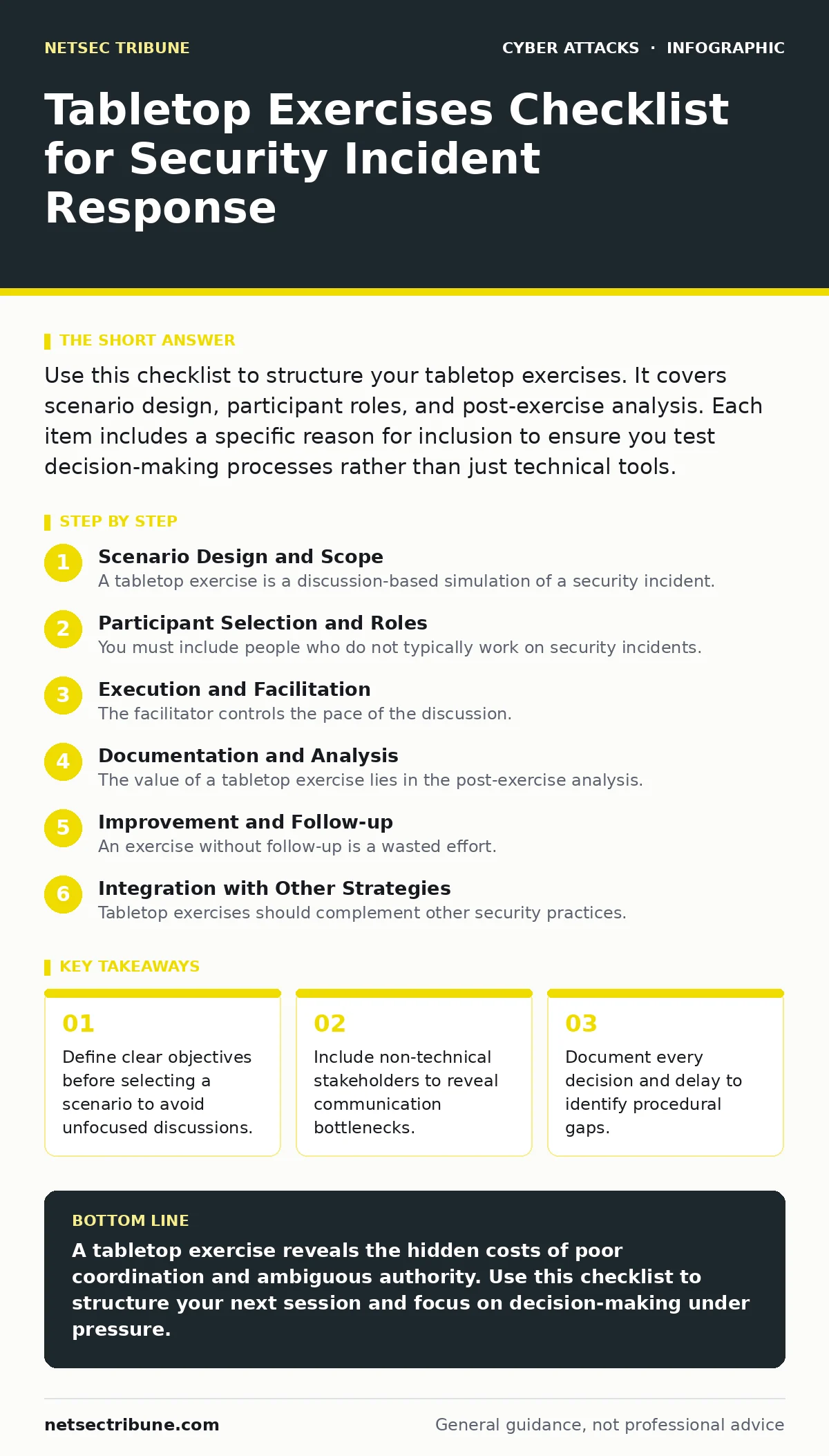
Use this checklist to structure your tabletop exercises. It covers scenario design, participant roles, and post-exercise analysis. Each item includes a specific reason for inclusion to ensure you test decision-making processes rather than just technical tools.
Scenario Design and Scope
A tabletop exercise is a discussion-based simulation of a security incident. It tests your organization's ability to coordinate a response without triggering actual systems. The goal is not to prove your technology works, but to reveal where human judgment breaks down.
- Define a single primary objective: Focusing on one outcome prevents the session from drifting into unrelated technical debates.
- Select a scenario with ambiguous data: Real incidents rarely provide clear evidence, so ambiguity forces teams to make decisions under uncertainty.
- Exclude technical remediation steps: Testing firewall rules belongs in a technical drill, not a tabletop discussion about strategy.
- Include a timeline with delays: Introducing unexpected pauses reveals whether your team can maintain momentum when information is scarce.
The scenario should mirror a realistic threat model. Suppose you are dealing with a compromised executive account. The challenge is not just resetting the password, but determining who to notify and when. This connects to the principles of social engineering red flags, as recognizing the initial compromise is often the first step in the response chain.
Participant Selection and Roles
You must include people who do not typically work on security incidents. If only engineers attend, the exercise will ignore legal, public relations, and operational impacts. The presence of diverse roles exposes communication gaps that technical teams often overlook.
- Invite a legal representative: They must decide when privileged information is at risk, which changes the response strategy.
- Include a public relations lead: They determine when and how to speak to external audiences, preventing conflicting messages.
- Assign a dedicated scribe: A participant who does not make decisions ensures every comment and timestamp is recorded for later analysis.
- Include an operations manager: They assess the business impact of shutting down services, adding weight to technical decisions.
Consider the implications of multi-factor authentication in this context. If the scenario involves credential theft, the MFA implementation details matter less than the process for verifying identity when standard methods fail. The exercise should test the backup verification procedures, not the MFA vendor.
Execution and Facilitation
The facilitator controls the pace of the discussion. They inject new information to challenge the team's assumptions. If the scenario proceeds too smoothly, the exercise fails to reveal weaknesses. The facilitator must be willing to introduce complications that force the team to adapt.
- Inject a secondary incident: A simultaneous DDoS attacks scenario tests whether the team can prioritize resources during competing crises.
- Withhold critical evidence: Simulating missing logs forces the team to decide how to act without complete information.
- Challenge a consensus decision: Asking "what if this is wrong?" prevents groupthink and encourages critical evaluation of the plan.
- Limit technical jargon: Ensuring all participants understand the discussion keeps the focus on strategy rather than tool specifics.
Documentation and Analysis
The value of a tabletop exercise lies in the post-exercise analysis. You must document not just what happened, but why decisions were made. This record becomes the basis for improving your incident response plan.
- Record decision timestamps: Knowing how long a decision took reveals bottlenecks in the approval chain.
- Note communication failures: Identify which channels were ignored or which stakeholders were left out of the loop.
- Document resource constraints: Note where the team lacked the tools or personnel to execute their plan effectively.
- Identify policy contradictions: Highlight where existing policies conflict with the actions taken during the exercise.
Consider the impact of API abuse in your documentation. If the scenario involves automated attacks via APIs, the response plan must address rate limiting and access revocation at the API gateway level, not just the application layer.
Improvement and Follow-up
An exercise without follow-up is a wasted effort. You must translate the findings into actionable changes. This means updating policies, training staff, or adjusting tools. The goal is continuous improvement, not a one-time checkmark.
- Assign owners to each finding: Every identified gap must have a specific person responsible for addressing it.
- Set a deadline for review: A finding without a timeline will likely be ignored by competing priorities.
- Update the incident response plan: Incorporate the lessons learned into the official documentation to prevent recurrence.
- Schedule a follow-up drill: Verify that the changes made have improved the team's performance in a subsequent exercise.
See also: Data Breach Response: Containment, Recovery and Prevention Steps · Difference Between Cloud Logging and Monitoring: Operational Reality
Integration with Other Strategies
Tabletop exercises should complement other security practices. They do not replace technical testing, but they inform it. For example, if an exercise reveals that clone phishing is a common entry point, your technical team can focus on email filtering rules.
- Align with user training: If the exercise highlights social engineering weaknesses, update your training materials to address those specific tactics.
- Review access controls: If the scenario involved privilege escalation, review your least privilege policies to ensure they are enforceable.
- Test external communications: If website defacement occurs, ensure your public facing statements are prepared in advance.
Key takeaways
- Define clear objectives before selecting a scenario to avoid unfocused discussions.
- Include non-technical stakeholders to reveal communication bottlenecks.
- Document every decision and delay to identify procedural gaps.
A tabletop exercise reveals the hidden costs of poor coordination and ambiguous authority. Use this checklist to structure your next session and focus on decision-making under pressure.
Frequently asked questions
How often should we conduct tabletop exercises?
Conduct them at least twice a year, or after any significant change to your infrastructure or personnel.
How long should a tabletop exercise last?
Aim for two to four hours. Longer sessions often lead to fatigue and reduced engagement.
Can we use a past incident as a scenario?
Yes, but modify the details to prevent participants from relying on memory rather than process.
What if we don't have a legal team?
Invite a consultant or use a hypothetical legal constraint to force the team to consider legal implications.
How this guide was produced: written by the NetSec Tribune editorial team with AI assistance, checked against the public references listed below, and reviewed when the facts change. See our editorial policy or report an error.