Asset Inventory for Patching: Definition, Purpose, and Execution
An accurate asset inventory reveals hidden endpoints that bypass security controls, ensuring patches reach every system before threat actors exploit known vulnerabilities.
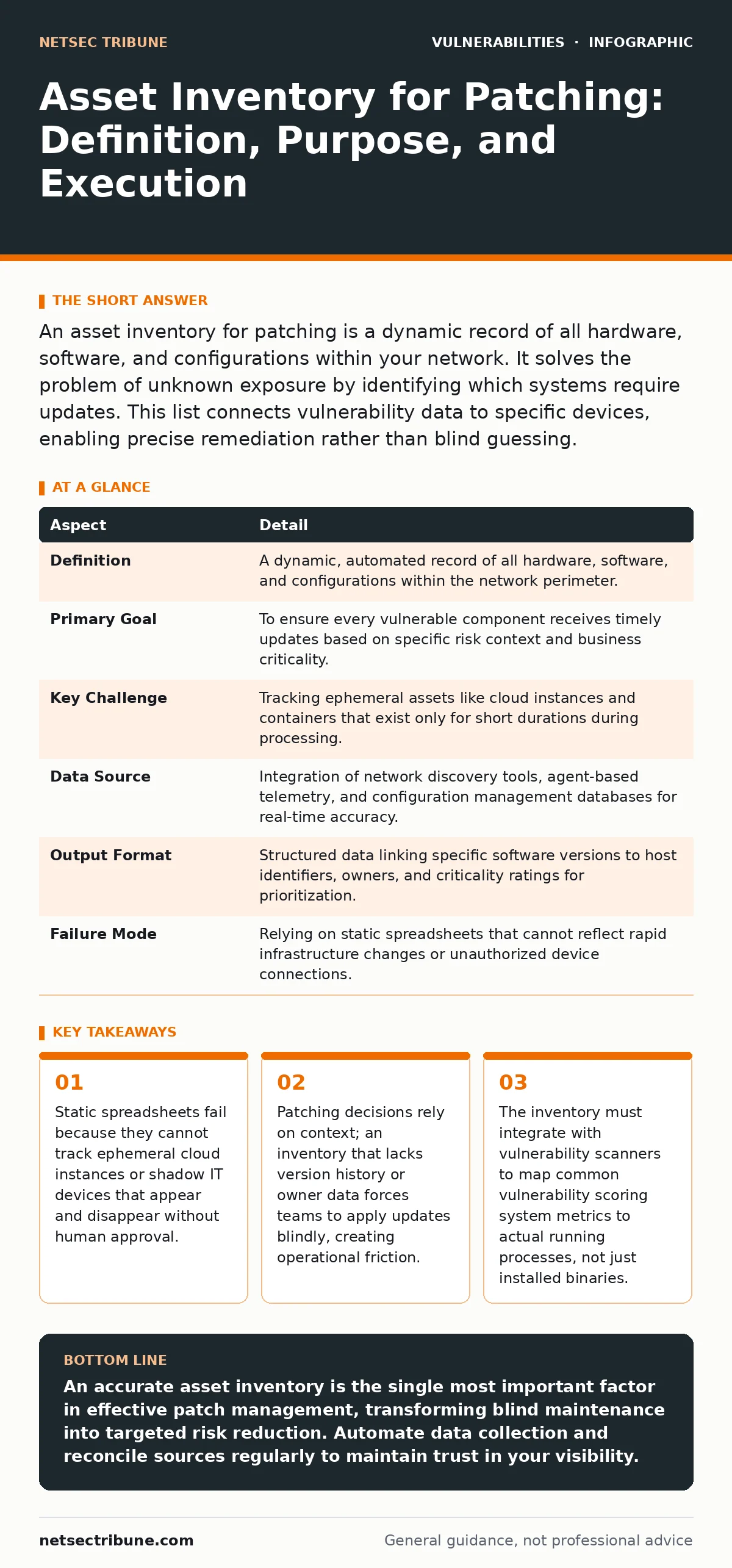
An asset inventory for patching is a dynamic record of all hardware, software, and configurations within your network. It solves the problem of unknown exposure by identifying which systems require updates. This list connects vulnerability data to specific devices, enabling precise remediation rather than blind guessing.
The Library Metaphor for Digital Chaos
Imagine a library where books move shelves overnight. Librarians cannot protect the collection if they do not know which volumes exist or where they sit. An asset inventory for patching serves the same function for your digital environment. It provides a single source of truth about every device, application, and configuration that connects to your network. Without this map, you are applying security fixes to a ghost town while real systems remain exposed.
Why Static Lists Fail Modern Defences
Traditional asset management relies on manual entry or periodic scans that capture a snapshot in time. This approach fails in dynamic environments where containers spin up and down in minutes. Cloud infrastructure changes state without human intervention. Shadow IT devices join the network using personal accounts. A static list becomes obsolete the moment it is created. Patching teams waste effort verifying systems that no longer exist while missing new endpoints that pose immediate risk.
| Aspect | Detail |
|---|---|
| Definition | A dynamic, automated record of all hardware, software, and configurations within the network perimeter. |
| Primary Goal | To ensure every vulnerable component receives timely updates based on specific risk context and business criticality. |
| Key Challenge | Tracking ephemeral assets like cloud instances and containers that exist only for short durations during processing. |
| Data Source | Integration of network discovery tools, agent-based telemetry, and configuration management databases for real-time accuracy. |
| Output Format | Structured data linking specific software versions to host identifiers, owners, and criticality ratings for prioritization. |
| Failure Mode | Relying on static spreadsheets that cannot reflect rapid infrastructure changes or unauthorized device connections. |
The Core Components of an Effective Inventory
A functional inventory requires more than a list of IP addresses. It needs context. The first component is identity. Each asset must have a unique identifier that persists across reboots and network changes. The second component is attribute data. This includes operating system versions, installed applications, and library dependencies. The third component is relationship mapping. You must know which server hosts which database and which application connects to which API. These relationships determine the blast radius of a potential breach.
Integrating Inventory with Vulnerability Management
Patching is not a random act of maintenance. It is a targeted response to known weaknesses. Your inventory must feed directly into your vulnerability management process. When a new common vulnerability and exposure is disclosed, you query the inventory to find every system running the affected version. This eliminates guesswork. It also allows you to apply CVSS environmental scores to prioritize fixes. A vulnerability on a public-facing web server requires faster action than the same flaw on an isolated development machine. The inventory provides the context needed to calculate that score accurately.
The Hidden Cost of Incomplete Data
Most organizations believe they have visibility into their environment. They do not. The hidden cost of an incomplete inventory is operational blindness. When a security incident occurs, responders cannot isolate the affected system if they cannot find it in their records. This delay extends the dwell time of an attacker. Furthermore, incomplete data leads to security misconfigurations. If the inventory does not track configuration changes, you cannot detect when a secure setting is altered to an insecure one. You patch the software but leave the door open.
See also: Bug Bounty Triage Explained: How to Filter Noise From Real Threats · CVSS Environmental Scores: Meaning, Definition and Practical Use
Common Misconceptions About Asset Tracking
Many teams treat the inventory as a one-time project. It is a continuous process. Another misconception is that network scanning alone provides sufficient data. Scanners see what is exposed on the wire. They miss internal libraries, dormant accounts, and offline devices that reconnect periodically. Agent-based tools provide deeper visibility but require installation and maintenance. The best approach combines both. You must also avoid the trap of tracking only critical assets. Attackers often target low-priority systems to gain initial access. Every connected device is a potential entry point.
Where Inventory Fits in the Defence Stack
An asset inventory is the foundation of your defensive posture. It supports other controls by providing the necessary context. For instance, compensating controls rely on knowing which systems cannot be patched immediately. You must document these exceptions and implement alternative protections. Similarly, web application firewalls need accurate inventory data to block traffic to vulnerable endpoints. If the inventory is wrong, the firewall rules are wrong. The inventory also helps identify exposed admin panels that should not be accessible from the public internet. It ensures that security controls are applied where they matter most.
Maintaining Accuracy Over Time
Accuracy decays rapidly. You must automate the collection and validation of inventory data. Manual updates are error-prone and unsustainable. Set up alerts for new asset discoveries. Investigate any device that appears without prior authorization. Review the inventory regularly to remove stale entries. Decommissioned hardware that remains in the record creates noise and reduces trust in the system. Trust in the data is paramount. If teams doubt the inventory, they will bypass it and revert to manual checks. This defeats the purpose of automation.
Key takeaways
- Static spreadsheets fail because they cannot track ephemeral cloud instances or shadow IT devices that appear and disappear without human approval.
- Patching decisions rely on context; an inventory that lacks version history or owner data forces teams to apply updates blindly, creating operational friction.
- The inventory must integrate with vulnerability scanners to map common vulnerability scoring system metrics to actual running processes, not just installed binaries.
An accurate asset inventory is the single most important factor in effective patch management, transforming blind maintenance into targeted risk reduction. Automate data collection and reconcile sources regularly to maintain trust in your visibility.
Frequently asked questions
How often should I update my asset inventory?
Update it continuously. Automated tools should refresh data in real-time or at least daily to capture changes in cloud environments and containerized applications.
What is the difference between an asset inventory and a CMDB?
A configuration management database stores detailed configuration data for IT service management. An asset inventory for patching focuses specifically on software versions, vulnerabilities, and patch status for security purposes.
Can I use network scanning alone for my inventory?
No. Network scanning only sees exposed services. It misses internal libraries, offline devices, and applications that do not expose network ports. Combine scanning with agent-based data for completeness.
How do I handle ephemeral cloud instances in the inventory?
Tag cloud instances at creation with metadata about their purpose and expected lifespan. Use automation to track their lifecycle and remove them from the active patching queue when they terminate.
How this guide was produced: written by the NetSec Tribune editorial team with AI assistance, checked against the public references listed below, and reviewed when the facts change. See our editorial policy or report an error.